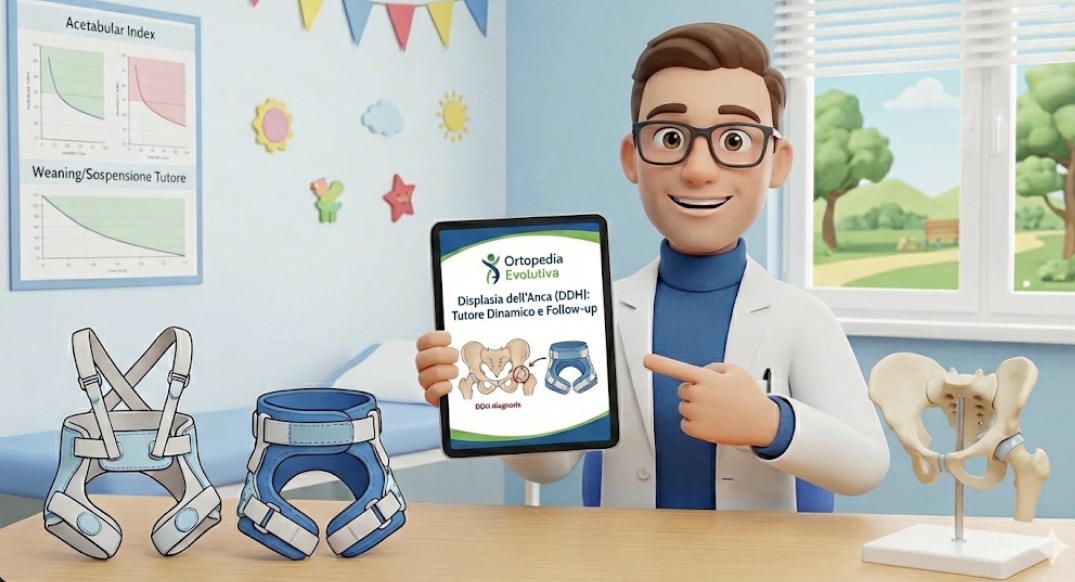
This is not a theoretical question
When the ultrasound results are normal, families expect a clear ending: "great, no more brace." And from a human perspective, this is understandable: weeks of orthosis (whether Pavlik, Coxaflex, or an equivalent dynamic brace) impact sleep, daily management, skin, diaper changes, clothing, and logistics.
The problem is that, from the hip's perspective, that moment isn't always a "treatment complete": often, it's the beginning of the phase where you want to understand if the acetabulum is maturing as hoped.
And this is where the divisive choice arises: immediate discontinuation or weaning (gradual reduction over a few weeks).
The study that tried to answer
Kuka and colleagues randomized infants with stable dysplasia treated early (onset <3 months) with a dynamic orthosis; in the paper, they call it a "Pavlik harness" because it is the most studied and standardized device in the literature. [1]
All children were managed similarly until ultrasound normalization; then, at that point, the bifurcation:
- immediate discontinuation, or
- weaning for 4–6 weeks. [1]
What I liked about the design is the endpoint: no "impressions," no feelings. They chose a parameter that truly informs our follow-up decisions: acetabular index (AI) on X-ray at 6 months. [1]
What emerged
The main result is clear: at 6 months, the average AI is lower in the weaning group (24.8°) compared to immediate discontinuation (26.9°), with a statistically significant difference. [1]
To put it simply: extending the orthosis a bit after ultrasound normalization seems to better support acetabular maturation in the following months. It's not a monumental leap, but it's a consistent signal.
However, then comes the data that brings everyone back to reality: the proportion of hips above the "concerning" threshold (AI ≥30°, which in their protocol guided part-time bracing) is similar between groups, and the difference is not significant (17% vs 22%). [1]
So yes: on average, AI improves a bit, but this doesn't necessarily mean it truly reduces the number of cases that end up in "recovery" with another device.
Why the advantage seems to disappear at 1 year
At one year, the groups show no differences in AI. [1] For me, this is not a "disproof" of the 6-month data; it's a consequence of how real-world pathways work: if you see a residual at 6 months, you intervene (for example, with a part-time brace), and that intervention tends to flatten long-term differences.
In other words: the study tells us that scaling down usage influences the short term; in the long term, everything you do afterward to address residuals comes into play. [1]
The right question to ask (rather than "weaning yes/no")
This is the part that interests me most, because it's what truly changes the discussion at the table with parents: there isn't a single answer that works for everyone, but there is a more honest way to decide.
I would translate it this way: how "borderline" is the situation when you are about to discontinue?
- If ultrasound normalization is solid and the course has been linear, immediate discontinuation remains a reasonable choice: the trial does not "reject" it. [1]
- If, however, you are in that zone where everything has normalized but you're not 100% convinced (or you know that follow-up risks being inconsistent), a short weaning period can be a way to gain an advantage by the 6th month. [1]
And here, to avoid misunderstandings: the study talks about Pavlik, but the concept is broader. "Weaning" is a temporal strategy, not a brand; the logic can be discussed even if you more often use Coxaflex or a similar dynamic brace in the department, adapting methods and hours to the device and the center's protocol. [1]
What this study still doesn't clarify
What we don't know today—at least not from this RCT—is whether the radiographic advantage at 6 months translates into a measurable reduction in "clinically relevant" residual dysplasia in the long term. [1]
This is not a limitation that renders the study useless: it simply places it in the right context. It's a work that helps to better decide how to conclude a successful treatment, not a definitive verdict on the hip's fate at 10 years.
Disclaimer: informational content; does not replace individual clinical evaluation.
Reference
[1] Kuka CC, Hall CE, Bram JT, Sarkar S, DeFrancesco CJ, Sankar WN. To Wean or Not to Wean: A Randomized Controlled Trial of Pavlik Harness Weaning in Infantile Developmental Dysplasia of the Hip. Journal of Pediatric Orthopaedics. 2026 (online ahead of print). PMID: 41641599.