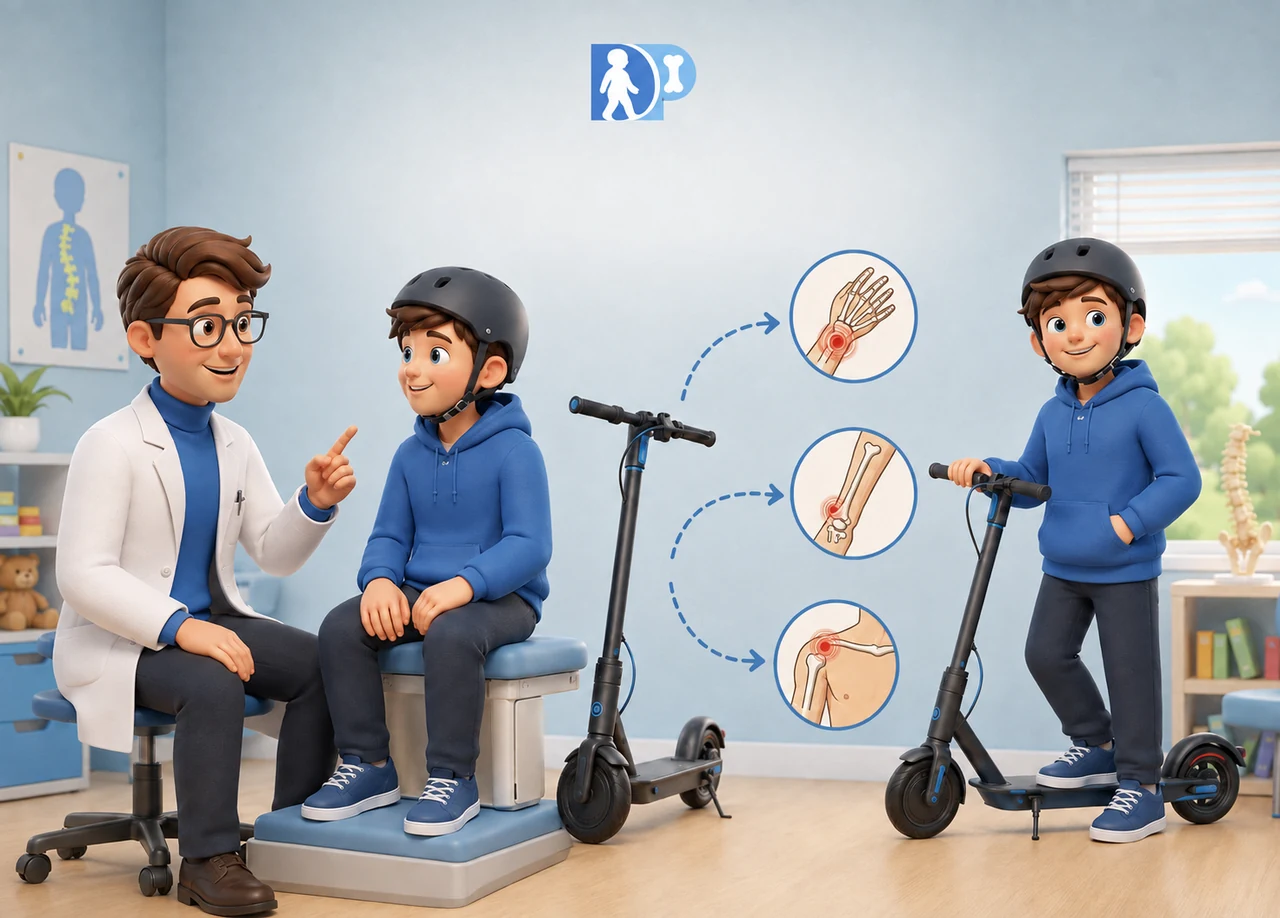
More than 18,000 paediatric fractures associated with electric scooters were estimated in the United States between 2014 and 2023. On its own, that figure mainly shows how quickly these vehicles have become part of adolescents’ daily lives. [1]
To understand whether the issue is simply an increase in numbers, we need to look at how accidents happen and the injuries they cause.
Wrist and forearm injuries remain common
In the 2025 American study, the most common fractures affected the wrist and forearm. The radius was the bone most often involved, followed by the clavicle. [1]
The Swedish Fracture Register described almost 1,900 fractures associated with electric scooters. In the paediatric subgroup, wrist fractures accounted for 44% of cases. [2]
Falling forwards onto an outstretched hand therefore continues to cause injuries that are very familiar in paediatric trauma care. What often differs is the rider’s age, speed and the circumstances of the accident.
An adolescent riding an electric scooter on the road may fall after sudden braking, hitting a pothole or a collision. The mechanism is closer to a small urban transport accident than to a fall from a traditional scooter used at low speed.
Not all of these fractures are minor
In the Swedish register, around 30% of fractures across the whole cohort were treated surgically. Among children, wrist fractures were among those most frequently operated on. [2]
That figure does not mean that a fracture caused by an electric scooter automatically has a stronger indication for surgery. Treatment depends on the same factors used in any other injury: age, displacement, stability and involvement of the joint or growth plate.
A stable fracture in an acceptable position can be treated in a cast. An unstable fracture, or one in an unacceptable position, may need reduction and fixation. The vehicle from which the child fell does not change these criteria.
Electric and traditional scooters do not appear equivalent
In 2026, Douglas and colleagues compared paediatric injuries from electric and traditional scooters in a large dataset. Children using electric scooters were older on average. Even after statistical adjustment for age and other factors, electric scooter accidents were associated with a greater likelihood of hospital admission and a lower likelihood of direct discharge from the emergency department. [3]
This comparison tells us more than a simple increase in the total number of emergency visits. These studies do not provide a precise denominator showing how many people used electric scooters or how far they travelled. We therefore cannot calculate an individual’s risk accurately.
We can say, however, that when an accident happens, the available data suggest greater average injury severity than with a traditional scooter. [3]
A visibly deformed wrist may not be the only injury
A European series of 633 children and adolescents reported more road traffic accidents and more severe head injuries with electric scooters than with traditional scooters. [4] Another study from 2026 described more head and chest involvement and greater average injury severity. [5]
This matters particularly during the initial assessment. If the accident involved high speed or a collision, an obvious upper limb fracture must not distract from possible associated injuries.
The word “scooter” can suggest a minor accident. In some cases, the mechanism is anything but minor.
Prevention: a few practical points
A helmet matters for reducing the risk of head injury, but it does not protect the wrist or forearm. For upper limb fractures, the priority is to reduce avoidable falls and high-energy collisions.
For an adolescent using an electric scooter, the simplest advice is also some of the most useful: one person per scooter, no phone use while riding, the ability to brake and control the scooter before using it in traffic, and compliance with age limits and local rules.
Electric scooters are now a means of transport for many young people. Treating them as toys underestimates the injuries they can cause.
References
[1] Weiss DL, Law CK, Yendluri A, et al. Rising trends in pediatric fractures associated with electric scooter use seen in emergency departments between 2014 and 2023. Phys Sportsmed. 2025;53(6):423-429. doi:10.1080/00913847.2025.2502323.
[2] Hernefalk B, Brüggemann A, Wolf O. Fracture distribution in electric scooter accidents: a nationwide observational cohort study of 1,874 fractures from the Swedish fracture register. J Orthop Surg Res. 2024;19:448. doi:10.1186/s13018-024-04940-4.
[3] Douglas KE, Hirsch AW, Fine AM, Lyons TW. Pediatric E-Scooter and Traditional Scooter Injuries: Emergency Department Visits 2015-2024. Pediatr Emerg Care. Published online July 7, 2026. doi:10.1097/PEC.0000000000003652.
[4] Schuller A, Hohensteiner A, Sator T, et al. Paediatric e-scooter riders at high risk of life-threatening traffic accidents. Pediatr Res. 2025;97(6):1929-1934. doi:10.1038/s41390-024-03667-6.
[5] Easwaran L, Vincent SA, Silveira LJ, et al. Exploring Trends in Pediatric Traumatic Injuries From Electric Bikes and Scooters. J Surg Res. 2026;326:262-272. doi:10.1016/j.jss.2026.05.061.
Disclaimer: This content is for general information and does not replace an individual medical assessment.