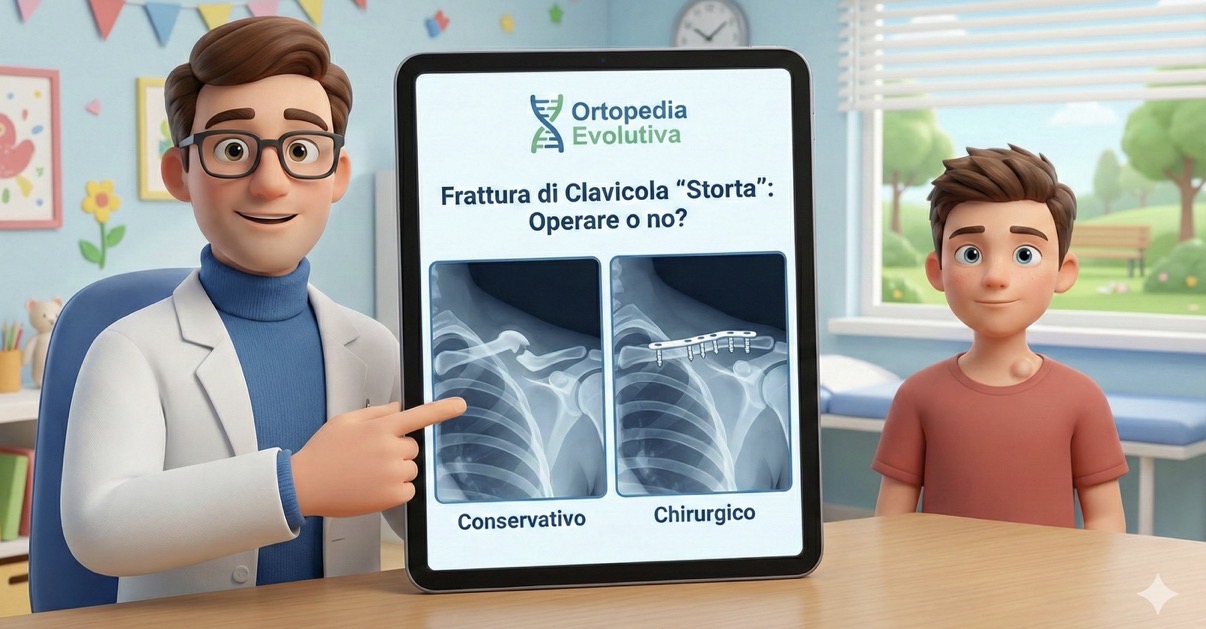
A "crooked" clavicle fracture is concerning, especially if the bone fragment seems to "point" towards the skin. In most children, it heals well even without surgery; surgery is needed when it adds safety or a real advantage, not just a "straighter" X-ray. [2,3]
Why it's being discussed (more than before) today
In recent years, clavicle surgery in adolescents has increased, particularly for severely displaced diaphyseal fractures. [2,3,4] The impetus is understandable: in adults, some dislocated fractures have broader indications, and the idea of "translating" the approach comes naturally. [3,4]
The problem is that in adolescents, the outcomes that truly matter (pain, shoulder function, return to sport, satisfaction) do not always improve significantly with osteosynthesis compared to conservative treatment, while specific risks increase: discomfort from the plate, surgical wound problems, cutaneous dysesthesias, and not infrequently, the request for hardware removal. [1,2,3]
This is where the key concept comes in: careful selection. [1,2]
1) "Absolute" Indications: Here, Surgery is Not Debatable
These are situations where surgery is not about "making the X-ray look good," but about managing a concrete risk or a problem with shoulder girdle stability:
- Open fracture (break in the skin). [3,4]
- Skin at risk: marked soft tissue tension with risk of progression to exposure (significant skin tenting, skin compromise) [3,4]
- Neurovascular compromise attributable to the trauma (compatible clinical signs). [3]
- Complex shoulder girdle injuries ("floating shoulder" type contexts with significant instability) and/or polytrauma, where stabilization can facilitate overall management and mobilization. [3,4]
In these cases, counseling is relatively straightforward: the indication is guided by safety. [3,4]
2) The Heart of the Debate: "Relative" Indications
This is where daily discussion arises. We are primarily talking about severely displaced diaphyseal fractures, often with shortening/overlap and/or comminution, in adolescent athletes. [2,3,4]
The Key Point to State Aloud
"Severely displaced" is not automatically synonymous with "needs surgery." [1,2]
Prospective multicenter data (FACTS) have helped to re-evaluate the idea of a universal advantage of osteosynthesis on patient-reported outcomes: surgery can be excellent in selected cases, but it is not a shortcut that always and in all cases improves pain, function, and long-term satisfaction. [1,2]
So: when does it become reasonable to move towards surgical intervention?
2A) Factors that Make a Surgical Discussion Reasonable (Without Turning Them into "Dogmas")
These elements, especially when combined and when the child is close to skeletal maturity, shift the risk/benefit ratio towards osteosynthesis. [2,3,4]
- Marked shortening/overlap + obvious deformity Not because "a number decides," but because it increases the probability that the outcome will be perceived as bothersome (prominence, friction with backpack straps, local pain) and that the course will be longer or more frustrating for certain profiles. [3,4] Here, counseling must be clear: surgery is not performed to "remove any bump," it is performed if a real benefit on comfort and function is expected. [2,3]
- Significant comminution / instability of the fracture site Instability makes maintaining alignment less predictable and can increase the probability of consolidation with residual deformity, especially in older children. [3,4]
- Adolescent nearing the end of growth With little residual growth, the margin for adaptation is more limited: for the same deformity, a surgical indication may become more reasonable compared to a biologically younger adolescent. [2,3]
- Very high functional demand (competitive sport) with a precise time objective Here, promises must be avoided. Osteosynthesis does not guarantee a "faster return" by definition, but in some contexts, it can offer a more predictable path. [2,4] The price is accepting the risks associated with hardware and the (not uncommon) possibility of wanting them removed. [2,3]
- Practical factors that weigh in on shared decision-making Adherence to follow-up, management of immobilization, family context, and expectations: these are not surgical indications in themselves, but they can influence the choice when the situation is borderline. [2,3]
2B) When, even if the X-ray is concerning, the Literature Suggests Not Operating
If there are no absolute indications and no strong "relative" indications emerge, conservative treatment often remains the most consistent choice: closed fracture, skin not at risk, no neurovascular deficit; manageable pain and good compliance. [2,3]
And even in severely displaced fractures, prospective data do not support a universal average advantage of osteosynthesis on patient-reported outcomes: therefore, surgery should not be an automatic response. [1,2]
3) The Most Important Part: How to Explain it (Well) to the Family
The phrase that works, without slipping into paternalism or "selling" the surgery, is this:
"Surgery realigns the clavicle immediately. What we need to understand is whether, for your child, this translates into a real advantage in terms of function, sport, and satisfaction sufficient to justify the risks of surgery and hardware." [1,2]
Disclaimer
Informational content; does not replace an individual clinical evaluation.
References
[1] Heyworth BE, et al. Prospective multicenter (FACTS): operative vs nonoperative in adolescent midshaft clavicle fractures. PubMed:
https://pubmed.ncbi.nlm.nih.gov/35984091/
[2] Patel M, et al. Clavicular Fractures in the Adolescent. JBJS. 2023. PubMed:
https://pubmed.ncbi.nlm.nih.gov/36753567/
[3] Markes AR, et al. Management of Displaced Midshaft Clavicle Fractures in Pediatrics and Adolescents. Open access:
https://pmc.ncbi.nlm.nih.gov/articles/PMC9636878/
[4] Fanter NJ, et al. Surgical Treatment of Clavicle Fractures in the Adolescent Athlete. Open access: