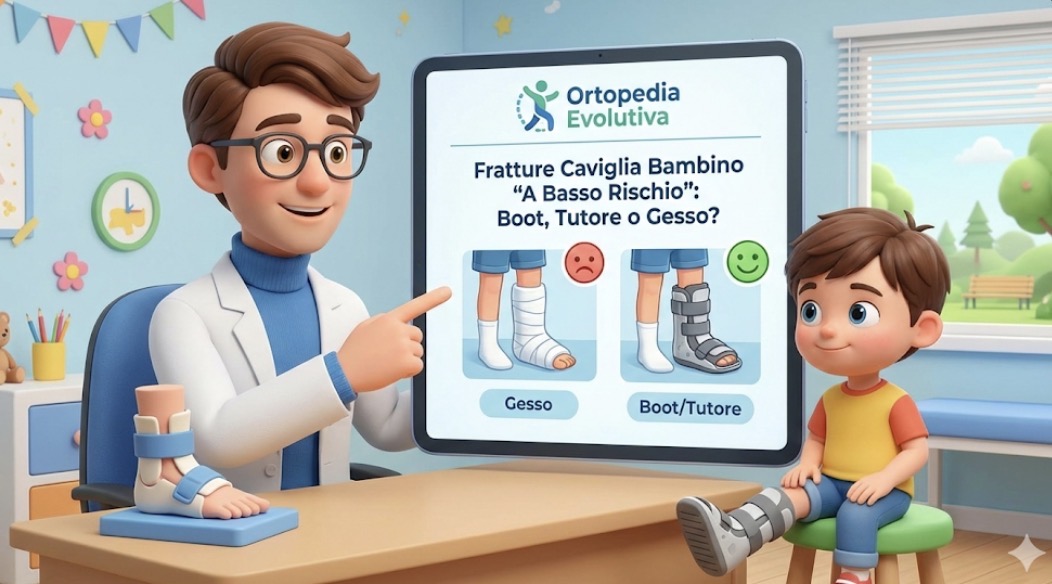
It often happens in the clinic: a child with a low-energy trauma, lateral ankle pain, unimpressive (or even negative) X-ray, a parent who looks at the image and then at the child and asks the most "human" question in the world: "Does he need a cast?".
For years, casting has been almost a conditioned reflex: it protects, "sets things right," and gives a sense of control. But in the last 15–20 years, a body of literature has grown that questions this automatic response, at least for what are defined as "low-risk" fractures/injuries: stable conditions, often infractions, without alarming clinical signs, managed conservatively nonetheless. The message is not revolutionary, but it is important: "more rigid" does not always mean "safer." [1][2][4]
What the newly published article adds (and why it's worth reading)
The systematic review with meta-analysis by Badhe et al. (2026) compiles 7 randomized trials (503 children, 0–18 years) comparing casts, removable braces, and, in some studies, "soft" bandages for low-risk/stable or suspected occult fractures managed non-surgically. [1]
The results are very "clinical," meaning they are genuinely useful for decision-making:
- Compared to casts, removable braces are associated with fewer unscheduled visits (RR 0.26) and a faster return to activities (on average ~1 week sooner). [1]
- Furthermore, they report better functional scores and greater child/family satisfaction with the removable device. [1]
- Bandaging shows interesting signs (less missed school and earlier return to activities), but with high heterogeneity, making it harder to turn into a "one-size-fits-all prescription." [1]
- In the included trials, no significant differences in pain or complications were found between the strategies (always within the "low-risk" perimeter selected by the studies). [1]
The authors' conclusion is balanced: removable braces are a good alternative to casts in low-risk cases, but the question "how rigid is truly necessary?" remains open, and definitive studies with standardized outcomes and cost-effectiveness are needed. [1]
It's not a 2026 fad: the idea was already strong (and so was the data)
This trajectory didn't start today. The "classic" RCT by Boutis et al. (Pediatrics, 2007) compared removable braces vs. casts in children with low-risk ankle fractures. At 4 weeks, the brace group showed better functional recovery and greater return to activities, as well as a clear patient preference (very few would have preferred a cast after trying the brace). [2] This work, due to its robustness and simplicity of message, significantly influenced a change in mindset.
Then there's another clinically crucial point, often underestimated: many children with "painful ankle + negative X-ray" are treated as if they have a Salter-Harris I of the distal fibula. The study by Boutis et al. (JAMA Pediatrics, 2016) showed that these "pure" physeal fractures are actually rare in that context; more often, they are ligamentous sprains or small occult avulsions. And, practically speaking, children (even those with lesions only visible on MRI) had comparable recovery when treated with a removable brace and "self-regulated" return to activities. [3]
This doesn't "demolish" the diagnosis of a fracture: it demolishes the idea that, when in doubt, the only answer is a cast.
As early as 2019, a previous systematic review/meta-analysis by Marson et al. (same journal as the 2026 article) concluded that there was no definitive "best treatment," but that devices allowing early mobilization tended to lead to faster recovery compared to rigid immobilization; and it emphasized the need for a definitive trial and more homogeneous outcomes. [4] The new 2026 work, in fact, reinforces this orientation with an updated RCT base. [1][4]
Finally, for those wondering "okay, but what about bandaging? weight-bearing casts? what's the minimum effective?", it's useful to know that there's also a recent feasibility RCT (Bone & Joint Journal, 2025) that randomized children (5–15 years) to supportive bandage, removable splint, or weight-bearing cast, precisely to understand if a definitive trial is feasible. [5] This is a clear signal: the community is looking not only "if" to simplify, but how to do it in a standardized way. [5]
The difficult part: selecting well (and explaining it well)
All this literature has an implicit premise: we are talking about low-risk/stable conditions, defined and selected by individual trials (and not always identically). [1][4]
So the point is not to "abolish the cast," but to dismantle the automatic response: if the clinical and radiographic evaluation (when indicated) is consistent with a low-risk profile, a removable brace can be a more proportionate choice, often more preferred, and, on average, associated with faster functional recovery. [1][2]
In practice, the phrase I try to keep as a compass is simple:
same goal (safe healing), different means (less invasive), provided good selection and clear instructions.
Disclaimer
Informational content; does not replace individual clinical evaluation.
References
[1] Badhe N, et al. Outcome of ankle fractures in children: an updated systematic review and meta-analysis. Ann R Coll Surg Engl. 2026. PMID: 41622914.
PubMed: https://pubmed.ncbi.nlm.nih.gov/41622914/
[2] Boutis K, et al. A randomized, controlled trial of a removable brace versus casting in children with low-risk ankle fractures. Pediatrics. 2007. PMID: 17545357.
PubMed: https://pubmed.ncbi.nlm.nih.gov/17545357/
[3] Boutis K, et al. Radiograph-Negative Lateral Ankle Injuries in Children: Occult Growth Plate Fracture or Sprain? JAMA Pediatr. 2016. PMID: 26747077.
PubMed: https://pubmed.ncbi.nlm.nih.gov/26747077/
[4] Marson BA, et al. Management of ‘low-risk’ ankle fractures in children: a systematic review. Ann R Coll Surg Engl. 2019. PMID: 30855167. PMCID: PMC6818065.
PubMed: https://pubmed.ncbi.nlm.nih.gov/30855167/
Full text: https://pmc.ncbi.nlm.nih.gov/articles/PMC6818065/
[5] Marson BA, et al. Supportive bandage, removable splint, or walking casts for low-risk ankle fractures in children: a feasibility randomized controlled trial. Bone Joint J. 2025. PMID: 39740682.