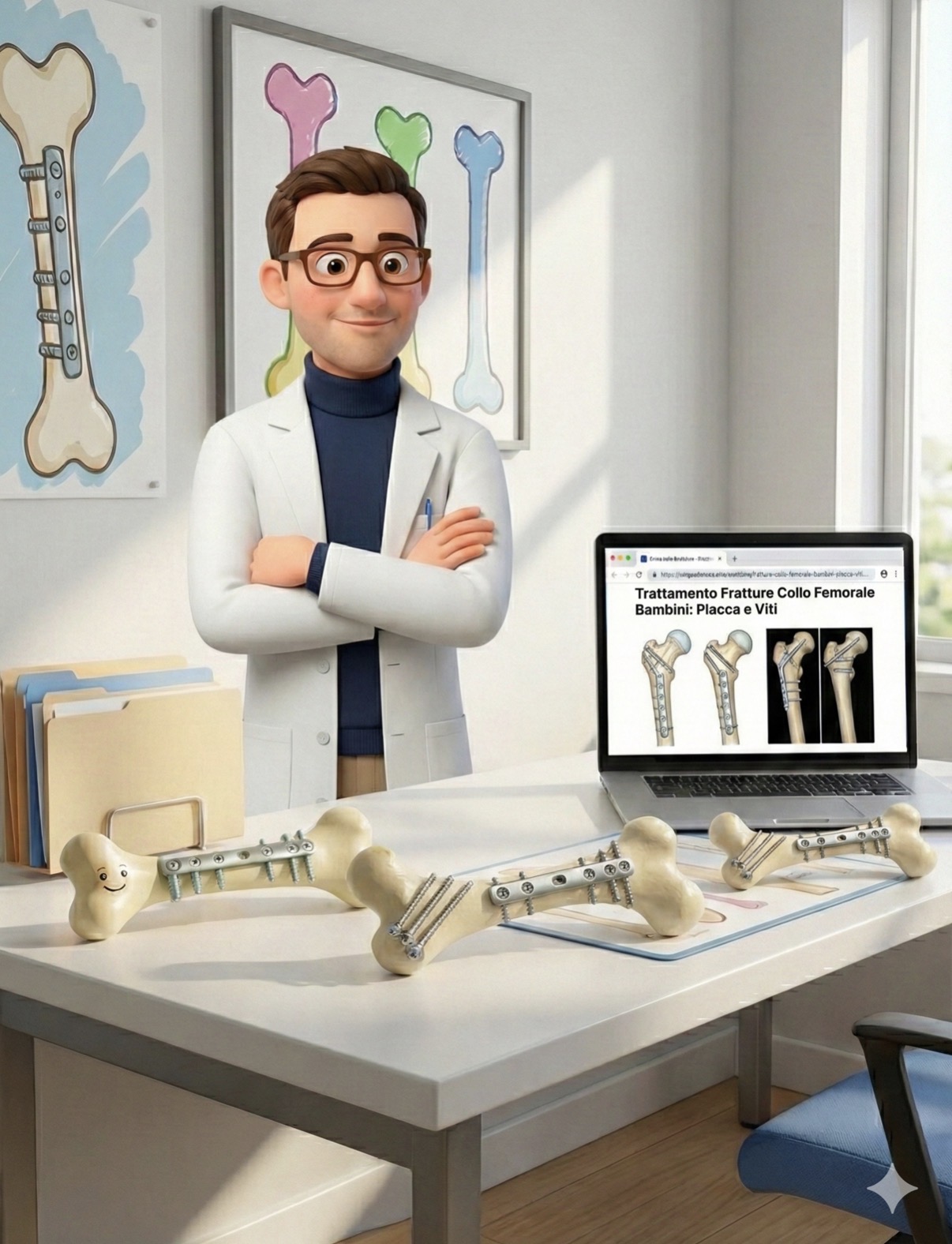
In pediatric orthopedics, there are fractures we see often and fractures we see rarely but which, when they occur, require clarity: the femoral neck is one of these. The reason is simple: here we are not just "repairing a bone," we are protecting the vascularization of the femoral head and a growth plate that can shape the growth trajectory of the hip.
In the clinic, after the acute phase, the question often becomes: "What is the safest fixation choice?" This is not a trivial question, because in the pediatric femoral neck, mechanical stability, the quality of reduction, and the aggressiveness of the surgical approach intertwine with a biological risk we know well: avascular necrosis.
Today we analyze this article
Chen Y-P, et al. Plate Versus Screw Fixation in Treating Pediatric Femoral Neck Fractures: A Systematic Review. J Pediatr Orthop. 2026 Jan 14. DOI: 10.1097/BPO.0000000000003207. PMID: 41532397. [1]
PubMed: https://pubmed.ncbi.nlm.nih.gov/41532397/
DOI: https://doi.org/10.1097/BPO.0000000000003207
What the authors did (in brief)
The authors conducted a systematic review searching PubMed, EMBASE, Cochrane Library, and Google Scholar for studies reporting outcomes of pediatric femoral neck fractures treated with plates or screws. The outcomes considered were functional evaluation (Ratliff criteria) and major post-operative complications. [1]
The result is a collection of 31 studies totaling 950 cases: significant numbers for a problem that does not have the volume of "common trauma." [1]
The core message: similar function, different complications
The first interesting thing is almost "reassuring": Ratliff functional criteria are comparable between plates and screws. [1]
But then comes the part that, in real life, weighs more than the functional scale: plates are associated with a reduction in the incidence of avascular necrosis and premature physeal closure compared to screws. [1]
This is a signal consistent with the idea (not always easy to demonstrate) that, in certain fractures, more robust stability and better control of the fracture site can translate into fewer biological complications. Stated this way, it seems straightforward; in practice, we know that there are many confounding factors (reduction, timing, trauma energy, pattern, age, weight). Precisely for this reason, a review that "sees" the direction of the association deserves attention, even if it does not provide us with an absolute truth.
The price to pay: coxa vara
The same review shows a possible trade-off: coxa vara is "slightly more frequent" in the plate group. [1]
Conversely, non-union and limb length discrepancy are reported as similar between the two groups. [1]
This is a point I like because it avoids the illusion of the perfect technique: every choice has a risk-benefit profile and, above all, depends on how we apply it (reduction, implant, axis control).
The subgroups that really matter (Delbet III/IV and displaced fractures)
The most "actionable" data is from the subgroups: in patients with Delbet III/IV fractures and in displaced fractures, plates reduce the risk of avascular necrosis and limb length discrepancy compared to screws. [1]
This is the part that, in discussions among colleagues, changes the tone of the conversation: not "always plate," but "plate more often when the situation is unstable or at risk."
A clinical vignette (generic)
Imagine an adolescent who arrives after trauma with a displaced femoral neck fracture. Reduction achieved with difficulty but acceptable. At that moment, the reasoning is not just "closing the fracture," but minimizing risks at 6-12 months and beyond. In such cases, being able to say that a systematic review associates plates with a lower risk of avascular necrosis and physeal closure, precisely in displaced/Delbet III-IV patterns, helps build a more solid and explainable choice. [1]
What remains open
The authors themselves classify the evidence as Level III: it is a review of retrospective studies and series, so it does not eliminate heterogeneity nor replace RCTs (which are difficult to conduct here). [1]
The practical value, however, is clear: when biological risk is high, stability and control of the fracture site might matter more than "minimal invasiveness" for its own sake.
Disclaimer: informational content, not a substitute for individual clinical evaluation.
References
[1] Chen Y-P, Lin C-H, Hong C-K, Yao S-H, Chen C-H. Plate Versus Screw Fixation in Treating Pediatric Femoral Neck Fractures: A Systematic Review. J Pediatr Orthop. 2026 Jan 14. DOI: 10.1097/BPO.0000000000003207. PMID: 41532397.
PubMed: https://pubmed.ncbi.nlm.nih.gov/41532397/ — DOI: https://doi.org/10.1097/BPO.0000000000003207