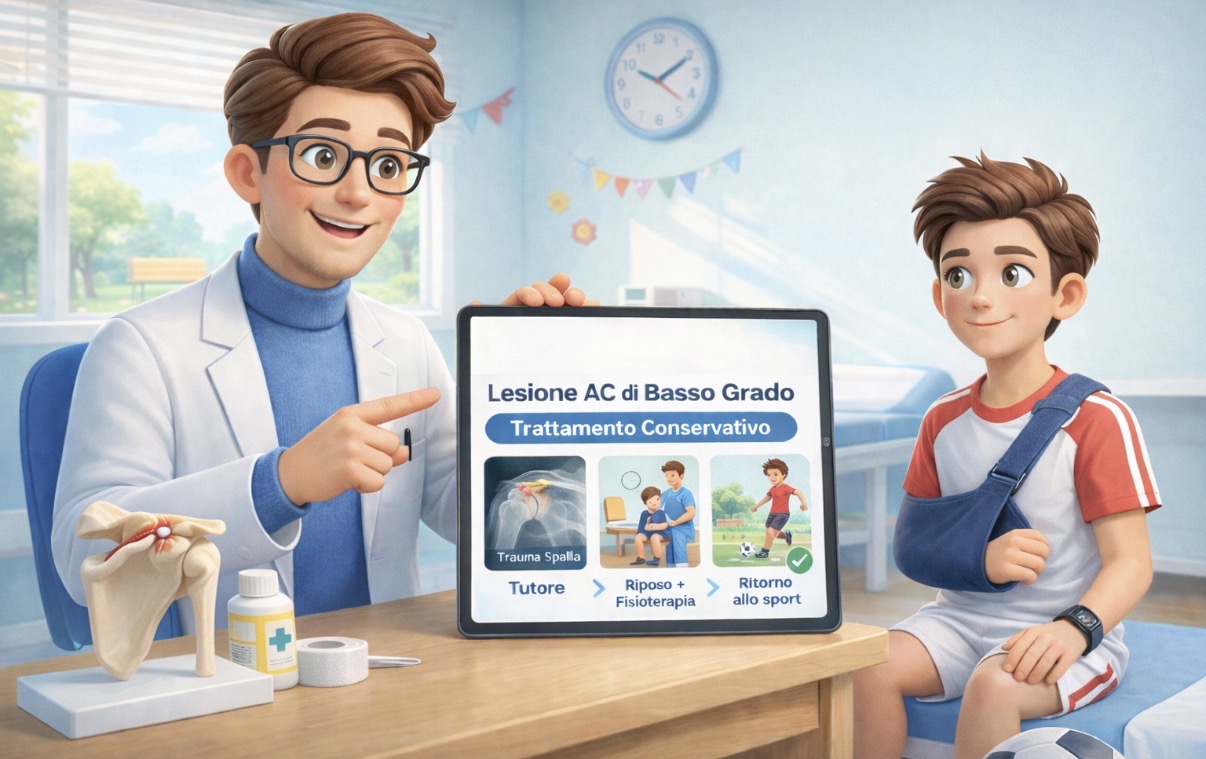
A shoulder injury in a young athlete is one of those situations that, in the clinic, seems simple until you start talking about recovery times. The parent's question almost always comes immediately: "When can they play again?" The coach's question comes a moment later, though not always in person. And the patient's question, especially if they are an adolescent, is often even more direct: "Do I only miss one game or am I out for a month?"
Low-grade acromioclavicular (AC) joint injuries fall exactly into this space: they are generally not "dramatic" injuries, but they still require an accurate evaluation, because the risk is twofold. On one hand, trivializing them too much; on the other, burdening them with anxiety, imaging, and restrictions beyond what is necessary. The study by Reed and colleagues, recently published in the Journal of Pediatric Orthopaedics, is useful precisely for this reason: it doesn't promise revolutions, but it puts some numbers on a management approach that we often take for granted. [1]
The authors retrospectively analyzed a cohort of patients under 18 years of age, evaluated for AC joint injury at two referral hospitals between 2014 and 2024. In total, 110 shoulders in 108 patients were included, with an average age of approximately 12.8 years; 74% were male. The most important finding is that 95% of the injuries were low-grade and all cases were treated conservatively. [1]
This information alone is interesting. Because in daily clinical practice, the temptation to "do something more" in the face of a very painful shoulder, especially if the child plays contact sports, exists. Instead, the study brings us back to a simple point: for minor conditions, non-surgical treatment remains the most natural and, likely, the most correct path. [1]
The conservative strategies used were those we know well: simple sling, rest, physical therapy, or a combination of the two. Specifically, 40% of patients were managed with a sling, 29% with physical therapy, 17% with rest, and 15% with a sling plus physical therapy. [1] This is a useful detail because it suggests a certain variability even within conservative treatment: there is no single rigid protocol, and the clinical context probably matters more than the "package" itself.
The most interesting data, of course, is the return to sport. Here we must be honest: not all patients had a documented date in their medical records, and this is a significant limitation of the study. However, in cases where the data was available, the return to sports activity occurred with a median time of 21 days. [1] This does not mean that "three weeks applies to everyone," but it is a concrete number, useful when trying to give families a realistic outlook.
In my opinion, the most interesting part of the work isn't even this. It's the fact that the return to sport was significantly slower in patients with concomitant injuries. [1] And this is a very plausible result from a clinical perspective as well. Often the real problem is not the isolated AC joint sprain, but the traumatic context in which it occurs: a more significant contusion, diffuse residual pain, stiffness, high-energy mechanism, or other scapular girdle injuries that make recovery less linear.
In the clinic, a typical case often occurs: a 13 or 14-year-old boy, direct trauma to the shoulder during football, rugby, or soccer, pain in the upper part of the shoulder, X-rays without striking signs, but pain well localized to the AC joint. The family fears a "serious" injury, the boy wants to know when he can return, and the risk is to slide in two wrong directions: "it's nothing, go back whenever you want" or "stay out for a long time because the shoulder is delicate." This study helps us stay in the right middle ground: in most low-grade injuries, the course is favorable, but the recovery time should not be improvised and also depends on the possible presence of associated injuries. [1]
Naturally, the limitations must be clearly stated. This is a retrospective study, without a comparator group and with incomplete documentation on return to sport. Furthermore, the results are especially valid for low-grade injuries: extending them to more severe conditions would be incorrect. [1] However, precisely because it does not try to prove too much, the work has its practical utility: it helps to make initial counseling more solid.
If I had to summarize the message very simply, I would say this: in minor AC joint injuries in pediatric athletes, conservative treatment is not a fallback, but the natural treatment, and in most cases leads to a relatively rapid return to sport. The point is not to decide whether to operate. The point is to properly recognize the low grade, identify any concomitant injuries, and set up a credible recovery, without alarmism but also without unnecessary haste. [1]
For those who work with children and adolescent athletes, this is exactly the kind of information needed: not an abstract theory, but a realistic estimate to bring to the visit, where expectations matter almost as much as the diagnosis.
Disclaimer
This content is for informational purposes only and does not substitute for an individual clinical evaluation.
References
[1] Reed JM, Epner E, Hymel AM, Dale KM, LeClere LE. Nonoperative Treatment of Low-grade AC Joint Injuries in Pediatric Athletes. Journal of Pediatric Orthopaedics. 2026 Mar 2. Online ahead of print. DOI: 10.1097/BPO.0000000000003256. PMID: 41770030.