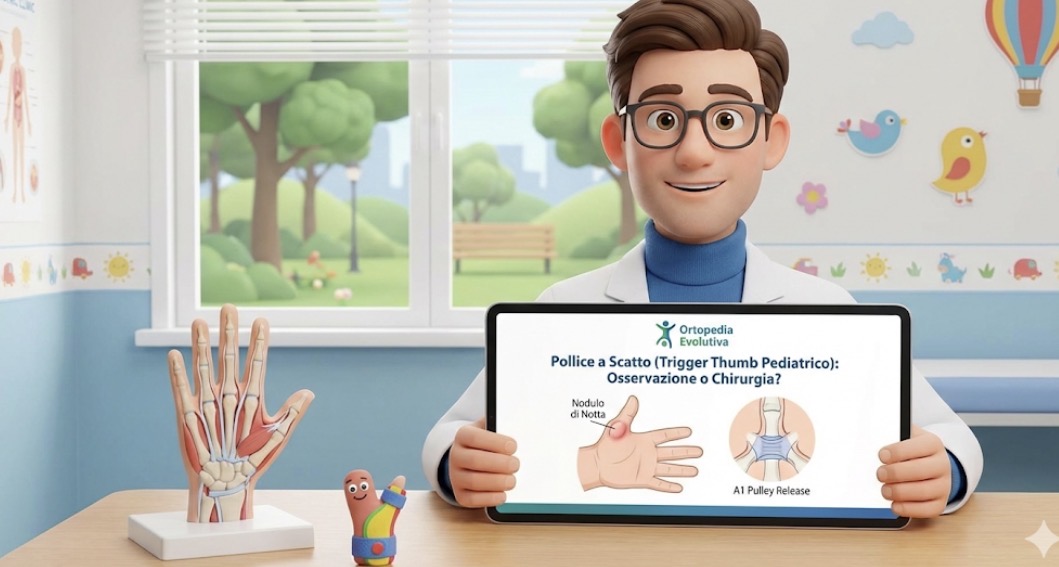
Trigger Thumb: A "Small" Diagnosis That Generates Big Discussions
In the clinic, a very similar scene often occurs: worried parents, a small child using their hand, but "that thumb" remains flexed, or it snaps and sometimes seems to get stuck. The question is always the same, phrased in different ways: "Do we need to operate immediately?"
It's a legitimate question, because A1 pulley release surgery is a procedure with generally good outcomes. But precisely because it works well, over the years there has been an almost "reflexive" tendency to propose it early. The point is that the natural history of pediatric trigger thumb is not as trivial as it once seemed.
What the 2024 Meta-Analysis Adds
Tang and colleagues published a systematic review with meta-analysis on spontaneous resolution in children managed with observation. [1]
The estimated overall rate is around 43.5% spontaneous resolution, but with an important caveat: the studies are heterogeneous (follow-up, definitions of "resolution," initial severity, enrollment criteria). [1]
So far, nothing surprising. The interesting part comes when the authors look at time: in subgroups with follow-up ≥24 months, the estimated resolution rate (in their dataset) rises to approximately 58.9%, while under 24 months it drops to around 26.8%. [1]
Translated into simple words: if we choose observation, we must have the courage to give it time. Otherwise, we are not truly "observing"; we are just postponing a decision.
The Natural History "In Practice": What Prospective Data Say
This snapshot is consistent with a widely cited US prospective study: children initially observed, followed for years. Five years after the first evaluation, about one-third of thumbs spontaneously resolved, while a significant proportion underwent surgery over time (not necessarily because it "failed," but because the family decided to close the chapter). [2]
The same study also reveals a clinically intuitive detail: the greater the initial interphalangeal flexion, the lower the probability of spontaneous resolution. [2] This is not a "verdict," but it is a useful element when discussing strategy.
Why It's Discussed More Today Than Before: Appropriateness and Timing
Two recent papers help explain why the topic has become hot again:
- US national data show a tendency to treat surgically more often and at younger ages than what the literature on natural history would suggest, with the suspicion of overtreatment in a proportion of cases. [3]
- A "long" case series (20 years) describes how patients present and what factors are more often associated with surgical vs. conservative choice, reminding us that the decision, in reality, depends on many variables: age, severity, laterality, functional impact, expectations. [4]
So: When Does the Literature Lean Towards Surgery, and When Not?
If I had to summarize the approach that might be most consistent with recent evidence, I would do it this way:
Reasoned observation (with clear follow-up and counseling) tends to be sensible when:
- functional limitation is modest, and the child uses their hand without difficulty in daily life;
- there is no significant pain;
- the family is informed that resolution, if it occurs, may take months or years, and accepts this trajectory;
- the situation is stable and clinically monitorable. [1–2]
Surgery becomes more reasonable when:
- the locking is persistent and truly interferes with function/grasp, or with daily activities;
- the condition is rigid, not very modifiable over time, or the flexion is significant and shows no signs of improvement at follow-up (knowing that initial severity can reduce the probability of resolution). [2]
- the risk/benefit balance, discussed transparently, leads the family to prefer a quick and definitive solution, even for practical reasons (school, sports, family organization), provided the indication is appropriate.
Here's the point: it's not a competition between "surgical" and "conservative" approaches. It's a choice of timing and indication that should be consistent with natural history, clinical severity, and family priorities.
A Final Note of Clinical Common Sense
What the 2024 meta-analysis reminds us is simple but uncomfortable: a significant proportion can resolve spontaneously, but to notice it, one must observe long enough. [1]
At the same time, surgery remains an effective solution when the indication is solid. The real discussion is not "whether" to operate, but which cases and when.
Disclaimer: This article is for informational purposes only and does not replace an individual clinical evaluation.
References
[1] Tang QS, Miao XL, Zhao K, Hu J, Ren X. The prevalence of spontaneous resolution among pediatric trigger thumb: a systematic review and meta-analysis. J Orthop Surg Res. 2024;19:461. DOI: 10.1186/s13018-024-04960-0. PMID: 39095911.
[2] Hutchinson DT, Rane AA, Montanez A. The Natural History of Pediatric Trigger Thumb in the United States. J Hand Surg Am. 2021;46(5):424.e1–424.e7. DOI: 10.1016/j.jhsa.2020.10.016. PMID: 33436280.
[3] Park KM, et al. Trends in the Management of Pediatric Trigger Thumb in the United States. HAND (N Y). 2023. PMID: 34730008.
[4] Ray SB, Gibbs CM, Fowler JR. Trigger Thumb in Pediatric Patients: A 20-Year Update. HAND (N Y). 2024;19(4):679–684. PMID: 36346127.