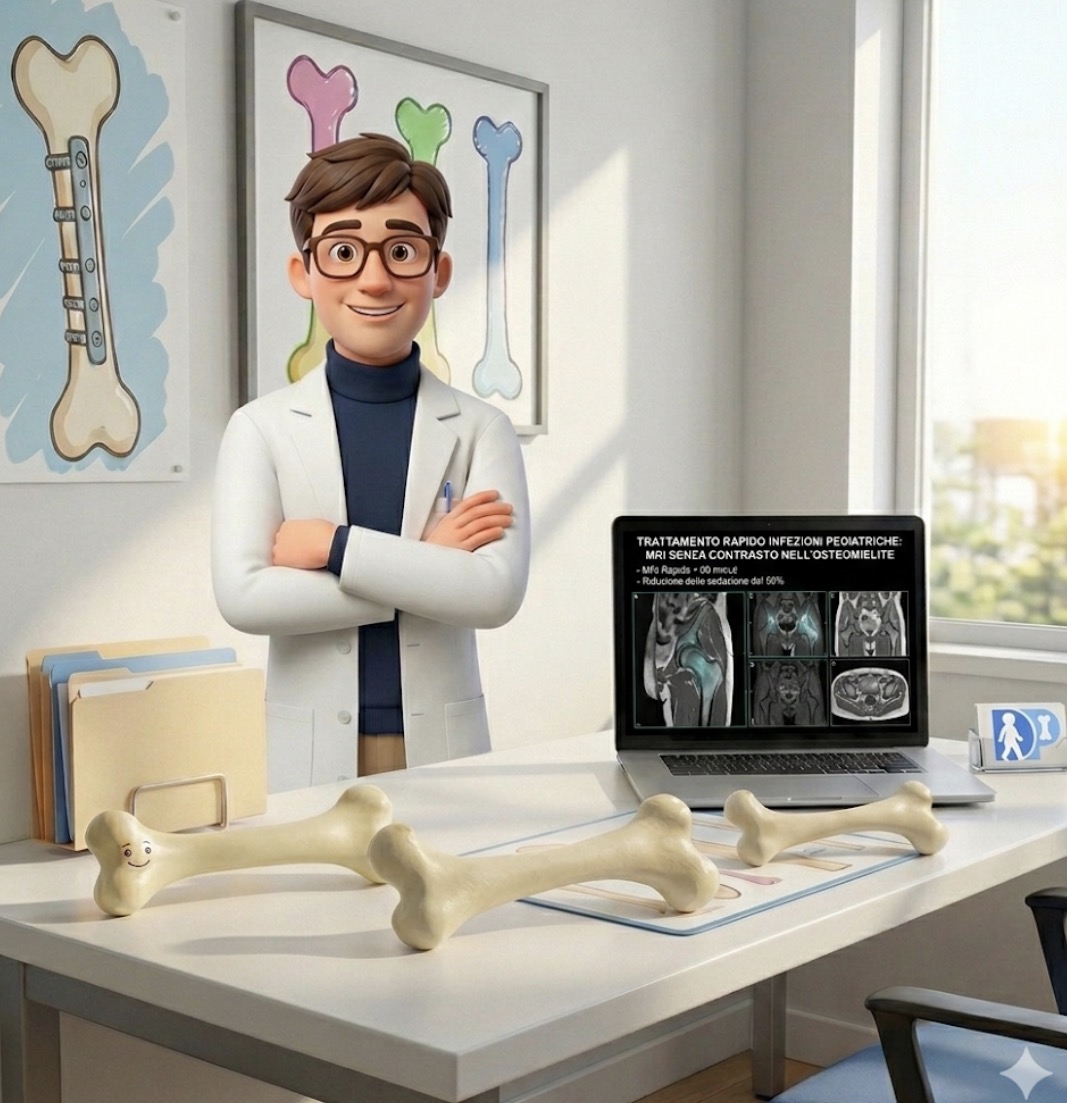
In recent years, rapid MRI has evolved from an interesting idea to a truly hot topic in pediatric osteoarticular infections. The reason is simple: in osteomyelitis, septic arthritis with suspected bone extension, pelvic infections, or deep myositis, MRI remains the best examination to understand where the infection truly is and how much it has spread. Historically, the problem has always been the logistical cost: contrast, sedation, long times, radiological waiting, and the risk of delaying decisions that, in some cases, should be rapid. [1][2]
Rapid MRI was developed precisely to try and break this bottleneck. In practice, it is an abbreviated protocol, without contrast medium and ideally without sedation, built around limited but high-yield sequences for edema, fluid collections, and diffusion. It is not a "poor" MRI: it is a more essential MRI, designed to answer an urgent clinical question without turning every suspected infection into a long and burdensome process. [1][3]
The most useful work, from a practical perspective, is that of Chan and colleagues, published in JPOSNA in 2024. The authors compared a traditional pathway with a rapid MRI protocol in children evaluated for acute musculoskeletal infection. The results align with what many of us suspected, but here they are finally quantified: with rapid MRI, sedation decreased from 53% to 4%, contrast from 88% to 0%, the median time from order to examination dropped from 6.5 hours to 2.2 hours, MRI duration from 63.2 to 24 minutes, time to final report from 13.5 to 7 hours, median length of stay from 5.3 to 3.7 days, and hospital expenses were also significantly lower. [1]
These numbers are powerful, especially because they don't just describe a radiological issue but a change in the clinical pathway. In outpatient clinics and wards, the frustrating situation of a child with fever, limp, altered inflammatory markers, unclear location, and an MRI that is "necessary but difficult to obtain in a timely manner" often arises. If the protocol becomes faster and less dependent on contrast and anesthesia, everything changes: not only the patient's comfort but also the speed with which one decides whether to observe, drain, debride, or simply limit an unnecessary intervention. [1][2]
The systematic review by Keenan and colleagues, also from 2024, goes in the same direction but with a broader scope. The review concludes that the early use of MRI in clinical care pathways for pediatric musculoskeletal infections can improve outcomes, especially because it helps to better define the extent of the disease and choose the correct intervention, with the possibility of reducing unnecessary surgeries and reinterventions. The message, for me, is important: rapid MRI is not just interesting because it is more convenient; it is interesting because it can make the first therapeutic action more precise. [2]
That said, it would be wrong to turn the topic into a slogan like "rapid MRI for everyone." The same review reminds us that one of the historical criticalities of early imaging is precisely the risk of delaying necessary treatment if the pathway is not well organized. This is especially true in clinically highly suggestive cases of frank septic arthritis, where a toxic child with a tense joint and significant pain cannot be trapped in a radiological algorithm if the surgical decision is already substantially clear. This is a reasonable clinical inference, consistent with the organizational problem highlighted by the authors. [2]
And this is precisely where the third useful work comes in, the international survey by Bedoya and colleagues from 2025. Perhaps the most interesting data is not technical but cultural: only 22% of the institutions that responded actually used a rapid MRI protocol for acute musculoskeletal infections. Pediatric institutions were more advanced than general ones, and the main declared barrier was the lack of a shared protocol, even more so than the availability of technicians or technology. In other words: the problem today is not so much whether rapid MRI "can be done," but whether centers can integrate it into a coherent pathway involving orthopedics, radiology, anesthesia, and the emergency department. [3]
This, in my opinion, is the most modern part of the topic. For years, we have thought about MRI in pediatric infections as an examination to be requested "if needed." Today, the focus is shifting: how do we organize the system so that it is truly useful and doesn't arrive too late? Rapid MRI does not replace clinical judgment, does not eliminate the need for sedation in every child, and does not resolve all anatomical uncertainties. However, it seems to offer a concrete way to reduce unnecessary friction, especially in deep or vaguely located infections, where knowing early whether there is only synovitis, osteomyelitis, an abscess, or pelvic extension changes a great deal. [1–3]
If I had to summarize the message in one sentence, I would say this: rapid MRI is not interesting because it "shortens radiology," but because it can shorten the time between clinical suspicion and the right decision. And in pediatric osteoarticular infections, that time truly matters. [1][2]
Disclaimer
This content is for informational purposes only and does not replace an individual clinical evaluation.
References
[1] Chan KS, McBride D, Wild J, Kwon S, Samet J, Gibly RF. A Rapid MRI Protocol for Acute Pediatric Musculoskeletal Infection Eliminates Contrast, Decreases Sedation, Scan and Interpretation Time, Hospital Length of Stay, and Charges. J Pediatr Soc North Am. 2024;5(3):731. doi:10.55275/JPOSNA-2023-731. PMID: 40433331. PMCID: PMC12088088.
[2] Keenan M, Hsu M, Leveille L, Alvarez C, Simmonds A. Early Magnetic Resonance Imaging Use in Clinical Care Pathways for Musculoskeletal Infections in Pediatric Patients: A Systematic Review. J Pediatr Soc North Am. 2024;8:100096. doi:10.1016/j.jposna.2024.100096. PMID: 40433000. PMCID: PMC12088116.
[3] Bedoya MA, Iwasaka-Neder J, Chauvin NA, Samet JD, Meyers AB, Acharya PT, et al. Rapid MRI for acute pediatric MSK infections: survey of current utilization and procedural practices. Pediatr Radiol. 2025;55(7):1403-1413. doi:10.1007/s00247-025-06206-5. PMID: 40072522.