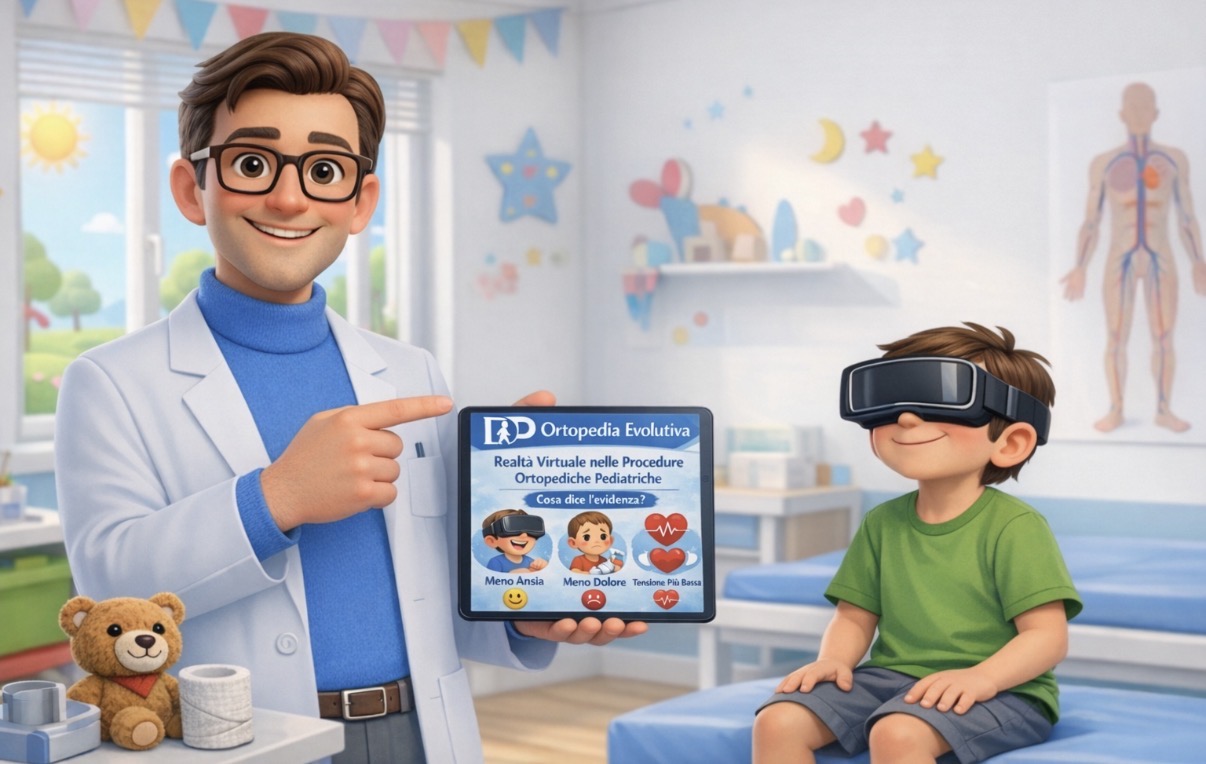
There are moments in pediatric orthopedics that, on paper, seem "minor": removing a cast, taking out a percutaneous pin, changing a dressing. Then you experience them in the clinic and realize they are not minor at all. For some children (and their parents), they become the most dreaded appointment: anticipatory anxiety, crying, stiffening, difficulty cooperating. And in the end, it's not just the child who suffers; the overall experience of care suffers.
In recent years, virtual reality (VR) has been proposed as a distraction technique: a headset, an immersive environment, a game or a scene "that takes away" attention during the procedure. A good idea, certainly. But does it really work?
A systematic review with meta-analysis just published in the Journal of Children's Orthopaedics tried to answer this question with the highest possible level of evidence for this type of intervention: including only randomized controlled trials. [1] The authors selected four RCTs, totaling 624 children (average age about 10 years), comparing VR against standard care during orthopedic procedures, predominantly outpatient and often related to cast care. [1]
The most robust result concerns anxiety. VR reduces anxiety with a moderate effect (SMD −0.55) and, importantly, with no heterogeneity between studies (I²=0%). [1] Translated practically: the effect on anxiety is consistent and reproducible across the included contexts. For pain, there is an effect, but it is more contained (SMD −0.43) and with greater variability between studies. [1] Heart rate also decreases modestly (SMD −0.34), consistent with less stress activation. [1]
These numbers should be interpreted with realism. VR is not an anesthetic and does not replace analgesics, correct techniques, or adequate communication. However, it can change the "atmosphere" of the procedure, which is often the decisive part. In the clinic, we often see children who have had a bad cast removal experience: the next time, they arrive tense even before entering, and anticipatory anxiety becomes the main problem. In these cases, reducing anxiety also means reducing resistance, pain perception, and the "dead" times spent trying and re-trying. The meta-analysis does not directly measure flow efficiency, but anyone working in a busy clinic immediately grasps the potential organizational benefit.
VR also has another advantage: it is a non-pharmacological intervention. In a context where sedation and drugs are not always indicated (or desirable) for short procedures, being able to offer an alternative strategy is interesting. Of course, it is not a universal solution: not all children like the headset, some may feel uncomfortable or nauseous, and age/temperament matter a lot. Furthermore, the available literature is still limited: four studies are few, and true "blinding" is impossible, so there is some expectation effect. [1] That said, the effect on anxiety is clear enough to make VR a credible resource, at least in some situations.
In summary: this work does not change orthopedics in the classical sense, it does not shift surgical indications and does not alter the biology of healing. However, it changes something that matters greatly in pediatrics: the experience of care. And when the experience improves, collaboration, time, and everyone's well-being often improve as well.
Disclaimer
This content is for informational purposes only and does not replace an individual clinical assessment.
References
[1] Alharran AM, AlAyyaf AE, Addar A, Hamdy R, Marwan Y. Virtual reality as a distraction technique in pediatric patients undergoing orthopedic procedures: A systematic review and meta-analysis of randomized controlled trials. Journal of Children’s Orthopaedics. 2026. DOI: 10.1177/18632521251414463. PMID: 41769155.
PubMed: https://pubmed.ncbi.nlm.nih.gov/41769155/
Full text (PMC): https://pmc.ncbi.nlm.nih.gov/articles/PMC12935579/