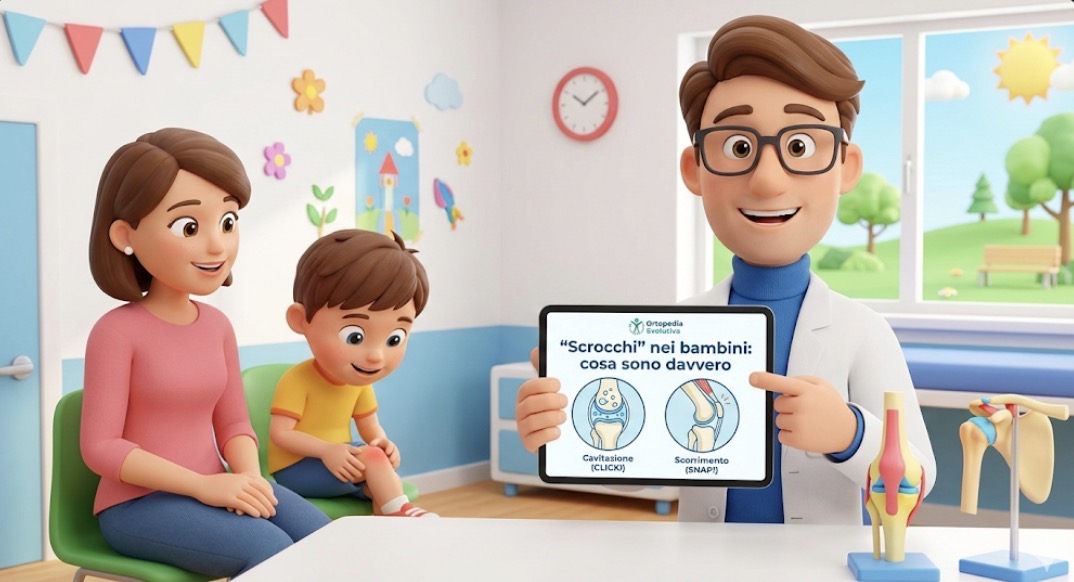
"Cracks" in Children: What They Really Are
One of the phrases I hear most often is: "Doctor, their knee/shoulder/fingers are cracking... is it dangerous?" I completely understand the anxiety, because the sound immediately makes one think of something "wearing out." In most cases, however, wear and tear is not an issue in children (that's an adult story).
Cracking sounds can arise from two very common mechanisms:
- Cavitation: Inside the joint, there is a fluid (synovial fluid). With certain movements, especially if it's "stretched" or moved rapidly, small gas bubbles can form and collapse. This creates a dry, "click" sound.
- Tendon and ligament gliding: In children, tissues are elastic, and structures are small. A tendon gliding over a bony prominence can make a "snap" or "friction" sound, often without any problem.
In both cases, if there is no pain, it is usually just a variation of movement.
Myth #1: "If it cracks, it's getting damaged"
No. The sound, by itself, is not synonymous with damage. What matters is how the child is doing: are they running? playing? playing sports? or do they stop because they are in pain? A sound without symptoms, in the vast majority of cases, does not require treatment.
Myth #2: "It's because they lack calcium"
This is another very common idea. Cracks are not a reliable sign of "weak bones" or deficiencies. If the child is growing well, eats a reasonably varied diet, and the pediatrician has not reported any problems, that's not where you should look.
Myth #3: "Cracking your knuckles causes arthritis"
This is a question that even adolescents ask ("I do it often, am I ruining myself?"). Arthritis does not come from "cracking." What can happen is that if someone constantly forces a movement, it can irritate the soft tissues (as happens with any repetitive habit). But this is not the same as "wear-and-tear" osteoarthritis.
When it's best to get it checked (the important signs)
Here I want to be very clear: it's not the sound itself, but the associated symptoms.
An evaluation is prudent if any of these appear:
- Persistent pain (not just occasional discomfort)
- Swelling, redness, or warmth of the joint
- Limping or refusal to bear weight on a leg
- Joint locking ("gets stuck," unable to straighten or bend)
- Repeated painful snapping always in the same spot, especially if it limits sports or play
- Fever associated with joint pain (this requires attention and often urgent evaluation)
Two very common examples (which are scary but often benign)
- Hip click in newborns: Many parents hear a "tick" when changing diapers. In most cases, it's a phenomenon of "gliding tendons." It's different from the "clunk" that is sought with specific maneuvers during an examination. If the pediatrician has doubts, a hip ultrasound is the right tool.
- Knee cracking during growth: During sprints, jumps, or climbing stairs, an occasional sound may occur. If there is no pain and no swelling, it is often nothing. If, however, there is pain in front of the knee or under the kneecap, it is worth discussing because it could be an overload (sports, growth, elasticity).
What you can do at home (without "obsessing" over the sound)
- Observe if there is pain and when: at rest? after sports? always the same?
- Look at function: can they run and jump as before?
- If they play intense sports and discomfort appears, a period of reduced load and simple work on stretching and motor control often helps (here, if needed, it can be set up with a physical therapist).
- Avoid "cracking for fun" a joint if it causes discomfort: it serves no purpose.
Disclaimer
This content is for informational purposes only and does not replace a medical consultation. If your child has pain, swelling, limping, or joint locking, it is appropriate to seek a clinical evaluation.