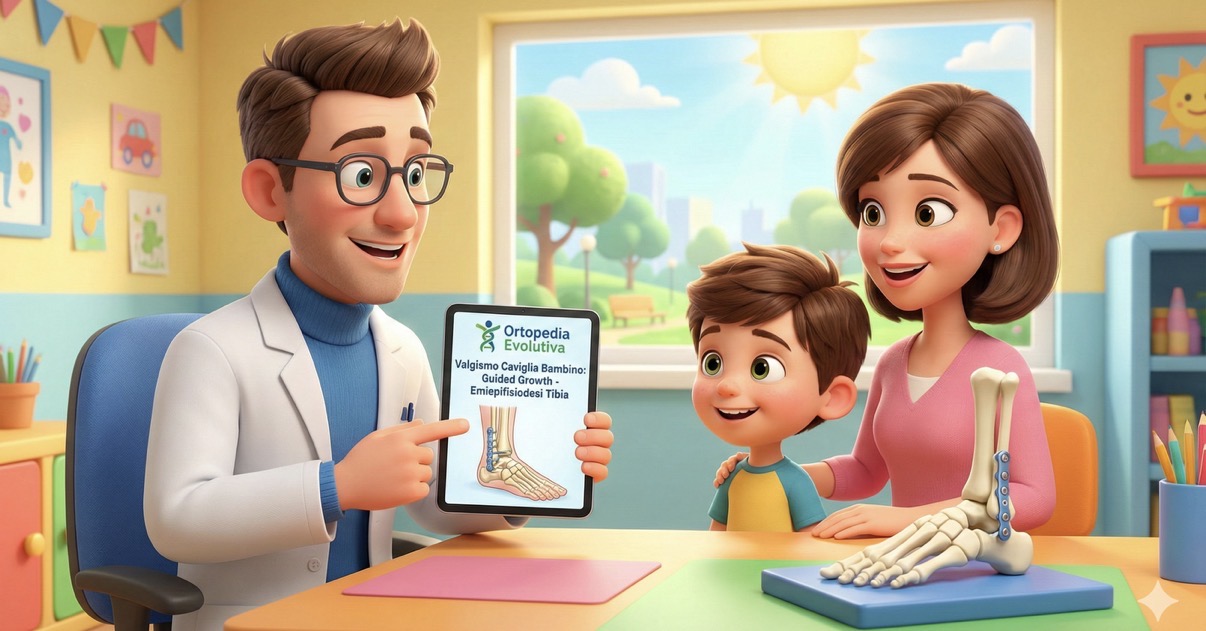
Ankle valgus in pediatric age is one of those problems that sometimes "can be seen from afar" (leaning on the inner edge, shoes worn strangely), but then on X-ray it tells a more precise story. And above all: not all valgus deformities are the same. There are forms related to growth, others that are part of more complex pictures (associated deformities, neurological pathologies, dysplasias), and the point is not just "straightening": it is doing it with timings and strategies compatible with the child and their growth.
In recent years, guided growth has made a gradual approach more frequent: instead of correcting everything at once with osteotomies, we exploit residual growth to "accompany" the axis towards more physiological values. But when we talk to families, the question that always comes back is concrete: "How long does it take? And does it last over time?".
This is where Ashkanani and colleagues' systematic review, published in the Journal of Pediatric Orthopaedics on January 15, 2026, fits in well, bringing together the available evidence on temporary distal medial tibial hemiepiphysiodesis (DMTH) to correct ankle valgus. [1]
The numbers that really matter in the clinic
The review includes 17 retrospective studies, for a total of 549 patients and 800 ankles: it is not a Level I study, but it is enough to obtain "realistic" estimates to use in counseling. [1]
On a radiographic level, the message is clear: on average, the correction is substantial. Parameters such as tibiotalar tilt (TT), LDTA, and tibiotalar angle (TTA) significantly improve after the intervention, approaching physiological values. [1] This helps us tell families: yes, the intervention is small, but the effect can be great—with one fundamental condition: it takes time.
And in fact, the second piece of data that I find "honest" is the speed: the average correction is about 0.6° per month, and the average duration until implant removal was 18.6 months. [1] In other words, it is not an "operate today, straight tomorrow" intervention: it is a process. Sometimes this is an advantage (progressive, less aggressive correction), other times it is a critical issue if there is little residual growth or if the deformity is already marked.
And after removal? The issue of rebound
Anyone who does guided growth knows that removal is not a definitive "end of the line": there is a risk of rebound. Here the review gives a useful indication: on average, rebound is about 0.3° per month, and alignment remains "largely preserved" after removal (with a slight loss compared to the maximum achieved). [1] Translated: rebound exists, but it is not necessarily a return to the starting point; often it is a small step backward that must be intercepted and managed with correct follow-up and timing.
A clinical vignette (very generic)
In the clinic, a child comes in who "doesn't complain too much," but the parents notice that they get tired quickly when walking and their shoes wear out on the inside. An X-ray reveals ankle valgus with parameters confirming the deformity. At that stage, the value of an article like this is to help you set realistic expectations: "Correction happens slowly, we're talking months; the implant needs to be checked; after removal, we need to continue to follow up because some rebound can happen." [1]
Safety: we don't sell "zero risks"
The review reports complications in the order of 11% (in the studies that reported the data) and reoperations around 3.9%, mostly related to hardware. [1] These are relatively low percentages, but sufficient to remind us that: even a "small" intervention requires attention to the wound, implant discomfort, scheduled check-ups, and a clear threshold for re-evaluation.
What remains for me, in practice
If I have to summarize: DMTH is a technique that, on average, brings the ankle towards physiological alignment with a good safety profile, but with two essential keywords: time and follow-up. [1] And until we have more standardized comparative studies (as the authors themselves request), the best way to use this evidence is as a tool for counseling and planning, not an automatism. [1]
Disclaimer: This content is for informational purposes only and does not replace individual clinical evaluation.
References
[1] Ashkanani M, et al. Guided Growth for Pediatric Ankle Valgus: A Systematic Review of Distal Medial Tibial Hemiepiphysiodesis (DMTH) Outcomes. J Pediatr Orthop. 2026 Jan 15. DOI: 10.1097/BPO.0000000000003219. PMID: 41537464. PubMed: https://pubmed.ncbi.nlm.nih.gov/41537464/ — DOI: https://doi.org/10.1097/BPO.0000000000003219