Back to all videos
Hip2 min
Video Explanation: Hip Dysplasia – What Parents Need to Know
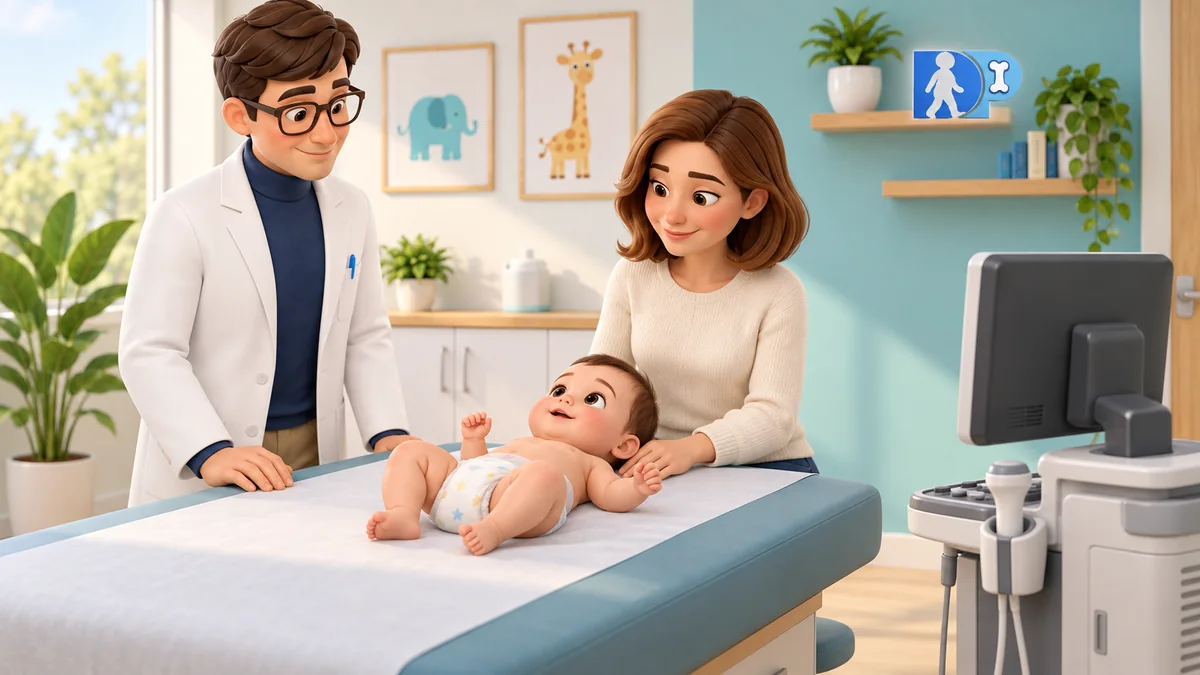
Watch this practical video about the Pavlik harness: how to wear it, how long treatment lasts and what to expect during hip dysplasia treatment.
Press play to watch the video. Use controls to enable audio.
In-Depth Explanation
Developmental dysplasia of the hip (DDH, formerly called "congenital hip dislocation") is an abnormality where the hip joint doesn't develop correctly. It can range from mild instability to complete dislocation of the femoral head.
**Spectrum of the condition:** DDH includes various degrees of severity:
- **Immature hip:** Slightly delayed development, often normalizes spontaneously.
- **Dysplasia:** The acetabulum (the pelvic "cup") is too shallow, the hip is unstable.
- **Subluxation:** The femoral head is partially out of place.
- **Dislocation:** The femoral head is completely out of the acetabulum.
**Risk factors:** Breech presentation, family history (parents or siblings with DDH), female sex (4:1 ratio), firstborn, oligohydramnios. In the presence of risk factors, ultrasound screening is strongly recommended.
**Early diagnosis:** In the first months of life, hip ultrasound is the key exam. It allows visualization of the joint (still predominantly cartilaginous and therefore invisible to X-rays) and classification of dysplasia degree according to Graf classification.
**Treatment:** Early treatment (within 6 months) with the Pavlik harness has a success rate over 90%. Late diagnoses may require casts, braces, or more complex surgical interventions, with less predictable results.
**The importance of screening:** Untreated DDH leads to limping, limb shortening, and early arthritis. Early screening allows avoiding these consequences with simple and effective treatments.
3 Warning Signs to Watch For
- 1Asymmetry of skin folds on thighs or buttocks
- 2Difficulty spreading the newborn's legs during diaper change
- 3One leg appearing shorter than the other when the child is lying down
Why a Specialist Visit Matters
The pediatric orthopaedist interprets hip ultrasound, classifies the dysplasia, and sets up the most appropriate treatment. Regular follow-up is essential to monitor treatment response and ensure correct hip development.
Prefer reading the complete medical information sheet?
Go to Video: Pavlik Harness — How to Use It and Treatment Duration Information SheetNeed a specialist evaluation?
Book an appointment at Istituto Gaetano Pini or CTO Milan.