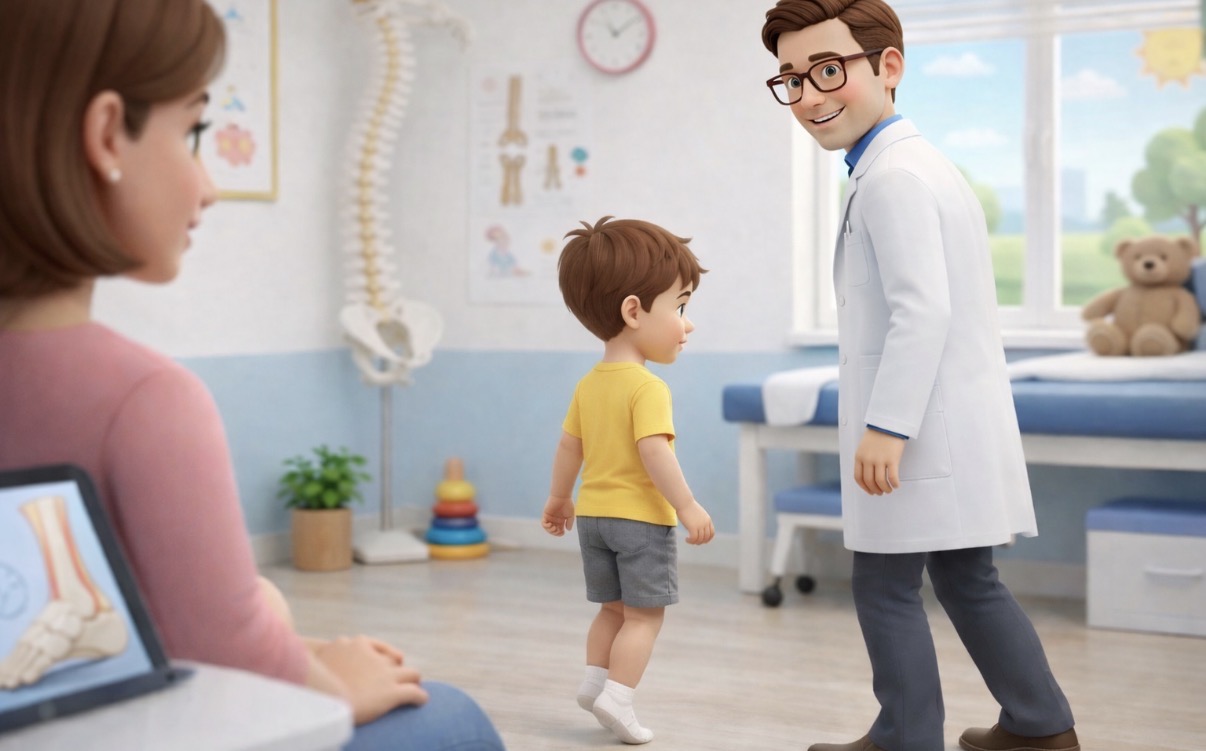
A child who walks on their toes is one of those situations where the way it's approached matters more than the diagnosis itself. This is because the risk of error goes in two opposite directions: on one hand, trivializing everything as a "normal phase," and on the other, turning every instance of tiptoeing into a problem that needs medical intervention. The review by Baldo and colleagues, published in 2025, is useful precisely because it attempts to bring the evaluation back to a simple and practical level, especially for family pediatricians, non-pediatric orthopedic surgeons, and parents. [1]
A child who walks on their toes is one of those situations where the way it's approached matters more than the diagnosis itself. This is because the risk of error goes in two opposite directions: on one hand, trivializing everything as a "normal phase," and on the other, turning every instance of tiptoeing into a problem that needs medical intervention. The review by Baldo and colleagues, published in 2025, is useful precisely because it attempts to bring the evaluation back to a simple and practical level, especially for family pediatricians, non-pediatric orthopedic surgeons, and parents. [1]
A child who walks on their toes is one of those situations where the way it's approached matters more than the diagnosis itself. This is because the risk of error goes in two opposite directions: on one hand, trivializing everything as a "normal phase," and on the other, turning every instance of tiptoeing into a problem that needs medical intervention. The review by Baldo and colleagues, published in 2025, is useful precisely because it attempts to bring the evaluation back to a simple and practical level, especially for family pediatricians, non-pediatric orthopedic surgeons, and parents. [1]
The central message of their work is clear: certain signs should move toe walking out of the category of reassuring variants. In particular, the authors identify three very concrete red flags: persistence of tiptoeing for more than 6 months after the acquisition of independent walking, persistence beyond 2 years of age, or the later onset of toe walking in a child who previously walked normally. [1] This is a simple but very useful summary, as it helps to avoid that gray area where a child is observed for too long without a real re-evaluation, or conversely, referred too early for a battery of unnecessary tests.
So far, however, we primarily have a practical guide to warning signs. The next step, in my opinion, is to integrate this approach with what orthopedic literature says about idiopathic toe walking. And here the picture becomes more interesting.
In 2024, the BSCOS/APCP consensus group published a very comprehensive Delphi study on the management of idiopathic toe walking (ITW) in the Bone & Joint Journal. [2] The value of this work lies not in providing a "definitive cure," but in clarifying some points that are often confused in practice. First of all, idiopathic tiptoeing is a diagnosis of exclusion. Therefore, the examination should not be limited to "watching how they walk," but must include developmental history, any regression, tone, strength, symmetry, ankle range of motion, basic neurological examination, and a search for associated signs. [1][2]
In other words: Baldo's paper tells you when to be suspicious, and the orthopedic consensus reminds you how to structure the evaluation when suspicion arises.
The second important point is that not all persistent toe walking should be treated in the same way. Orthopedic literature clearly distinguishes between:
- a child who walks on their toes but has preserved dorsiflexion and no significant retraction;
- a child with gastrocnemius-soleus/Achilles shortening and joint limitation;
- a child with a variable, intermittent picture, often more "behavioral" or sensory than mechanical. [2][3]
This distinction matters a lot. Because one of the most frequent illusions is to think that there is a single therapeutic scale valid for everyone: stretching, orthotics, physical therapy, serial casting, botulinum toxin, surgery. In reality, the literature does not support such a linear path.
Perhaps the most uncomfortable fact is that the natural history of ITW is not at all simple. Eastwood's old study is still cited because it showed that many children improve, but not all normalize their gait spontaneously, and that casting alone did not seem to significantly alter the natural history, while surgery could improve some outcomes but with indications that needed clarification. [4] It is an outdated work, but it continues to carry weight precisely because high-quality modern data remain surprisingly scarce.
In recent years, something has moved on the conservative front. An RCT published in 2025 compared serial casting, exercises, and a wait-list control in children aged 3-10 with ITW. [3] The result, in summary, is that serial casting more clearly improves dorsiflexion and some parameters of tiptoeing severity compared to observation, while exercises alone seem to have a more modest effect. [3] It is not the definitive trial that closes the debate — the numbers are small — but it is important because it finally brings some prospective evidence to a field dominated by case series and habits.
So, what do we really take home?
For general pediatricians, the most useful point is probably this: not all children who walk on their toes need to be referred immediately, but those with the red flags from Baldo's review do. [1]
For non-pediatric orthopedic surgeons, the message is different: ITW is not a diagnosis made "at a glance"; before labeling it as idiopathic, rigidity, neurological signs, regression, asymmetry, and other secondary causes must be ruled out. [1][2]
For parents, perhaps the most honest statement is this: toe walking does not automatically mean illness, but if the behavior persists too long, worsens, or appears later, it should not be dismissed with a generic reassurance. [1]
In the clinic, a very common case often occurs: a 3-and-a-half-year-old child, who has always been on their toes "more than others," but is lively, without pain, with good overall development. In such a situation, the question is not "to operate or not to operate," nor "to do tests immediately." The right question is: are we dealing with a picture consistent with ITW? Is there retraction? Is it improving or not? Are there signs that move the case out of the physiological range?
This is where Baldo's review and orthopedic literature fit together well: the first helps not to miss pathological cases, the second helps not to treat everyone in the same way.
If I had to summarize the current situation in one sentence, I would say this:
in toe walking, the first treatment is a good clinical evaluation; the second is the correct patient selection; only then comes the therapeutic choice.
And this, ultimately, is also the best way to avoid both unnecessary alarmism and diagnostic delay.
Disclaimer
This content is for informational purposes only and does not replace an individual clinical evaluation.
References
[1] Baldo F, Traunero A, Ballaben A, Zago A, Barbi E. Red Flags in the Evaluation of the Tiptoeing Child. J Paediatr Child Health. 2025;61(4):540-544. doi:10.1111/jpc.16793. PMID: 39923242.
PubMed: https://pubmed.ncbi.nlm.nih.gov/39923242/
[2] Gelfer Y, McNee AE, Harris JD, et al. The management of idiopathic toe walking. Bone Joint J. 2024;106-B(10):1190-1196. doi:10.1302/0301-620X.106B10.BJJ-2024-0466.R1. PMID: 39348908.
PubMed: https://pubmed.ncbi.nlm.nih.gov/39348908/
[3] Giray E, et al. A comparative randomized-controlled trial of serial casting and exercises on ankle range of motion, toe walking severity, walking balance, and functional health-related quality of life in children with idiopathic toe walking. J Pediatr Orthop B. 2025. PMID: 40167594.
PubMed: https://pubmed.ncbi.nlm.nih.gov/40167594/
[4] Eastwood DM, Menelaus MB, Dickens DRV, Broughton NS, Cole WG. Idiopathic toe-walking: does treatment alter the natural history? J Pediatr Orthop B. 2000;9(1):47-49. doi:10.1097/01202412-200001000-00010. PMID: 10647110.