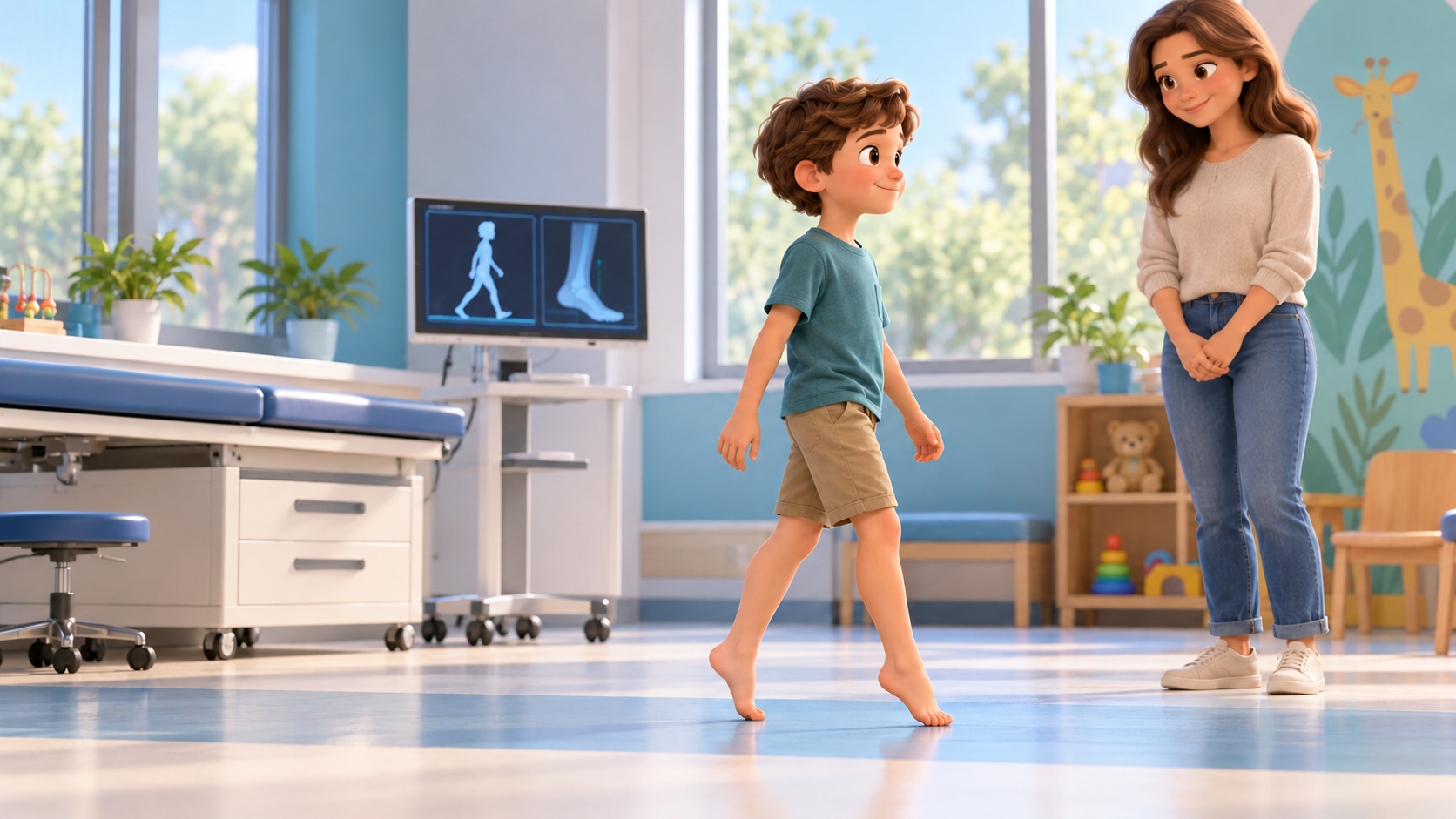
Paediatric Orthopaedic Specialist
Toe walking / idiopathic equinus
Home Exercise Program
Not every exercise listed here is suitable for every child: the selection is individual and is defined during the consultation.
For whom: Idiopathic toe walking assessed by a specialist. Treatment is not automatically needed without symptoms or contracture. Weakness, regression, asymmetry or new onset require reassessment.
Dose and frequency: Perform only the exercises selected during the visit. The listed dosages are examples to adapt: follow the dose, frequency, rest and progression prescribed for age, symptoms and phase. Do not automatically perform the whole list.
Equipment and supervision: A stable, clear surface, comfortable clothing and a secure support. Check resistance-band anchors. Adult supervision; avoid marbles and small objects if the child may put them in their mouth, using a towel instead.
Avoid: Forcing a painful or unauthorised movement; Increasing load, resistance or frequency without the agreed rest periods; Doing balance exercises without stable support or supervision.
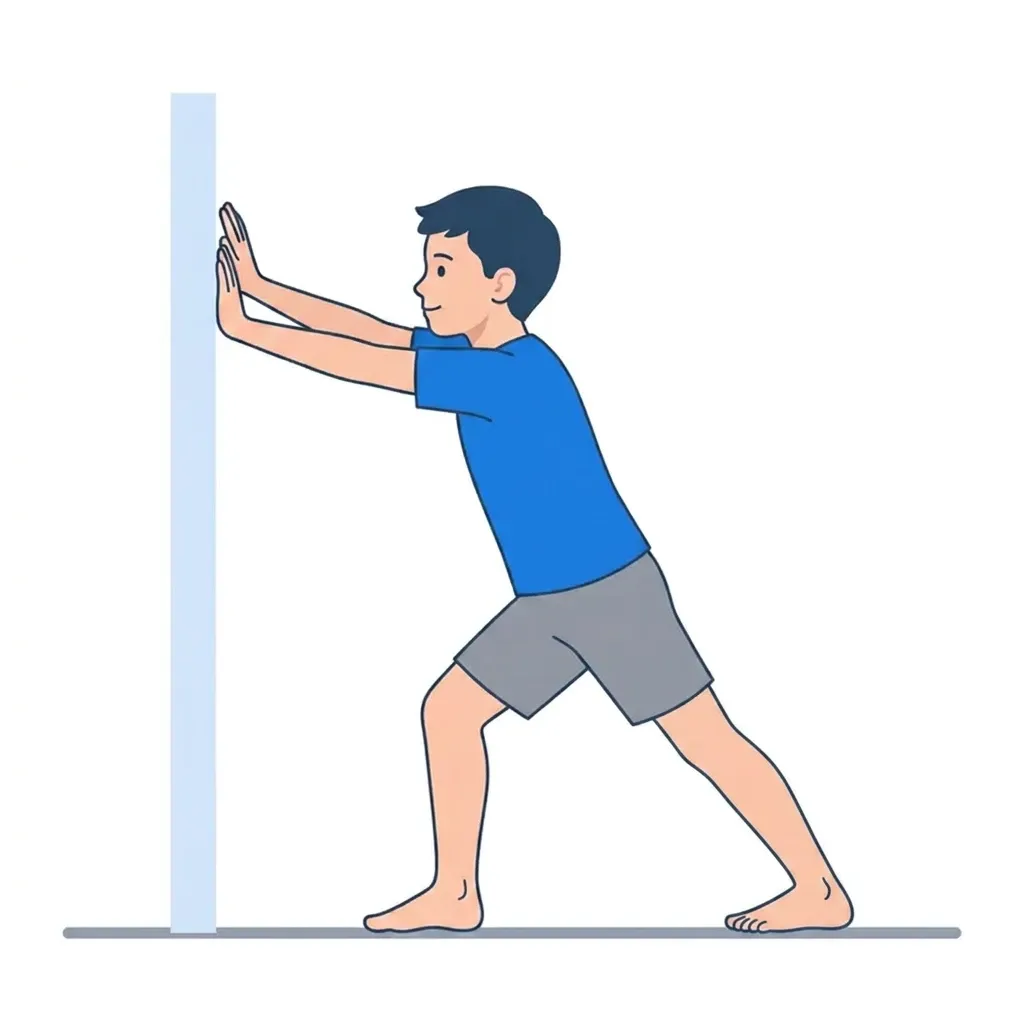
1.Calf stretching
May be part of the programme when tightness is present; it does not by itself guarantee normal gait.
Perform the wall stretch (see "Achilles Tightness" section) paying attention to technique. In toe walking the calf tends to be tight and stretching is usually proposed more regularly than in other conditions. Consistency matters more than intensity.
Indicatively 3 × 30 seconds, once or more per day; frequency to be adapted after clinical assessment and advice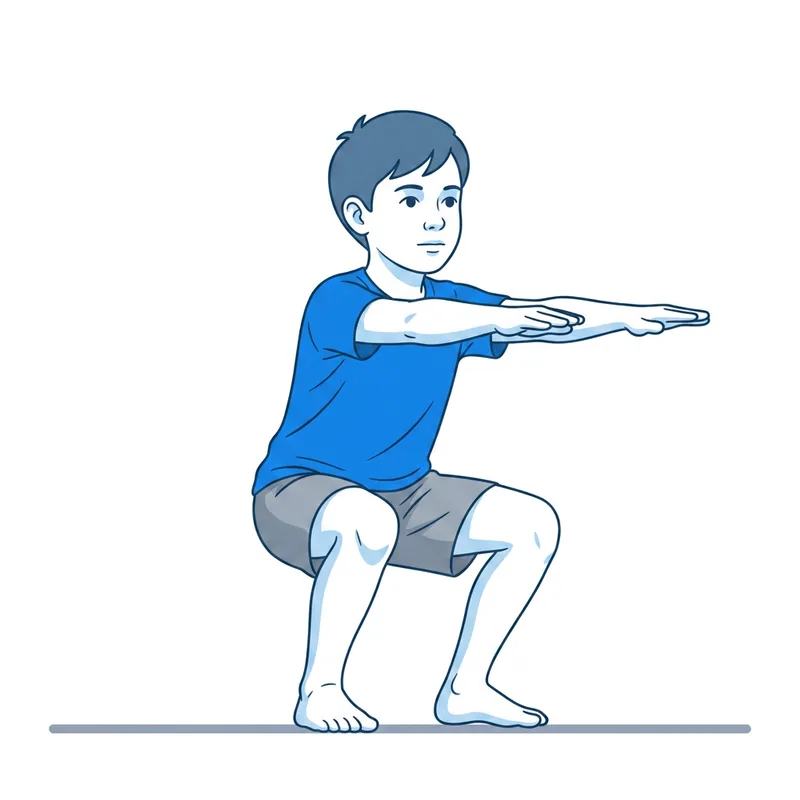
2."Heel down" exercises (squat and walking)
Exercises to encourage a walking pattern with the heel down
Heels-down squat: do 10 slow squats keeping heels always on ground. Hold support if needed. Heel walking: walk only on heels (toes up) for 15-20 meters. This is the opposite of toe walking: in young children, toe walking can resolve spontaneously, and these exercises (together with games that involve heel contact) remain a reasonable option in the meantime. Make it a fun game!
Indicatively 10 squats + 3-4 heel walking laps; frequency to be adapted after clinical assessment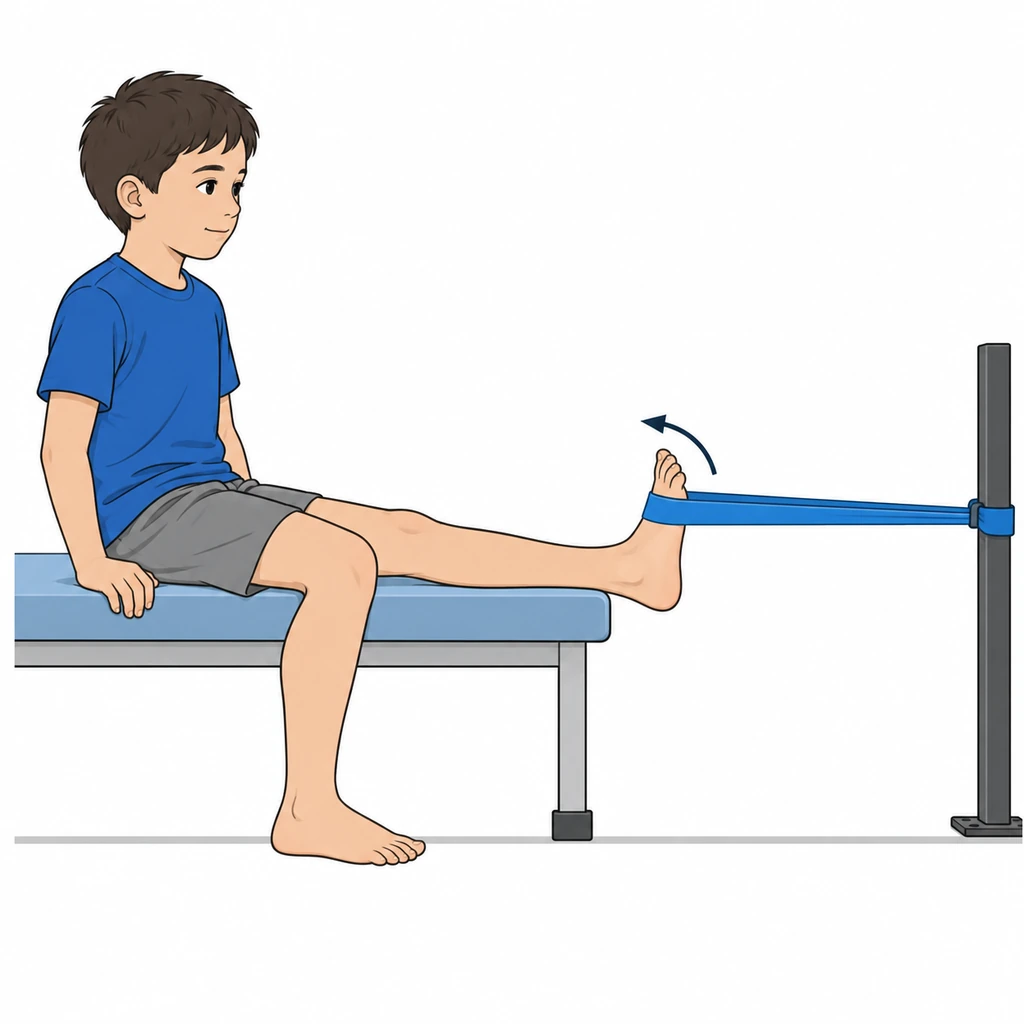
3.Dorsiflexor strengthening (tibialis anterior)
Strengthens muscles that lift the foot, often weak in toe walkers
Seated on chair with band wrapped around top of foot, other end fixed in front (to table leg, or held by parent). Starting with relaxed foot, pull foot toward yourself (dorsiflexion) against band resistance, then slowly return. Movement is only at ankle!
3 × 15 reps per foot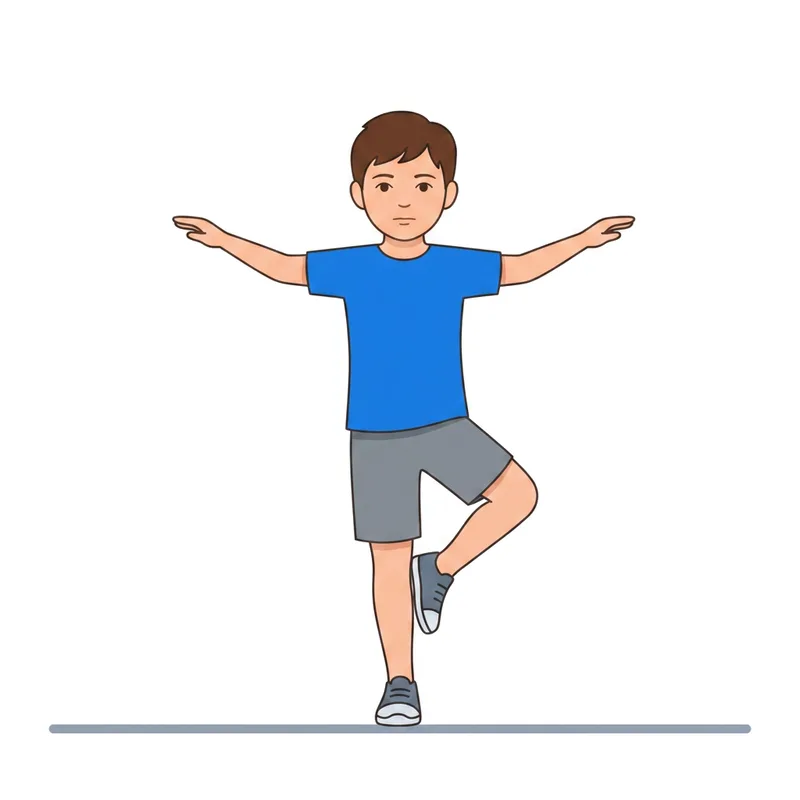
4.Balance and proprioception
Improves body awareness and stability
After clearance for weight bearing, start on firm ground with eyes open, next to a secure support and with adult supervision. Place the other foot down before losing balance. Progress to an unstable surface or eyes-closed work only under direct professional supervision; do not add these challenges independently. Stop for pain or instability.
3 × 30 seconds per leg, progressing when stable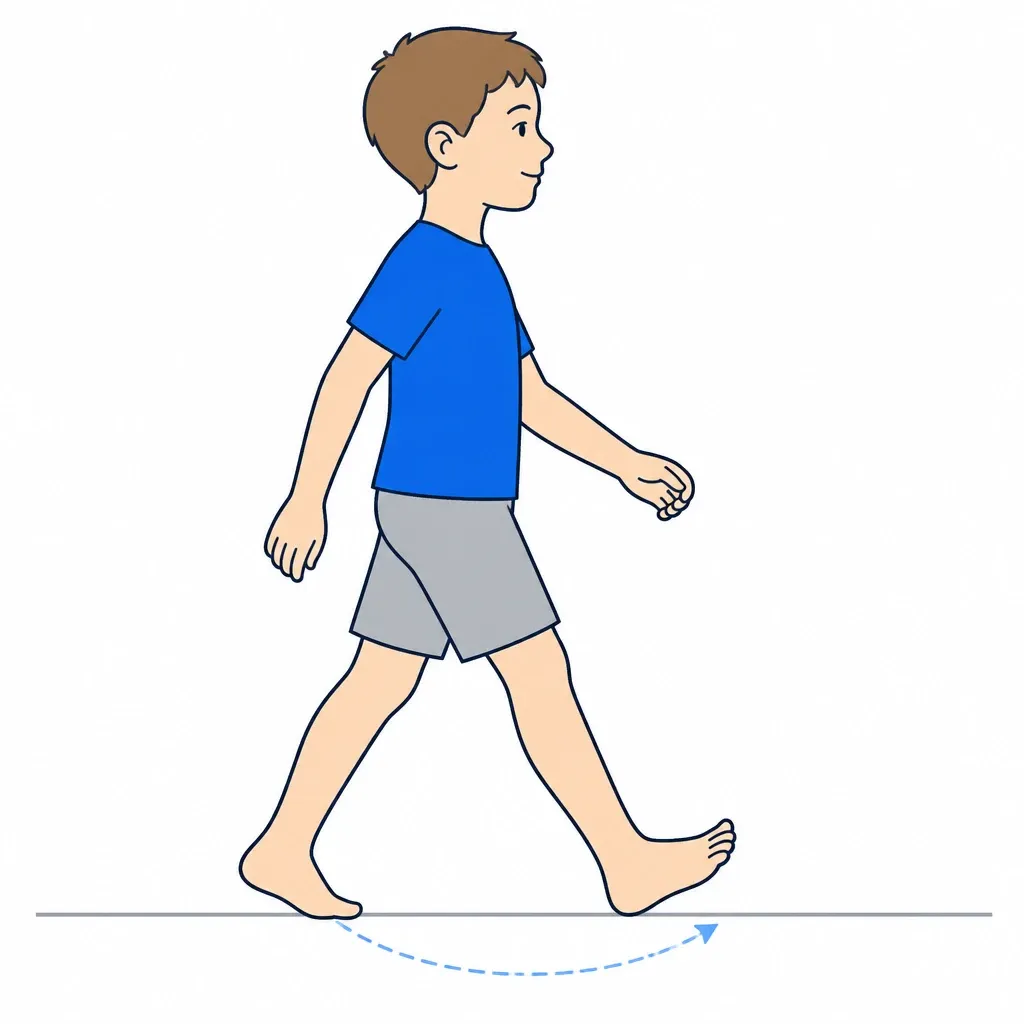
5.Movement hygiene routine
Daily strategies to remember correct walking
Agree a few activities suited to the child and fit them into the day without constant reminders about walking. Use only the selected stretches and games, respecting frequency, rest and tolerance. Do not impose hourly exercises or increase stretching because toe walking continues; review the programme with the treating clinician.
To be integrated into the daily routine, according to the advice given at the consultation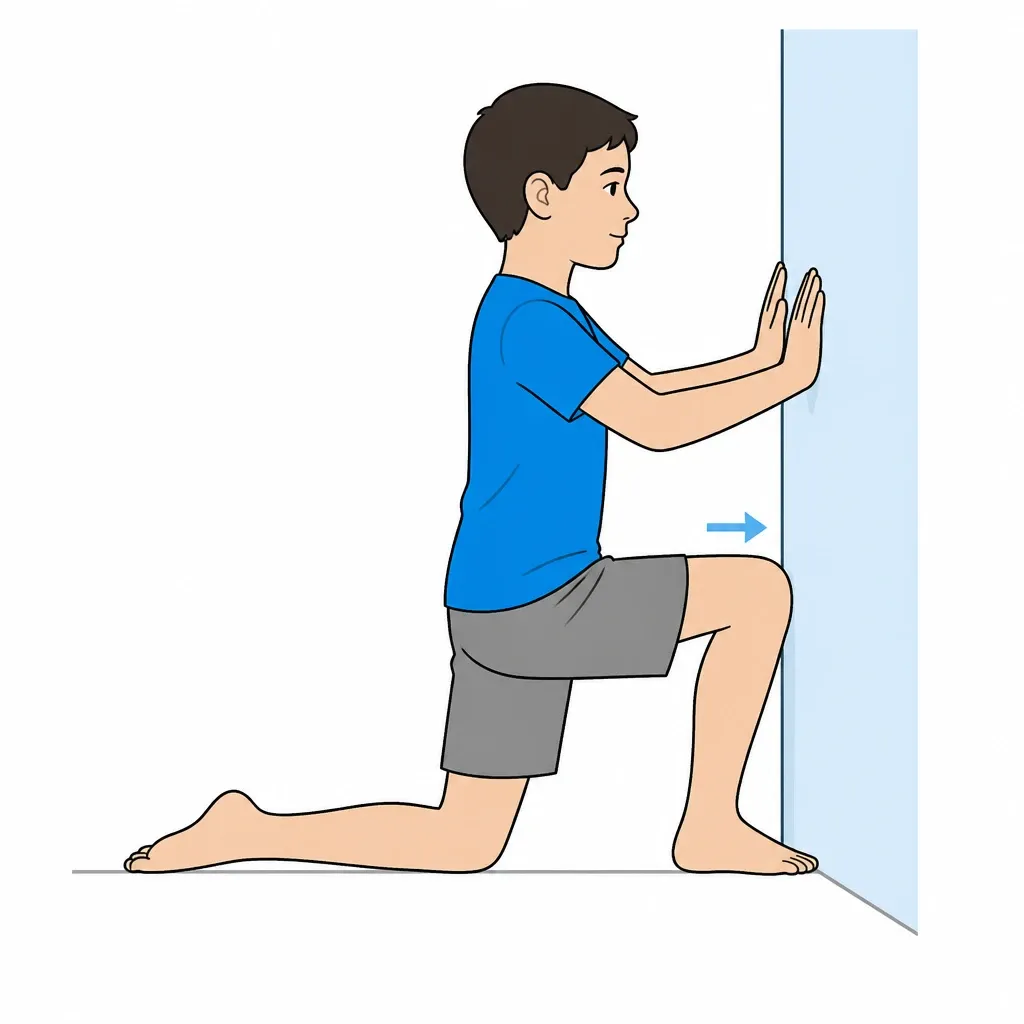
6.Bent-knee dorsiflexion (knee-to-wall)
Targeted soleus stretch, often the real limiter in toe walking
Facing a wall, keep the heel down and slowly bring the knee towards the wall within a comfortable range, without twisting the foot or forcing it parallel. Adjust the starting distance to current mobility. If the physiotherapist uses a measurement, record the GREAT-TOE-to-wall distance with the same technique each time; do not interpret it as a diagnostic test on its own.
Indicatively 3 × 20-30 seconds per leg, to be adapted according to clinical advice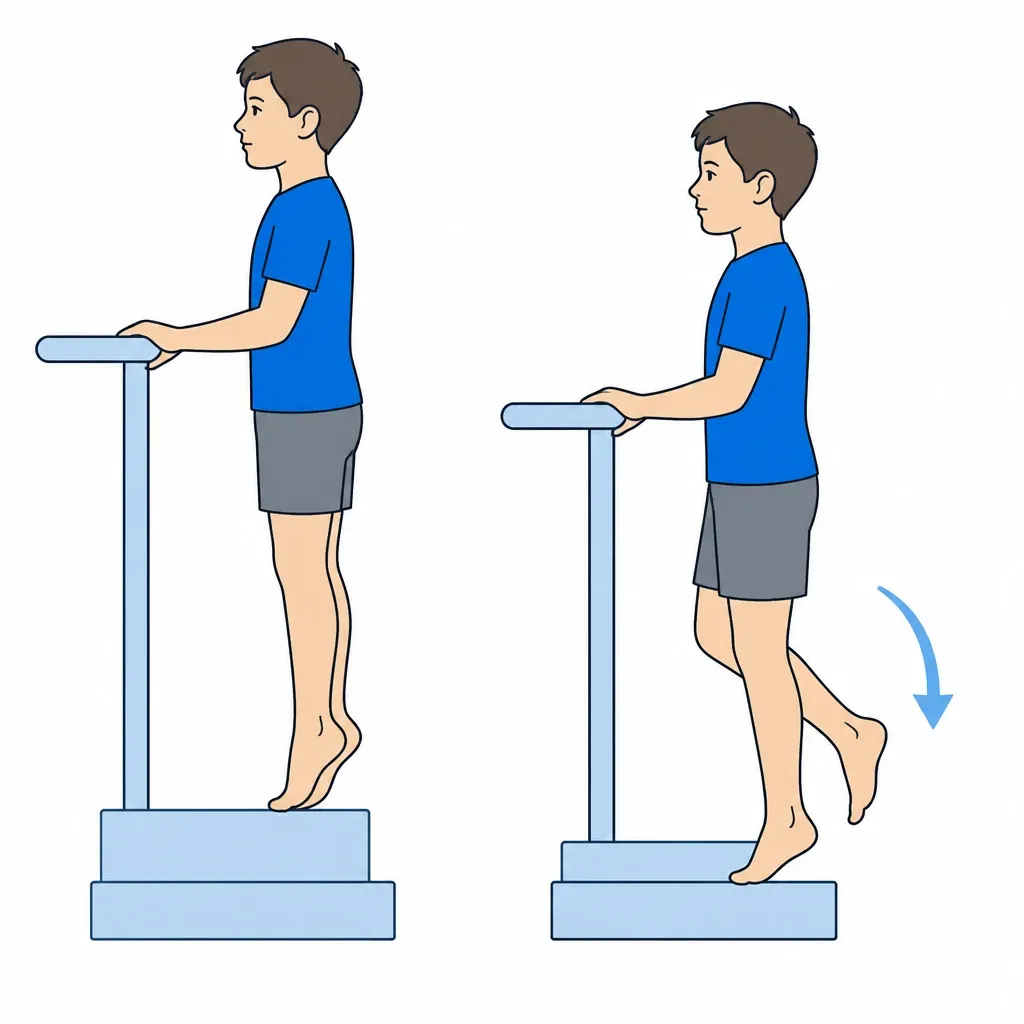
7.Eccentric calf raises on a step
Controlled calf strengthening when indicated and compatible with available mobility
Only when prescribed and demonstrated: hold a secure handrail, rise onto both forefeet and lower slowly within the permitted range. Start on the floor; use a step only if authorised without forcing the heels below the tolerated level. This does not promise permanent lengthening or correct every cause of toe walking.
Indicatively 3 × 12 reps, according to clinical advice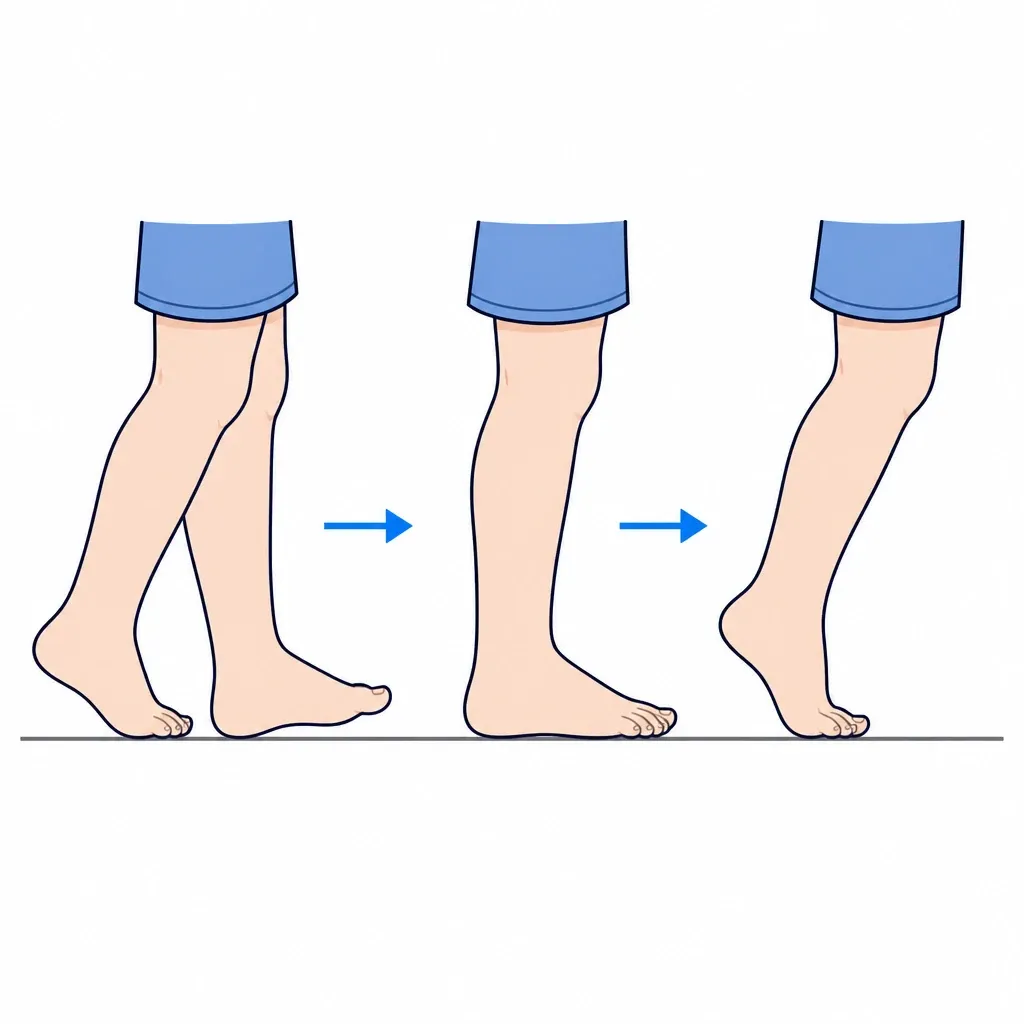
8.Guided heel-to-toe walking
Guided heel-to-sole-to-toe practice when feasible; it does not change bone torsion or guarantee an automatic new gait pattern.
Walk slowly along a line (tape on the floor) marking three beats for each step: 1) heel contact, 2) whole sole contact, 3) push off with the toes. Slowing down helps the child control the movement. Counting aloud "one-two-three" turns it into a game and improves motor learning.
Indicatively 3 laps of 10 metres, according to clinical advice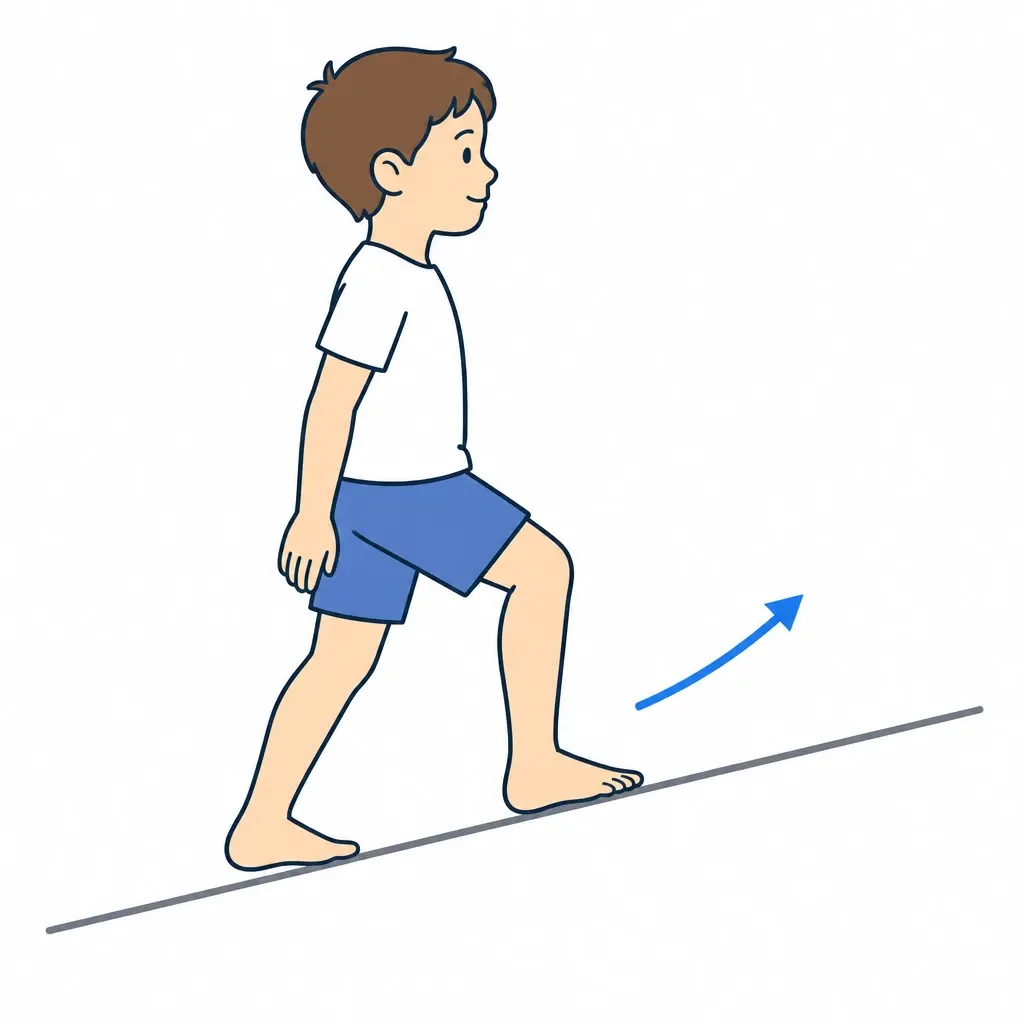
9.Uphill walking
A walking activity adapted to the child’s foot-contact ability
Walk slowly with an adult on a gentle, even, safe incline, aiming for comfortable foot contact. Use only when indicated without pain, fatigue or loss of balance. An incline does not force heel contact: if toe walking or compensations persist, reduce the slope or return to level ground and discuss with the physiotherapist.
Indicatively 5-10 minutes, a few times a week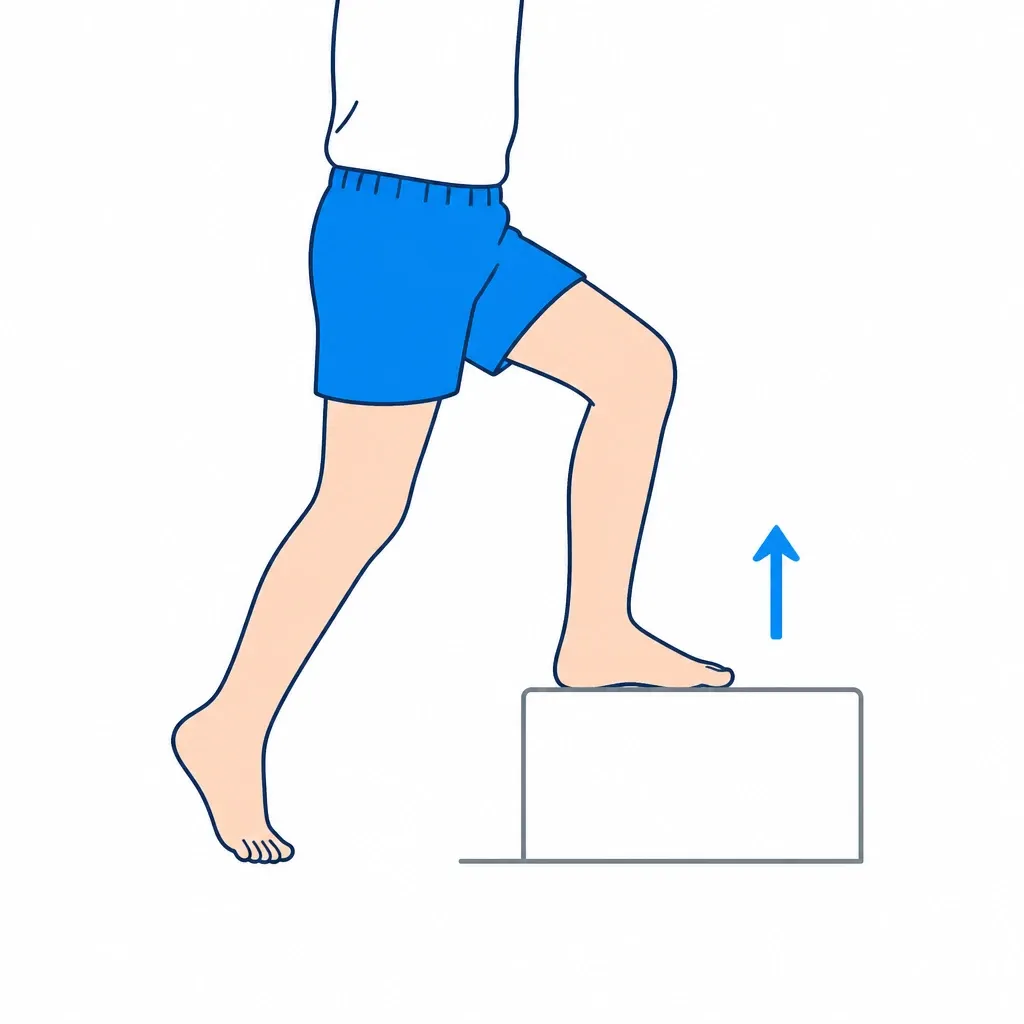
10.Full-foot step-up
Strengthens the extensor chain while keeping the heel down
In front of a low step (15-20 cm). Place the whole foot on the step, heel included, and step up pushing with the top leg without swinging. Step down slowly with control. If the heel lifts, use a lower step. Hold a support at first.
3 × 10 reps per leg
RED FLAGS - When to stop and contact the doctor immediately
Stop the exercises immediately and contact the specialist (or go to the emergency department if severe) if any of the following occur:
- Acute or sudden pain during exercise
- Significant swelling after exercises
- Pain that progressively worsens over days
- Fever or general malaise
- Difficulty walking or using the limb after exercises
- Any neurological symptoms (tingling, numbness, sudden weakness)
- A red or hot joint, or inability to bear weight: seek prompt assessment; use emergency care if severe.
- Acute pain during stretching (tension is normal, pain is not)
- Onset or worsening of joint stiffness
- Child systematically refuses exercises
- Worsening of walking pattern
- Any neurological symptoms
In case of doubt, always prefer a check-up over continuing the exercises.
Dott. Daniele Priano
Paediatric Orthopaedics - ASST Gaetano Pini-CTO
Content version: 21 September 2026
ortopediaevolutiva.com • Printed: 18/10/2026
 Full sheet and videos
https://ortopediaevolutiva.com/en/parents-kids/exercises/foot-ankle/toe-walking
Prepare the visit handout
Use the condition and phase indicated by your clinician. You can leave out individual exercises; instructions, illustrations and safety advice remain together.
Exclude exercises if needed
10 of 10 exercise cards included
The full web page remains available. Your selection is not saved or shared.
Before You Start
Who is this guide for?
Idiopathic toe walking assessed by a specialist. Treatment is not automatically needed without symptoms or contracture. Weakness, regression, asymmetry or new onset require reassessment.
What you need
A stable, clear surface, comfortable clothing and a secure support. Check resistance-band anchors. Adult supervision; avoid marbles and small objects if the child may put them in their mouth, using a towel instead.
Suggested frequency
Perform only the exercises selected during the visit. The listed dosages are examples to adapt: follow the dose, frequency, rest and progression prescribed for age, symptoms and phase. Do not automatically perform the whole list.
Common mistakes to avoid
- •Forcing a painful or unauthorised movement
- •Increasing load, resistance or frequency without the agreed rest periods
- •Doing balance exercises without stable support or supervision
⚠️ Red flags — when to stop and contact the doctor immediately
Stop exercises immediately and contact the specialist if any of the following occur:
- Acute or sudden pain during exercise
- Significant swelling after exercises
- Pain that progressively worsens over days
- Fever or general malaise
- Difficulty walking or using the limb after exercises
- Any neurological symptoms (tingling, numbness, sudden weakness)
- A red or hot joint, or inability to bear weight: seek prompt assessment; use emergency care if severe.
- Acute pain during stretching (tension is normal, pain is not)
- Onset or worsening of joint stiffness
- Child systematically refuses exercises
- Worsening of walking pattern
- Any neurological symptoms
Detailed Exercises
- 1
Calf stretching
May be part of the programme when tightness is present; it does not by itself guarantee normal gait.
Perform the wall stretch (see "Achilles Tightness" section) paying attention to technique. In toe walking the calf tends to be tight and stretching is usually proposed more regularly than in other conditions. Consistency matters more than intensity.
Indicatively 3 × 30 seconds, once or more per day; frequency to be adapted after clinical assessment and advice - 2
"Heel down" exercises (squat and walking)
Exercises to encourage a walking pattern with the heel down
Heels-down squat: do 10 slow squats keeping heels always on ground. Hold support if needed. Heel walking: walk only on heels (toes up) for 15-20 meters. This is the opposite of toe walking: in young children, toe walking can resolve spontaneously, and these exercises (together with games that involve heel contact) remain a reasonable option in the meantime. Make it a fun game!
Indicatively 10 squats + 3-4 heel walking laps; frequency to be adapted after clinical assessment - 3
Dorsiflexor strengthening (tibialis anterior)
Strengthens muscles that lift the foot, often weak in toe walkers
Seated on chair with band wrapped around top of foot, other end fixed in front (to table leg, or held by parent). Starting with relaxed foot, pull foot toward yourself (dorsiflexion) against band resistance, then slowly return. Movement is only at ankle!
3 × 15 reps per foot - 4
Balance and proprioception
Improves body awareness and stability
After clearance for weight bearing, start on firm ground with eyes open, next to a secure support and with adult supervision. Place the other foot down before losing balance. Progress to an unstable surface or eyes-closed work only under direct professional supervision; do not add these challenges independently. Stop for pain or instability.
3 × 30 seconds per leg, progressing when stable - 5
Movement hygiene routine
Daily strategies to remember correct walking
Agree a few activities suited to the child and fit them into the day without constant reminders about walking. Use only the selected stretches and games, respecting frequency, rest and tolerance. Do not impose hourly exercises or increase stretching because toe walking continues; review the programme with the treating clinician.
To be integrated into the daily routine, according to the advice given at the consultation - 6
Bent-knee dorsiflexion (knee-to-wall)
Targeted soleus stretch, often the real limiter in toe walking
Facing a wall, keep the heel down and slowly bring the knee towards the wall within a comfortable range, without twisting the foot or forcing it parallel. Adjust the starting distance to current mobility. If the physiotherapist uses a measurement, record the GREAT-TOE-to-wall distance with the same technique each time; do not interpret it as a diagnostic test on its own.
Indicatively 3 × 20-30 seconds per leg, to be adapted according to clinical advice - 7
Eccentric calf raises on a step
Controlled calf strengthening when indicated and compatible with available mobility
Only when prescribed and demonstrated: hold a secure handrail, rise onto both forefeet and lower slowly within the permitted range. Start on the floor; use a step only if authorised without forcing the heels below the tolerated level. This does not promise permanent lengthening or correct every cause of toe walking.
Indicatively 3 × 12 reps, according to clinical advice - 8
Guided heel-to-toe walking
Guided heel-to-sole-to-toe practice when feasible; it does not change bone torsion or guarantee an automatic new gait pattern.
Walk slowly along a line (tape on the floor) marking three beats for each step: 1) heel contact, 2) whole sole contact, 3) push off with the toes. Slowing down helps the child control the movement. Counting aloud "one-two-three" turns it into a game and improves motor learning.
Indicatively 3 laps of 10 metres, according to clinical advice - 9
Uphill walking
A walking activity adapted to the child’s foot-contact ability
Walk slowly with an adult on a gentle, even, safe incline, aiming for comfortable foot contact. Use only when indicated without pain, fatigue or loss of balance. An incline does not force heel contact: if toe walking or compensations persist, reduce the slope or return to level ground and discuss with the physiotherapist.
Indicatively 5-10 minutes, a few times a week - 10
Full-foot step-up
Strengthens the extensor chain while keeping the heel down
In front of a low step (15-20 cm). Place the whole foot on the step, heel included, and step up pushing with the top leg without swinging. Step down slowly with control. If the heel lifts, use a lower step. Hold a support at first.
3 × 10 reps per legFull-foot step-up — OrtopediaEvolutiva exercises
Illustrated video with a synthetic voice and English text in the film. Press Play to load YouTube. Follow the instructions and precautions on this exercise sheet. Open on YouTube
Frequently Asked Questions
Is toe walking normal in young children?
Occasional toe walking can occur during early walking. Persistent toe walking after age 2, onset after a period of heel-to-toe walking, asymmetry, pain, stiffness, weakness or motor difficulties warrants assessment. Idiopathic toe walking is diagnosed after other causes have been excluded. An asymptomatic child without contracture does not automatically need treatment.
Are orthopaedic shoes needed for toe walking?
There is no rigid shoe that should be prescribed to every child to prevent toe walking. Treatment, when needed, addresses symptoms, contracture and agreed goals: it may include guided exercises, stretching when indicated or selected orthoses. Shoes and orthoses are not interchangeable; selection and use follow assessment.
When is serial casting needed for toe walking?
Serial casting may be offered in selected cases to recover movement when contracture prevents a plantigrade position. The decision considers examination, symptoms, goals and response to previous care; it is not triggered automatically after 3-6 months of exercises. Improved dorsiflexion alone does not guarantee lasting normalisation of gait.