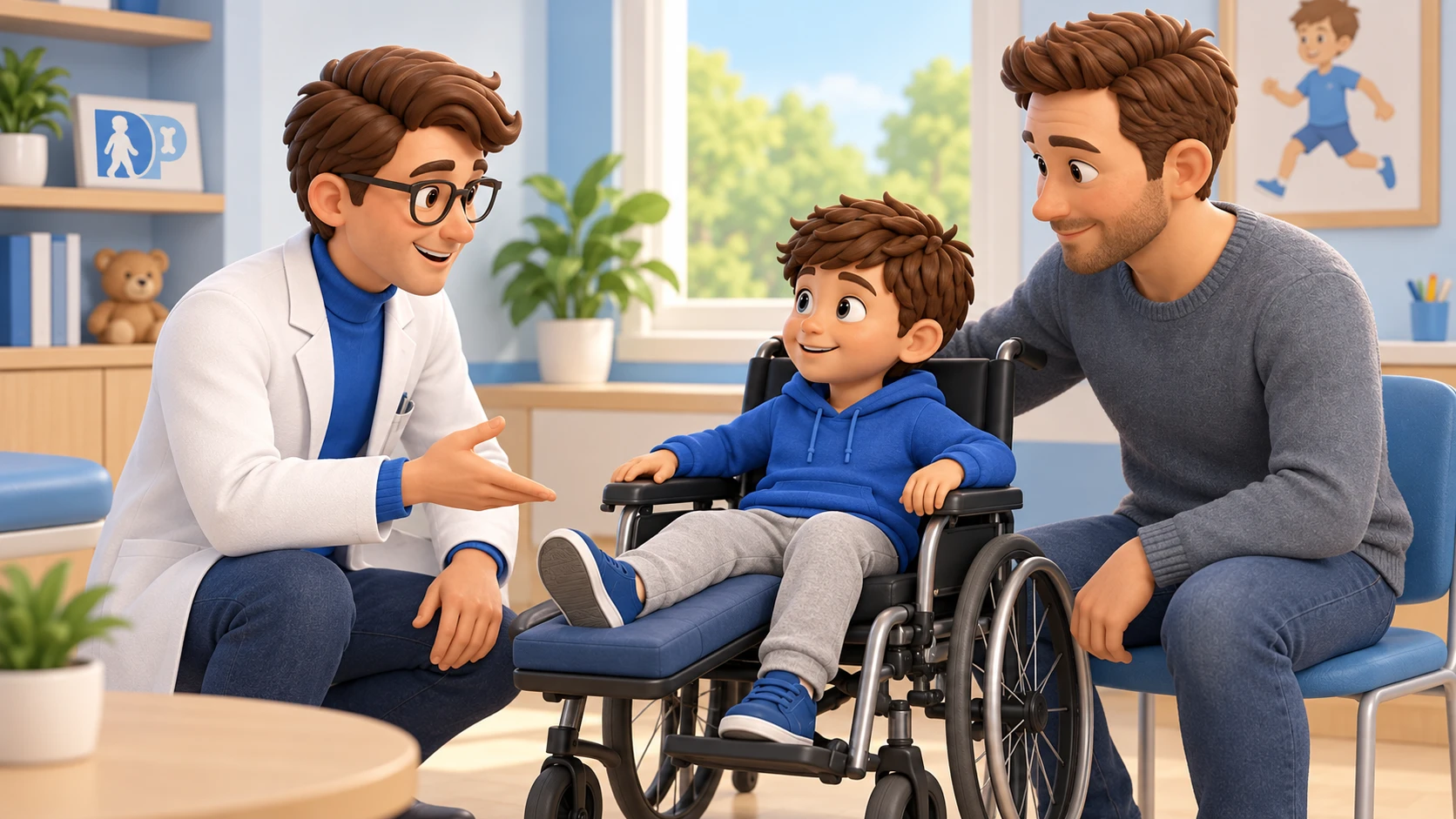
The period between 4 and 6 years of age has become a grey area in the management of femoral shaft fractures. A hip spica cast remains an effective option, particularly in younger children. As children approach 6, however, fixation with elastic nails is used increasingly often.
A multicentre study published in 2026 analysed 2,486 children aged 4, 5 and 6 years treated between 2013 and 2024. Overall, 47.3% underwent surgery. The increase in surgical treatment mainly involved children aged 5 and 6; casting remained clearly predominant at age 4. [1]
The study describes a change in practice, but does not demonstrate that titanium elastic nailing (TEN) is superior to casting.
Why this age range is different
At age 4, many children still cope well with non-operative treatment. As age and weight increase, weeks of cast immobilisation become more demanding: transfers, personal hygiene, sleep, car journeys and returning to school all need to be managed.
Fracture pattern and stability remain central to the decision. Alongside these factors, the practical demands of the following weeks may also play a part.
The authors of the 2026 study suggest both increasing familiarity with minimally invasive techniques and family-centred considerations as possible reasons for the rise in surgery. [1]
The burden of a cast does not show on a radiograph
A French study published in 2026 assessed this burden in 114 children under 6 treated with a hip spica cast. Parents rated the difficulty of managing the cast at an average of 7 out of 10; in 47% of families, one or both parents had needed time off work. [2]
This population was younger than the 4–6-year-olds in the American study, with a mean age of 2.7 years. These figures therefore cannot be used as a direct comparison between casting and TEN in older children. They do, however, show that the demands of caring for a child in a cast are substantial.
For a heavier, more independent child approaching age 6, being able to sit and move around earlier may make a considerable difference after the injury.
When I am more likely to consider TEN
In my practice, my threshold for fixation is lower as a child approaches 5–6 years, particularly if the fracture is unstable, the child is heavier or a prolonged period of immobilisation would be especially difficult to manage.
I do not see this as purely a matter of convenience. Internal stabilisation may allow earlier mobilisation, make transfers easier and reduce the time during which the hip and knee remain immobilised.
At age 4, with a stable fracture and a lighter child, casting may still be the simplest and most proportionate choice.
What we know about outcomes
Evidence specifically concerning children aged 4–6 remains limited.
A 2023 study compared 34 children aged 3–6 treated with TEN or a single-leg spica cast. Final malalignment was present in 33.3% of the cast group and was not observed in the TEN group. The sample was small and the groups were not perfectly comparable, so this finding needs cautious interpretation. [3]
The literature is broader for school-aged children. Flynn and colleagues reported shorter times to walking, returning to school and hospital discharge with elastic nails than with traction and a spica cast. [4] A randomised trial in children aged 6–12 reported faster recovery and greater parental satisfaction with TEN. [5]
These findings cannot automatically be applied to a 4-year-old. They do help explain why the functional advantages of internal stabilisation may carry more weight as a child approaches age 6.
The costs of surgery
TEN avoids some of the problems associated with casting, but introduces others: anaesthesia, surgical wounds, nail irritation or migration, infection, follow-up requirements and, often, a second operation to remove the implants.
The increase in surgery should therefore not become a new automatic rule. In this age group, selecting the appropriate treatment for the individual child matters more than a preference for one technique.
What is still missing
Administrative data describe how often surgery is performed much better than why it is chosen. Detailed information on weight, fracture pattern, quality of reduction, time to independent mobility and the actual impact on the family is missing.
Prospective studies specifically involving children aged 4–6 are needed. These should assess fracture union and alignment, but also return to school, independence, pain, parental days off work, family satisfaction and complications related to implant removal.
For now, the most useful finding is the change in practice itself: at ages 5–6, the decision is no longer automatically “a cast because the child is young”. Casting remains entirely appropriate for some children. For others, TEN fixation may make the overall course of treatment more manageable, while keeping fracture stability and surgical risks in view.
References
[1] Abbas Y, Kotzur T, Munshi MA, et al. Operative Treatment Versus Spica Casting for Treatment of Pediatric Femoral Shaft Fractures in Children Aged 4 to 6 Years: A Large Multi-Institutional Age-Stratified Comparative Analysis. J Pediatr Orthop. 2026;46(7):e626-e631. doi:10.1097/BPO.0000000000003362.
[2] de Charnace E, Bunetel IL, Haas M, et al. Socio-professional impact of the hip spica cast for femoral shaft fracture management in children under six. Orthop Traumatol Surg Res. 2026;112(1):104556. doi:10.1016/j.otsr.2025.104556.
[3] Eken G, Ermutlu C, Sarisozen B, et al. Less malunion and shorter bone union time with titanium elastic nail treatment for isolated femoral shaft fractures in three- to six-year-old children. Eur J Orthop Surg Traumatol. 2023;33(4):893-898. doi:10.1007/s00590-022-03223-0.
[4] Flynn JM, Luedtke LM, Ganley TJ, et al. Comparison of titanium elastic nails with traction and a spica cast to treat femoral fractures in children. J Bone Joint Surg Am. 2004;86(4):770-777. doi:10.2106/00004623-200404000-00015.
[5] Shemshaki HR, Mousavi H, Salehi G, Eshaghi MA. Titanium elastic nailing versus hip spica cast in treatment of femoral-shaft fractures in children. J Orthop Traumatol. 2011;12(1):45-48. doi:10.1007/s10195-011-0128-0. PMID:21340544.
Disclaimer: This article provides general information and does not replace an individual medical assessment.