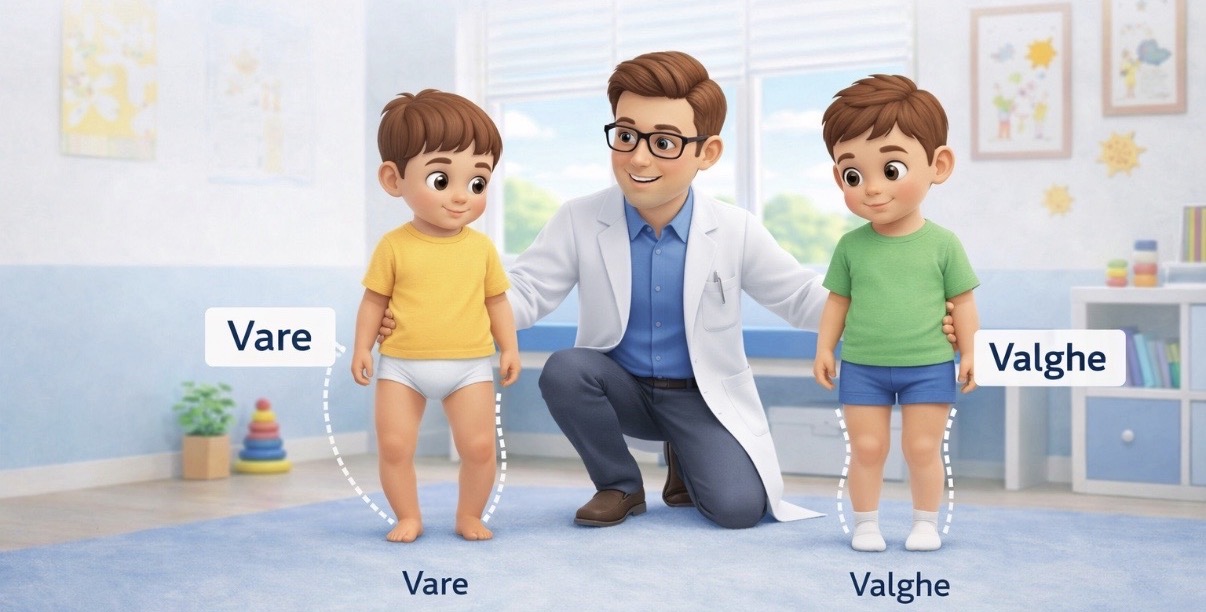
"Bowlegs" or "knock-knees" are one of the most frequent reasons parents seek an orthopedic evaluation in the early years of life. And, in fact, I understand why. You watch the child standing still, then walking, then compare photos from a few months earlier. Sometimes it seems to be getting worse. Other times, a grandparent notices it first. The question, almost always, is the same: Is it normal or not?
The most honest answer is this: often yes, it is normal, but not always. And the difference is not made by a single photograph, nor an isolated visual impression. It's made by age, symmetry, progression over time, and the clinical context [1,2].
Orthopedic literature is quite consistent on one basic point: the alignment of the lower limbs in children is not static, but changes with growth [1–3]. In the first months and first steps, it is common to observe a more varus phase; subsequently, the axis moves towards neutral and then towards a physiological valgus, which tends to be more evident in preschool age, and then gradually reduces towards values closer to those of an adult [1–3].
This means that an 18-month-old child with a certain varus and a 3-4-year-old child with a certain valgus can be perfectly within normal development.
This is precisely the first useful message for parents: not all "crooked" legs in young children are pathological. Indeed, many do not require any treatment. The review by Coppa and colleagues, which remains one of the clearest summaries on the evaluation and treatment of coronal knee deformities in skeletally immature individuals, reiterates that physiological conditions primarily require clinical observation and reassurance [1]. Studies like Patel et al. also confirm that physiological genu valgum generally begins around 2 years of age, is most marked at 3-4 years, and then tends to decrease by 7 years [2].
The delicate point, however, is understanding when we are no longer in the realm of a simple growth variant.
In the clinic, a typical case often occurs: a 2.5-year-old child, lively, without pain, runs and falls like peers, but with legs that seem very bowed to the parents. In many of these cases, the visit is reassuring, especially if the condition is bilateral, symmetrical, and consistent with age. Different is the 3-year-old child with marked varus, especially on one side, perhaps worsening, or the 5-year-old child with significant valgus, limping, or functional difficulties. Here the discussion changes [1,4].
The literature quite clearly indicates some red flags:
- Asymmetrical deformity;
- Progressive worsening instead of a spontaneously favorable evolution;
- Pain, limping, or functional limitation;
- Short stature or disharmonious growth;
- Clinical signs compatible with metabolic disease or dysplasia;
- Persistence of marked varus or valgus beyond the age window where we would expect physiology [1,2,4].
In genu varum in young children, the big issue not to miss is the boundary between physiology and Blount's disease. Here, not only the clinical appearance but also the course and, when necessary, radiography come into play. Coppa's review reminds us that in doubtful cases, weight-bearing radiography of the lower limb is the tool that allows us to move out of the gray area [1]. And a multicenter study from 2025 added an interesting element: in toddlers with persistent or worsening genu varum, a proportion may present a condition associated with vitamin D deficiency, and low-dose supplementation has been associated with more marked radiographic improvement compared to simple follow-up [4].
This work does not authorize shortcuts like "all children with bowed legs must take vitamin D," but it reminds us of something useful: if the varus does not behave as we would expect from a physiological condition, metabolic evaluation makes sense [4].
Another point that causes much confusion concerns treatment. Corrective shoes, orthotics, braces, various expedients: in daily practice, they continue to appear more than the literature justifies. And here the message must be stated clearly. In physiological conditions, there is no evidence that orthotics, special shoes, or braces change the natural history of the axis [1,3]. In other words: if the child is going through a normal phase of development, there is no device that will "straighten it sooner."
What is really needed is a well-conducted examination and, when appropriate, follow-up over time.
For family pediatricians and non-pediatric orthopedists, in my opinion, the most useful concept is this: the shape of the legs alone matters less than the whole picture. One should not be guided only by how "impressive" the knee looks to the eye, but by age, symmetry, evolutionary trajectory, and general growth data [1,2].
For parents, however, the most useful phrase is probably another: many varus or valgus knees between 0 and 6 years do not need to be treated, but some need to be well understood.
If I had to summarize the topic in a single sentence, I would say this: in the first years of life, legs change shape as part of growth; the task of the orthopedic examination is not to straighten physiology, but to recognize early what is not physiological.
Disclaimer
This content is for informational purposes only and does not replace an individual clinical evaluation.
References
[1] Coppa V, Marinelli M, Procaccini R, Falcioni D, Farinelli L, Gigante A. Coronal plane deformity around the knee in the skeletally immature population: A review of principles of evaluation and treatment. World J Orthop. 2022;13(5):427-443. doi:10.5312/wjo.v13.i5.427. PMID: 35633744.
PubMed: https://pubmed.ncbi.nlm.nih.gov/35633744/
[2] Patel M, Nelson R. Genu Valgum. StatPearls [Internet]. Updated 2025 Jan. PMID: 32644670.
PubMed: https://pubmed.ncbi.nlm.nih.gov/32644670/
[3] Weiner DS. The natural history of “bow legs” and “knock knees” in childhood. Orthopedics. 1981;4(2):156-160. doi:10.3928/0147-7447-19810201-08. PMID: 24823174.
PubMed: https://pubmed.ncbi.nlm.nih.gov/24823174/
[4] Sakamoto Y, Kamegaya M, Saisu T, Tomaru Y, Tokita A, Kim SG, Ishijima M. Vitamin D supplementation improves genu varum in toddlers: two-center pilot study. J Bone Miner Metab. 2025;43(3):265-273. doi:10.1007/s00774-025-01583-1. PMID: 39918569.