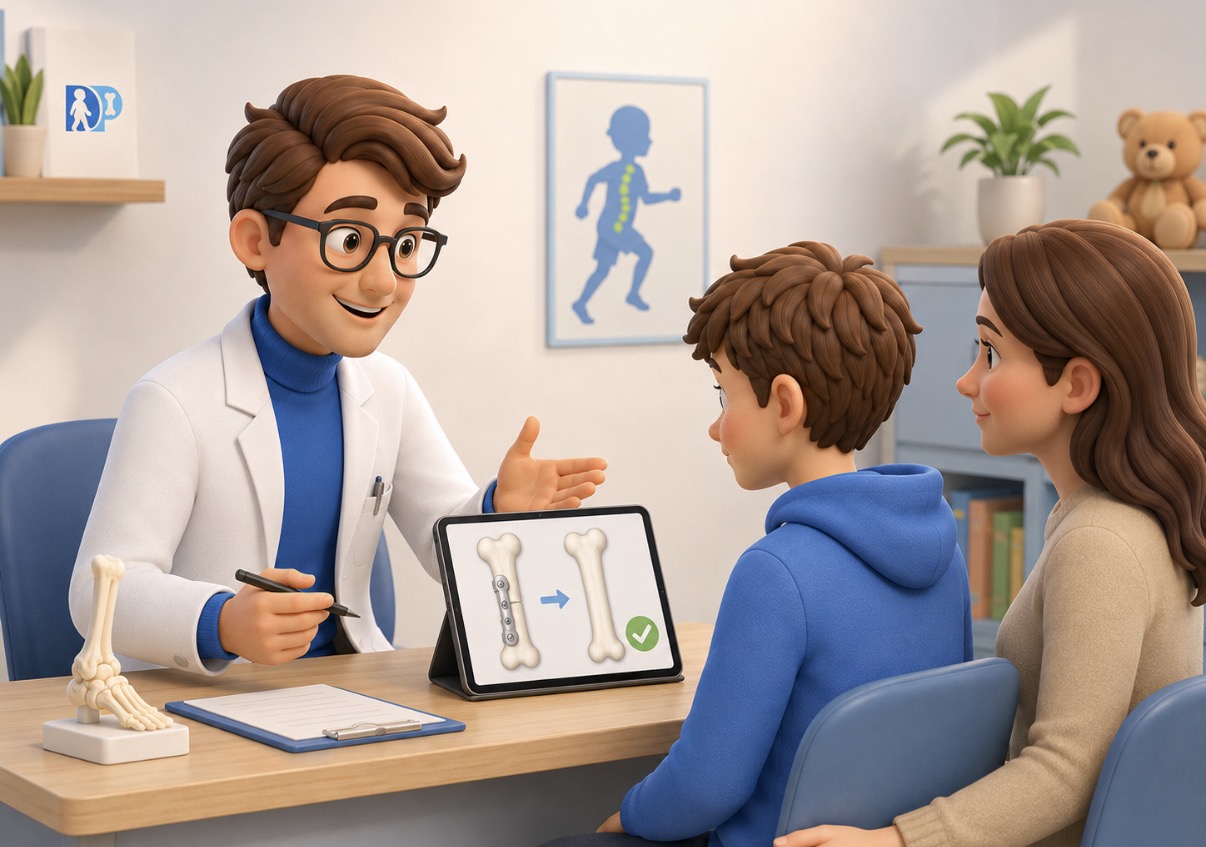
When a fracture has healed and the child has returned to their activities, a second question often arises: "Should the hardware be removed?"
The answer is not the same for all implants. For TENs (Titanium Elastic Nails), after complete consolidation, removal is often scheduled between 6 and 12 months. For plates, rigid nails, and other fixation devices, the decision is more individual and depends on the location, age, symptoms, and type of implant.
A recent survey among members of the Pediatric Orthopaedic Society of North America shows how common hardware removal is in pediatric orthopedics and how varied the decision-making process still is [1].
Should TENs always be removed in children?
In pediatric practice, they are very often removed, but there is no evidence that mandates their removal in every child. In the POSNA survey, forearm TENs were routinely removed by 90.8% of surgeons, femoral TENs by 87.3%, and tibial TENs by 86.3% [1].
The most frequent reason was, essentially, "because it is my usual practice." Symptomatic hardware was another important reason, while scientific evidence was indicated much less often as the main motive [1].
Removal has been part of pediatric practice for decades, especially with elastic nails, but TENs and plates pose different problems.
When can TENs be removed?
The first requirement is complete consolidation. In general, a window between 6 and 12 months is reasonable for many pediatric TENs, with different timings depending on the bone and fracture type.
In the POSNA survey, upper limb implants were most often removed between 7 and 9 months, and lower limb implants between 10 and 12 months [1]. In the femur, a large American series reported the removal of flexible nails on average after approximately 287 days, just over 9 months [6]. Another study from 2026 on the removal of femoral fixation devices reported an average of 9.4 months for elastic nails [7].
In the forearm, it's important not to rush. Makki and colleagues observed a higher risk of refracture when elastic nails were removed before 6 months; for plates, the risk increased especially when removal occurred within the first year [4].
If consolidation is not solid at six months, one waits. With complete healing, the 6–12 month window is reasonable for many TENs, adjusting it based on location and fracture.
Why in my practice I tend to remove them
For TENs used in the treatment of a pediatric fracture, after complete consolidation, I usually tend to schedule removal between 6 and 12 months.
The main reason is not to think that removing the material prevents a new fracture. We do not have data demonstrating that routine removal reduces the overall risk of refracture.
My reasoning is primarily clinical. If that child were to suffer a new trauma to the same segment in the future, I prefer to deal with a new fracture without pre-existing hardware that could complicate reduction, the choice of a new implant, or surgical access. This is a practical advantage, not an epidemiological demonstration of risk reduction.
In addition, there are two other practical reasons that, for TENs, I consider important.
The first is precisely related to the fact that they are intramedullary. If left in too long, the end we use to grasp and remove them can become progressively less accessible. Bone growth and apposition can cover the segment near the entry cortex, eventually completely embedding the nail end in the bone. Rather than true "osseointegration," I would speak of overgrowth and bone embedment: the practical result is that a TEN that would initially be simple to extract may require wider exposure, drilling, or opening of the cortex to be retrieved. In extreme cases, removal can become incomplete or technically much more challenging. In the 2026 series on removals after femoral fracture, bone overgrowth was documented even on the nails; in the large series from the Children's Hospital of Philadelphia, leaving hardware in for more than 18 months was associated with approximately three times higher probability of incomplete removal or breakage compared to the 9–18 month window [7,8]. Specific techniques have also been described for extracting elastic nails when the end is no longer prominent, precisely because in these situations removal may require additional instruments and access [9].
The second concerns a potential future bone infection. It is not correct to say that removing a healthy TEN serves to prevent osteomyelitis: we have no data demonstrating this benefit. However, if an infection were to appear on the same segment while the hardware is still present, management would become more complex because we would also have an infection associated with an implant. In a pediatric series of Staphylococcus aureus implant-associated infections, all children required surgical washout/debridement and antibiotic therapy; in many cases, the material was removed immediately or subsequently [10]. After the fracture has solidly consolidated, having a bone without a temporary implant therefore also makes it easier to manage a future infection, should one occur. This, however, is also a practical management argument and not a demonstration that routine removal reduces the incidence of infections.
Does leaving the material increase the risk of new fractures?
Peri-implant fractures exist, but they are rare, and this is not enough to prove that all implants should be removed.
A review of 7,584 pediatric implants identified 25 implant-related fractures, representing 0.33% overall. The femur was the most involved site, and the risk was higher in children with neuromuscular conditions or pre-existing bone alterations [2].
In a series of forearm plates left in situ, 7.3% of children experienced an implant-related fracture during follow-up [3]. These numbers explain why a new fracture around a plate or nail can be more complex to manage, but they do not prove that prophylactic removal is always the best choice.
TENs and plates should be considered separately.
Is removing a plate the same as removing a TEN?
No. For plates, especially diaphyseal forearm plates, routine removal is much more debatable.
A 2025 meta-analysis of 23 studies in adults found a higher risk of refracture after plate removal than after plate retention. The authors advise against routine removal of an asymptomatic forearm plate [5]. Studies in children were excluded, so this finding is not direct evidence for deciding whether to remove a plate in a child.
This data significantly changes how I interpret the problem. A femoral or forearm TEN, designed from the outset as a temporary device, is not equivalent to a well-tolerated plate that would require a new, more extensive surgical approach for removal.
Removal itself creates a more vulnerable area for a certain period. Screw holes remain weak points, and the bone must progressively regain its strength. For this reason, premature removal can create the very problem one wishes to avoid.
How frequent is refracture after removal?
In the pediatric femur, it appears to be infrequent, especially after TENs. In one study of over 2,800 femoral fractures, refracture after hardware removal was 0.8% after flexible nails and 2.2% after plating [6].
The 2026 study on implant removal after diaphyseal femur fracture also confirms that the procedure is generally safe. Elastic nails were removed on average after 9.4 months, and refractures were rare; plates and rigid nails, however, required more demanding interventions [7].
A large series from the Children's Hospital of Philadelphia, involving 2,585 pediatric removals, reported an overall complication rate of 9.5%, mostly minor. However, waiting beyond 18 months increased the probability of incomplete removal or material breakage compared to the 9–18 month window [8].
This is another reason why, when I have already decided that a TEN will be removed, I prefer to schedule it within a reasonable window instead of leaving it for years without a real reason.
How I decide the timing
For TENs, my usual approach is simple: confirmed consolidation and removal, in most cases, between 6 and 12 months. In the forearm, I avoid rushing; in the femur, we are often closer to 9–12 months.
For a plate, the reasoning changes. If it is asymptomatic and does not interfere with growth or function, removal is not automatic. If, however, it is prominent, bothersome, creates specific problems, or it is decided to remove it anyway, the timing must be more cautious.
What I would tell parents
I would say that hardware should not be removed simply because "a certain number of months have passed." First, we must be sure that the bone has healed. Then, we need to understand what type of implant it is and what concrete benefit we expect from its removal.
For TENs, after a consolidated pediatric fracture, I often schedule removal between 6 and 12 months. I do this also because, if there were to be a new fracture on the same bone in the future, I prefer to deal with it without pre-existing material.
However, this does not mean that every plate or every implant must be removed. The advantage of removal must always be weighed against the risk of a second surgery and against the possibility of refracture if intervention occurs too early.
For TENs, I continue to prefer, in most cases, removal after complete consolidation and generally between 6 and 12 months. For plates, the decision is much less automatic, especially if they are asymptomatic. The type of implant, the location, residual growth, symptoms, and the risk associated with a second surgery weigh more than a fixed deadline on the calendar.
References
[1] Ihnow S, Raymond B, Horodyski M, et al. Routine Removal of Orthopaedic Implants in Pediatric Trauma Patients With Fracture Union: Who, When, and Why. J Pediatr Orthop. 2026;46(7):e632-e637. doi:10.1097/BPO.0000000000003145.
[2] Jain A, Erkula G, Leet AI, Ain MC, Sponseller PD. Implant-related fractures in children: a 15-year review. J Pediatr Orthop. 2012;32(5):547-552. doi:10.1097/BPO.0b013e318259fe75.
[3] Clement ND, Yousif F, Duckworth AD, Teoh KH, Porter DE. Retention of forearm plates: risks and benefits in a paediatric population. J Bone Joint Surg Br. 2012;94(1):134-137. doi:10.1302/0301-620X.94B1.27155.
[4] Makki D, Kheiran A, Gadiyar R, Ricketts D. Refractures following removal of plates and elastic nails from paediatric forearms. J Pediatr Orthop B. 2014. PMID:24590255.
[5] Cao R, Zhang J, Sun W, et al. Removal of Forearm Plate Leads to a Higher Risk of Refracture-A Systematic Review and Meta-Analysis. Orthop Surg. 2025;17(1):36-44. doi:10.1111/os.14307.
[6] Siu JW, Chan C, Swarup I, Sabatini CS. Rate of Refracture After Removal of Hardware in Pediatric Femur Fractures. J Pediatr Orthop. 2023;43(8):e674-e679. doi:10.1097/BPO.0000000000002454.
[7] Aslanturk O, Roberts C, Siddique R, et al. Complications of Implant Removal of Pediatric Femoral Shaft Fractures. J Pediatr Orthop. 2026;46(7):e638-e646. doi:10.1097/BPO.0000000000003364.
[8] Desai VM, Mahon SJ, Pang A, et al. Complications of Hardware Removal in Pediatric Orthopaedic Surgery. J Pediatr Orthop. 2024;44(10):e957-e964. doi:10.1097/BPO.0000000000002780.
[9] Ferry ST, Dahners LE. Flexible intramedullary nail removal using a broken screw removal set. J Orthop Trauma. 2006;20(5):351-353. doi:10.1097/00005131-200605000-00009.
[10] Foster CE, Lamberth LB, Kaplan SL, Hulten KG. Clinical Characteristics and Outcomes of Staphylococcus aureus Implant-associated Infections in Children. Pediatr Infect Dis J. 2019;38(8):808-811. doi:10.1097/INF.0000000000002349.
Disclaimer: content for general informational purposes only. It does not replace an individual medical evaluation.