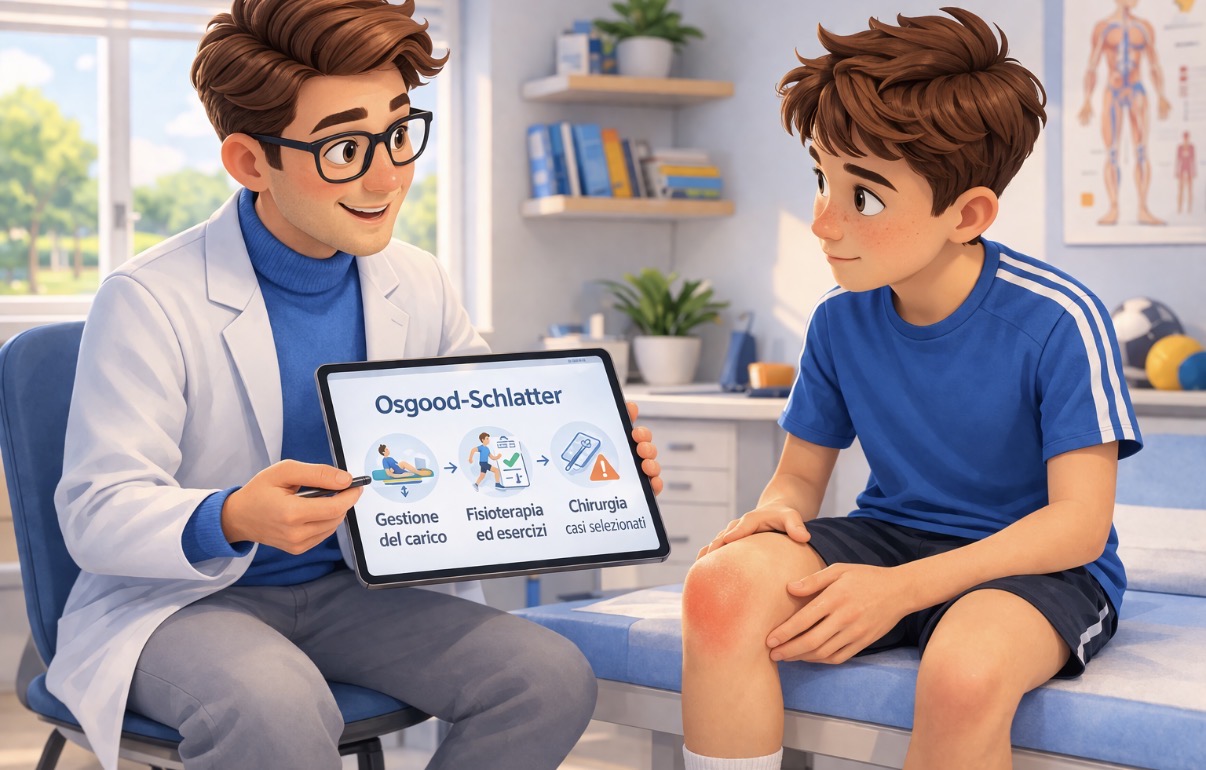
Osgood-Schlatter is one of those diagnoses that seems simple until you enter the real life of a young athlete. In theory, the picture is well-known: pain on the tibial tuberosity, often during a growth spurt, often in those who run, jump, and change direction. In practice, however, it's a condition that causes a lot of frustration. For the child, who wants to return to sports without pain. For the parents, who often hear very different opinions. And also for us, because the temptation to "do something more" when symptoms drag on is strong.
The review published in 2026 in the Orthopaedic Journal of Sports Medicine is useful precisely for this reason: not because it offers a definitive answer, but because it tries to bring order to a field where physiotherapy, rest, injections, variable protocols, and, more rarely, surgery are mixed. [1]
The authors included 15 studies for a total of 712 patients, analyzing conservative, infiltrative, and surgical treatments. [1] Already here, the first important message emerges: the literature exists, but it is very heterogeneous. We are not talking about a pathology with large randomized trials that allow us to say "this is the best path for everyone." We are talking about a frequent problem, but studied with different methods, different outcomes, and often not perfectly comparable follow-ups.
This explains why, when we read the results, we must avoid two opposite errors. The first is to dismiss everything with a "it will pass on its own." The second is to pursue any slightly more aggressive treatment because "something must be done."
The most solid part of the review, in my opinion, is precisely the confirmation of the central role of conservative treatment. [1] Not in the trivial sense of "rest and nothing else," but in the more correct sense of load management, sports adaptation, work on flexibility and strength, and reasoned progression. It is less spectacular than an infiltration or a procedure, but it remains the basis. And above all, it remains the basis because the natural history of the disease is largely favorable, even if often slower than families and coaches would like.
In the clinic, a precise scene often occurs: a thirteen-year-old playing soccer or basketball, pain under the knee for weeks or months, partial stop, then starts again as soon as the pain subsides a little, then everything starts over. The problem, in these cases, is almost never the absence of therapy. The problem is the wrong pace of recovery. It goes from too much to too little, then back to too much. And the apophysis continues to make itself felt.
The review also addresses infiltrative treatments, including PRP and dextrose, and here, in my opinion, we must be very honest. The results reported in some studies may seem promising, but the quality of the evidence does not allow them to be considered today as standard or as a superior solution to conservative treatment. [1] The fact that no complications are reported in these subgroups in this review does not automatically mean that they are "better" treatments or easy to propose. It only means that the available data are still too limited and too variable to transform them into a strong recommendation.
Even more interesting is the surgical chapter. The review confirms what practice already suggests: surgery remains a rare solution, to be considered especially in patients with persistent symptoms after skeletal maturation, or in very selected cases. [1] It is not a path to be lightly anticipated in a growing child just because the pain has lasted for a few months. This is an important point, because unrealistic expectations are often read online: "let's do something definitive and it will pass." In most cases, this is not the problem, and this is not the answer.
Another useful aspect of the review is that it forces us to say something simple but often unpopular: Osgood-Schlatter does not have a "magic" therapy. [1] Instead, it needs credible management. This means explaining the course well, negotiating with the child the tolerable level of activity, avoiding the total dichotomy between absolute stop and immediate return to full load, monitoring symptoms, and changing gears when necessary. It is more an educational job than a procedural one, but in many cases, it is what makes the difference.
If I had to summarize the practical message of the paper in one sentence, I would say this: the review does not change the paradigm, but confirms it. Osgood-Schlatter remains, first and foremost, a pathology to be treated with conservative intelligence. More invasive alternatives exist, but today we do not have strong enough data to shift the focus of care away from there. [1]
This, for those working in pediatric orthopedics, is especially useful in counseling. Because the value of a good clinic is not just prescribing exercises or saying "reduce sports." It is helping the family understand that improvement usually comes, but with times and methods that must be respected.
Disclaimer
This content is for informational purposes only and does not replace an individual clinical evaluation.
References
[1] Ndjonko LCM, Klein JH, Chakraborty Y, Kata S, Alinda A, Abuelenein I, Kalluvila AT, Green DW, Fowowe O, Simpson S, Wooldridge T. Treatments for Osgood Schlatter Disease: A Systematic Review of the Literature. Orthop J Sports Med. 2026;14(3):23259671251387354. doi:10.1177/23259671251387354. PMID: 41788553.