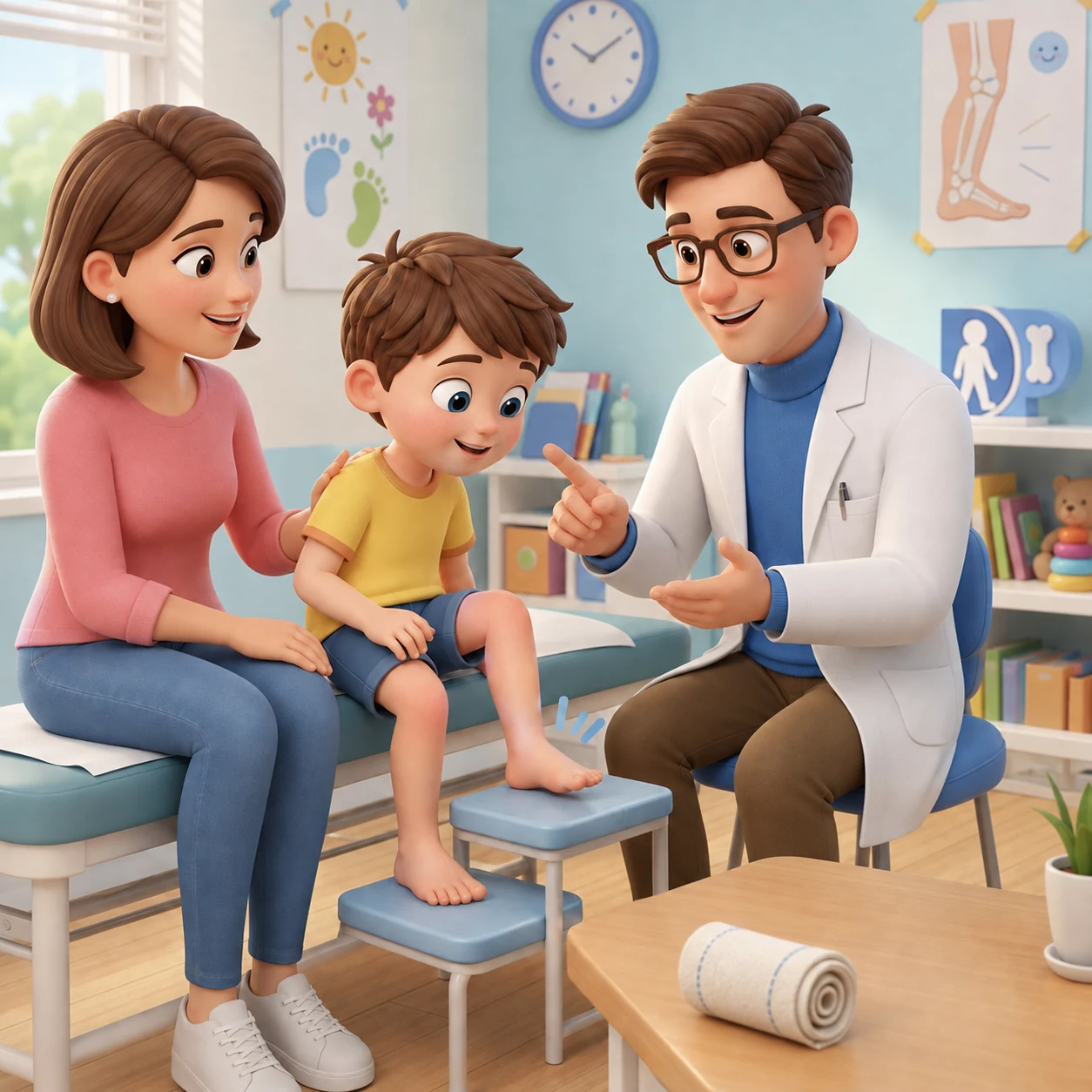
Cast removal is often seen as the end of a fracture. Then the child tries to move the elbow, wrist, or ankle, and the picture may seem less reassuring than expected: the joint is stiff, the muscle looks smaller, and movement is awkward. If a leg was immobilized, a noticeable limp may also appear.
At that point, many parents ask whether it is time to start physical therapy.
For uncomplicated pediatric fractures, in most cases, physical therapy is not an automatic step. Children recover motion very differently from adults, and much of the stiffness caused by immobilization tends to improve as they resume normal use of the limb. This does not apply equally to every fracture, however, and it does not mean that every slow recovery should simply be observed indefinitely.
A limb immobilized for weeks changes
After several weeks of immobilization, it is normal for the limb not to look or function exactly as it did before. Joint motion decreases, muscles lose volume, and the child may be afraid to use the part that has just been freed from the cast. In the lower limb, weight-bearing and the walking pattern also change.
In adolescents with leg or ankle fractures treated in a cast, a substantial reduction in bone mineral mass of the immobilized limb has also been documented at the time of cast removal. In one prospective study, differences compared with the healthy limb ranged from 6.2% to 31.7%, depending on the site measured; at 18 months, those differences were no longer detectable. [1]
What we see immediately after cast removal is therefore also the effect of weeks of disuse. A weaker or stiffer limb does not, by itself, indicate a complication that requires treatment.
The elbow is a good example
The elbow can be very stiff after a supracondylar fracture when the cast and any Kirschner wires are removed. This does not necessarily mean that recovery has stalled.
A randomized trial compared 61 children aged 5 to 12 years who had been treated for a supracondylar fracture, with or without percutaneous fixation, and immobilized for about three weeks. One group completed a standardized course of physical therapy, while the other did not. There were no differences in recovery of elbow motion; the group without physical therapy actually had better functional scores at the earlier assessments, while longer-term results were comparable. [2]
This study concerns a specific situation and should not be generalized to every elbow injury. It does, however, show why marked stiffness on the day a cast is removed is not, by itself, enough to prescribe physical therapy automatically in a child with an uncomplicated fracture and an otherwise regular course of treatment.
The usual recovery time also helps place the initial stiffness in perspective. In a series of children with supracondylar and lateral condyle fractures, reaching approximately 90% of the motion of the unaffected elbow took, on average, several weeks after immobilization ended, particularly for flexion and extension. [3]
Motion can therefore return progressively rather than within the first few days.
With the hand, “doing more” is not always better
Another randomized study evaluated 120 children with uncomplicated phalangeal or metacarpal fractures who had stiffness after cast removal. All received instructions and exercises to perform independently; half also received individual hand therapy. For one of the primary endpoints, recovery of full flexion, the home program was non-inferior to individual therapy. Results were less clear for some of the other motion measurements. [4]
This does not show that hand therapy is useless. It suggests instead that, even when stiffness is present, stiffness alone does not necessarily identify the child who will benefit from a structured rehabilitation program.
When the problem involves the leg
The lower limb is somewhat different because recovery involves not only joint motion but also weight-bearing, strength, and the walking pattern.
After cast removal, a child may initially walk poorly, put little weight through the foot, keep the knee stiffer, or rotate the limb to feel more secure. How much of this is acceptable depends on the fracture, the child’s age, and how long weight-bearing was restricted.
Recovery after major immobilization can take time. In a recent series of children younger than 6 years treated with a hip spica cast for a femoral shaft fracture, 71% had resumed walking within one month after cast removal. [5] This is very different from a simple tibial or ankle fracture, so the figure does not define a “normal” timeline for every child. It does show, however, that return to walking may continue over the weeks following the end of immobilization.
Here, clinical follow-up matters more than rushing to normalize the gait. A limp that progressively improves as weight-bearing and confidence increase is different from a limp that remains unchanged, worsens, or is associated with significant pain.
Walking again after a tibial fracture
There is no single number of days that applies to every child with a tibial fracture. Before encouraging more walking, check whether weight-bearing has been allowed and what restrictions remain. Cast removal, weight-bearing and a return to running are separate steps.
Once the treating clinician allows it, everyday activities and gentle play can support a gradual recovery. The figure for return to walking after a femoral fracture quoted above should not be applied to tibial fractures: the site, fracture stability and treatment differ. [5, 6]
At follow-up, clarify three points: how much weight the child may put through the limb, whether a brace or crutches are still needed, and which activities should still be avoided. If the limp worsens or the child refuses to bear weight again, arrange an earlier reassessment instead of increasing the exercises. The different injuries are described on the page about leg fractures in children.
When physical therapy becomes more useful
There are situations in which waiting for spontaneous recovery alone becomes less convincing.
Marked stiffness that shows no improvement over time deserves a new assessment. In my practice, if a significant limitation of motion or function is still present 20–30 days after cast removal, I tend to prescribe physical therapy. Before that point, in uncomplicated fractures with steady improvement, I often prefer to allow time for spontaneous recovery. The reasoning changes if the child continues not to use the limb despite fracture healing and permission to bear weight or move it, or if the injury involved the joint and soft tissues in a more complex way.
The 20–30-day interval is a clinical choice to discuss at the appointment, not a universal threshold established by the studies. It is not advice to wait if pain, swelling or function are getting worse; these changes call for an earlier reassessment.
The duration of immobilization also matters. Three weeks in a cast for an uncomplicated elbow fracture is not the same as prolonged immobilization after a complex joint injury, surgery, or an associated trauma. In those situations, physical therapy may help restore motion, strength, coordination, and confidence in using the limb, with goals tailored to the individual problem.
Before increasing exercises, however, it is important to make sure that the limitation is truly a rehabilitation issue. Increasing pain, persistent swelling, deformity, renewed refusal to bear weight, loss of motion after an initial improvement, or other unexplained symptoms require reassessment of the fracture and its healing first.
Cast removal does not mean the child is ready for sports
One final distinction often causes confusion. Recovering motion for everyday activities and returning to sports are not the same thing.
A child may move the wrist well or walk without a limp and still need more time before running, jumping, falling onto the limb, or returning to a contact sport. The decision depends on the type and site of fracture, the degree of healing, and the risk of another injury—not only on the feeling that the limb “is back to normal.”
For many pediatric fractures, the period after cast removal is therefore simpler than families expect: progressive movement, play, everyday activities, and a gradual return to normal use may already provide an effective form of recovery. Physical therapy has an important role when there is a specific problem to correct, not necessarily just because the child spent several weeks in a cast.
For a planned review of recovery in Milan, see the Gaetano Pini and CTO locations. Bring any existing X-rays and the instructions you received about weight-bearing, bracing and activities: these help establish which parts of recovery have already been allowed.
References
[1] Ceroni D, Martin XE, Delhumeau C, et al. Recovery of decreased bone mineral mass after lower-limb fractures in adolescents. J Bone Joint Surg Am. 2013;95(11):1037-1043. doi:10.2106/JBJS.L.00809.
[2] Schmale GA, Mazor S, Mercer LD, Bompadre V. Lack of Benefit of Physical Therapy on Function Following Supracondylar Humeral Fracture: A Randomized Controlled Trial. J Bone Joint Surg Am. 2014;96(11):944-950. doi:10.2106/JBJS.L.01696.
[3] Wang YL, Chang WN, Hsu CJ, Sun SF, Wang JL, Wong CY. The recovery of elbow range of motion after treatment of supracondylar and lateral condylar fractures of the distal humerus in children. J Orthop Trauma. 2009;23(2):120-125. doi:10.1097/BOT.0b013e318193c2f3.
[4] Tan C, Depiazzi J, Bear N, Blennerhassett L, Page R, Gibson N. Exercise handout and one-on-one hand therapy for management of stiffness after plaster cast immobilization of simple phalangeal and metacarpal fractures in children: a randomized, noninferiority trial. J Hand Ther. 2021;34(3):423-432.e7. doi:10.1016/j.jht.2020.03.017.
[5] de Charnace E, Bunetel IL, Haas M, et al. Socio-professional impact of the hip spica cast for femoral shaft fracture management in children under six. Orthop Traumatol Surg Res. 2026;112(1):104556. doi:10.1016/j.otsr.2025.104556.
[6] The Royal Children's Hospital Melbourne. Fracture care: leg — after the cast is removed. General advice for families; it does not determine weight-bearing or return-to-sport timing for an individual fracture.
Disclaimer: This content is intended for general informational purposes and does not replace an individual medical assessment.