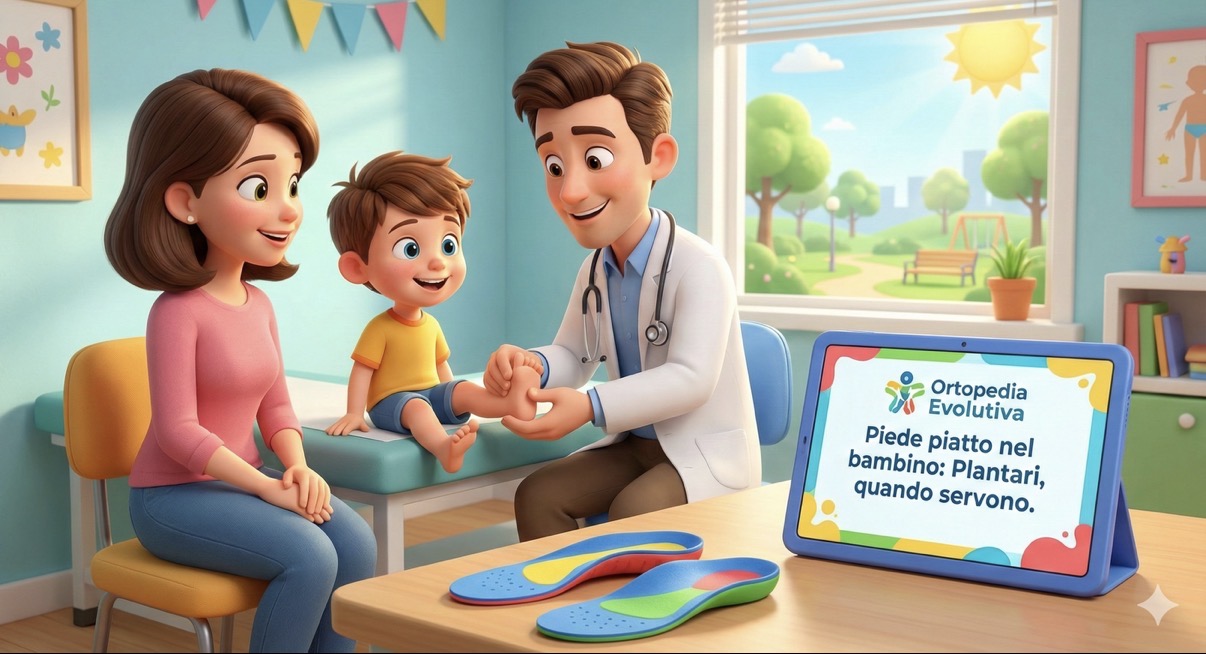
When a parent tells me, "Doctor, he has flat feet," the second sentence is almost always: "So he needs orthotics, right?" It's a legitimate question: between friends' advice, advertisements, and "it's always been done this way," it seems that orthotics are the automatic answer. In reality, the correct answer is simpler (and less absolute): it depends on the type of flat foot and the symptoms.
First thing: what kind of "flat foot" is it?
In young children, the arch of the foot is often not visible: there is a fat pad, the ligaments are more elastic, and the arch "develops" with growth. This is the classic flexible flat foot: the arch appears when the child stands on tiptoes or when you lift the big toe, and the foot is mobile.
Different is the rigid flat foot (foot with limited mobility, arch always absent, often pain/limitation): here we are not in the "normal growth" range and a more accurate evaluation is needed. [2]
Five common misconceptions I often hear
- "If you don't use orthotics early, the arch will never form."
In most children with flexible flat feet and no pain, the evolution is benign. Many interventions do not permanently modify the arch structure. [2][3]
- "Orthotics create the arch."
Literature reviews state that orthotics can primarily help with symptoms (pain, fatigue, activity tolerance), but it is not solidly proven that they permanently change the "shape" of the foot in the long term. [1][2][3]
- "If he runs and falls often, it's because he has flat feet."
In practice, coordination and strength (and a bit of age) matter more than the arch. A flexible flat foot can coexist with sports and play without problems.
- "An expensive custom orthotic is always necessary."
Not always. When the goal is to reduce pain and fatigue, we often start with simple solutions and only progressively "custom-made" if it's not enough or if the morphology is particular. [2]
- "All flat feet need to be corrected."
No: treatment is indicated when it is symptomatic (pain, fatigue, limitation) or when there are risk factors/atypical features (rigidity, worsening, asymmetry). [2]
So: when do orthotics make sense?
In the clinic, the practical rule is this: orthotics are not a prize for having an arch, but a tool to feel better.
They can be useful if:
- the child has foot/ankle pain or often stops due to fatigue; [1][2]
- there is marked heel valgus with symptoms during sports or long walks;
- there is a retracted Achilles tendon/gastrocnemius (child struggles with dorsiflexion), where stretching and functional management are often combined. [2]
And what do we do "in real life," besides orthotics?
- choose stable shoes (not rigid like a block, but with good heel support);
- modulate loads: more gradual "playtime," fewer sudden peaks;
- work on calf and foot (stretching/targeted activities when indicated). [2]
When to seek "early" medical attention (red flags)
Contact your pediatrician/orthopedist if there is:
- persistent or nocturnal pain, or limping;
- rigid foot (does not "give," arch never present, limited movement);
- rapid worsening, marked asymmetry between the two feet;
- significant difficulty walking/running compared to peers;
- neurological signs (very "strange" gait, sudden falls, weakness). [2]
Disclaimer: This content is for informational purposes only and does not replace a medical visit. If your child has pain, limping, or foot rigidity, a clinical evaluation is prudent.
References
[1] Oerlemans LNT, et al. Foot orthoses for flexible flatfeet in children and adults: systematic review and meta-analysis. 2023. (Full text PMC) https://pmc.ncbi.nlm.nih.gov/articles/PMC9825043/
[2] Cochrane Library. Evans AM, et al. Foot orthoses for treating paediatric flat feet. 2022. https://www.cochranelibrary.com/cdsr/doi/10.1002/14651858.CD006311.pub3/full
[3] POSNA Study Guide. Acquired Flexible Flat Feet – Treatment is indicated in symptomatic patients. https://posna.org/physician-education/study-guide/flat-feet-%28acquired-flexible-flat-feet%29
[4] AAP Journal Blogs. Flat Feet: To Treat or Not To Treat. 2025. https://publications.aap.org/journal-blogs/blog/32563/Flat-Feet-To-Treat-or-Not-To-Treat