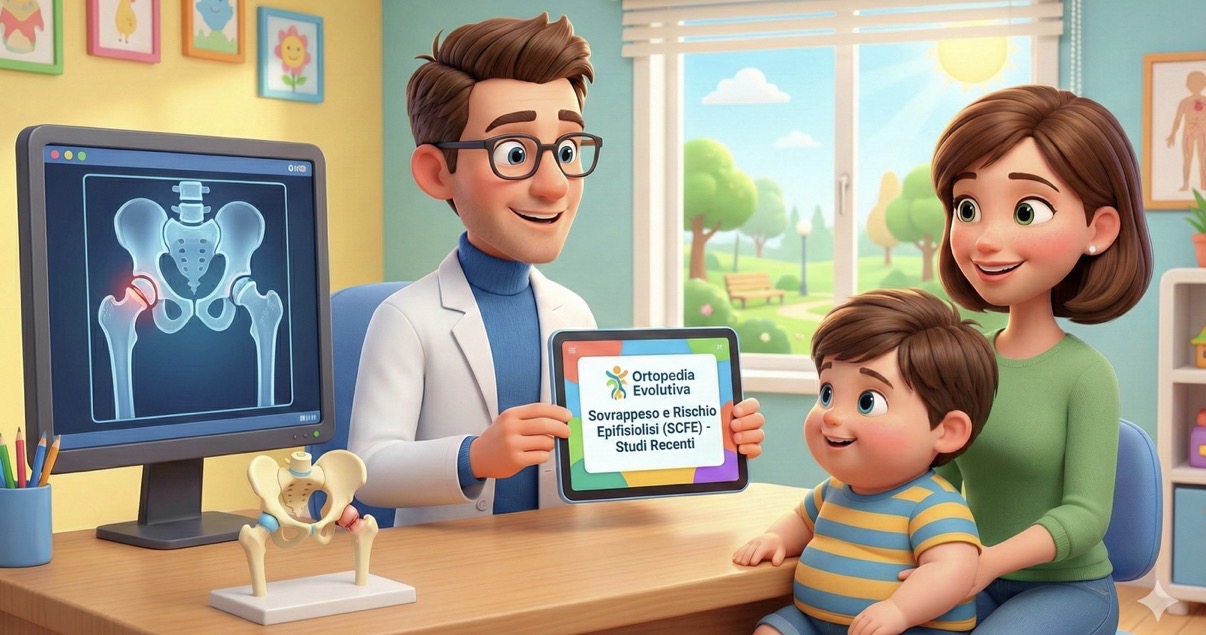
In the clinic, it happens: an overweight adolescent, limping for a few days, poorly localized pain ("my knee hurts"), no clear trauma. In these cases, the hip should always be considered carefully, because during growth, the growth plate is a delicate point and some pathologies present with "referred" pain.
Slipped capital femoral epiphysis (SCFE) is the classic example: it's not a diagnosis to be made "at a glance," but it's a diagnosis where timeliness matters.
Today we analyze these articles
- Bouchard MD, Vescio BG, Munir M, et al. The Epidemiology of Slipped Capital Femoral Epiphysis in Children and Adolescents: A Systematic Review of Risk Factors and Incidence Across Populations. JBJS Reviews. 2025;13(5). DOI: 10.2106/JBJS.RVW.25.00052. PMID: 40403127. PubMed: https://pubmed.ncbi.nlm.nih.gov/40403127/ DOI: https://doi.org/10.2106/JBJS.RVW.25.00052
- Novais EN, Movahhedi M, Pradhan P, et al. Impact of Childhood Obesity on Capital Femoral Epiphysis Morphology: A Large-Scale, Automated 3D-CT Study and Potential Implications for SCFE Pathogenesis. J Bone Joint Surg Am. 2025;107(18):2102–2109 (Epub 2025 Aug 14). DOI: 10.2106/JBJS.24.01472. PMID: 40811524. PubMed: https://pubmed.ncbi.nlm.nih.gov/40811524/ DOI: https://doi.org/10.2106/JBJS.24.01472
Study 1: Epidemiology (the risk exists, but it's not "the same everywhere")
Bouchard and colleagues' systematic review attempts to answer a concrete question: how is SCFE distributed in pediatric populations with obesity, and how much does it vary between contexts? The authors include 15 studies (5,467 patients) and report enormous geographical variability, with widely disparate examples (extremes such as Sweden vs. South Korea are cited in the article) and an overall ("pooled") estimated incidence of 9.62 per 100,000. [1]
This point, for me, is particularly useful for avoiding shortcuts:
- Yes, obesity is an important risk factor;
- But the "overweight" label alone doesn't explain everything: predispositions, socioeconomic determinants, access to care, and probably differences in case recognition/registration all play a role. [1]
In practice: when talking to families, it's good to be clear that the risk increases, but without turning weight into a "sole cause" or a blame.
Study 2: The "mechanics" of the hip (measurable growth differences possible)
Novais and colleagues' work does not study patients with SCFE: it studies children without hip pathology, using a large series of 3D CT scans (almost 4,900 subjects, 7–19 years old) analyzed with automated measurements. [2]
The idea is simple and intelligent: if obesity increases the risk, are there structural differences in the femoral epiphysis that could make the physis more vulnerable?
The authors describe, in subjects with obesity, age-related trajectories that include:
- Larger femoral head in various age groups,
- Smaller epiphyseal tubercle after a certain age,
- More posterior epiphyseal tilt between 7 and 15 years,
- A superior "cupping" trend that changes with age. [2]
This is not an invitation to perform CT scans "for screening" (in fact, it would be a mistake). However, it is a pathophysiological piece of the puzzle: it suggests that the risk is not just "more load," but may include anatomical differences that emerge during growth and potentially influence the stability of the physis. [2]
What I take into clinical practice (without forcing conclusions)
These two studies, together, do not change a protocol overnight. However, they do change the quality of reasoning and counseling:
- If an adolescent limps and reports hip/groin/thigh pain or "just knee pain" without clear trauma, the threshold for considering the hip should remain low (especially if overweight).
- With families, the useful phrase is: "Overweight increases the risk, but it doesn't necessarily mean there's a serious problem. Precisely for this reason, if limping or persistent pain occurs, it's advisable to get an early evaluation."
- On a scientific level, the 3D study opens a path: to seek sensible predictive markers and models, avoiding unnecessary medicalization and remembering that clinical validations are needed.
Conclusions
The systematic review confirms that SCFE in pediatric populations with obesity is a real issue, with highly variable incidences across contexts and therefore likely multifactorial. [1]
The 3D study suggests that, in children with obesity, some characteristics of the femoral epiphysis follow different trajectories, with possible implications for the mechanical vulnerability of the physis during growth. [2]
The practical message remains sober: in the presence of limping or hip/knee pain in an adolescent, a timely evaluation is worthwhile.
Disclaimer: This content is for informational purposes only and does not replace an individual clinical evaluation.
References
[1] Bouchard MD, et al. JBJS Reviews. 2025. DOI: 10.2106/JBJS.RVW.25.00052. PMID: 40403127.
[2] Novais EN, et al. J Bone Joint Surg Am. 2025. DOI: 10.2106/JBJS.24.01472. PMID: 40811524.