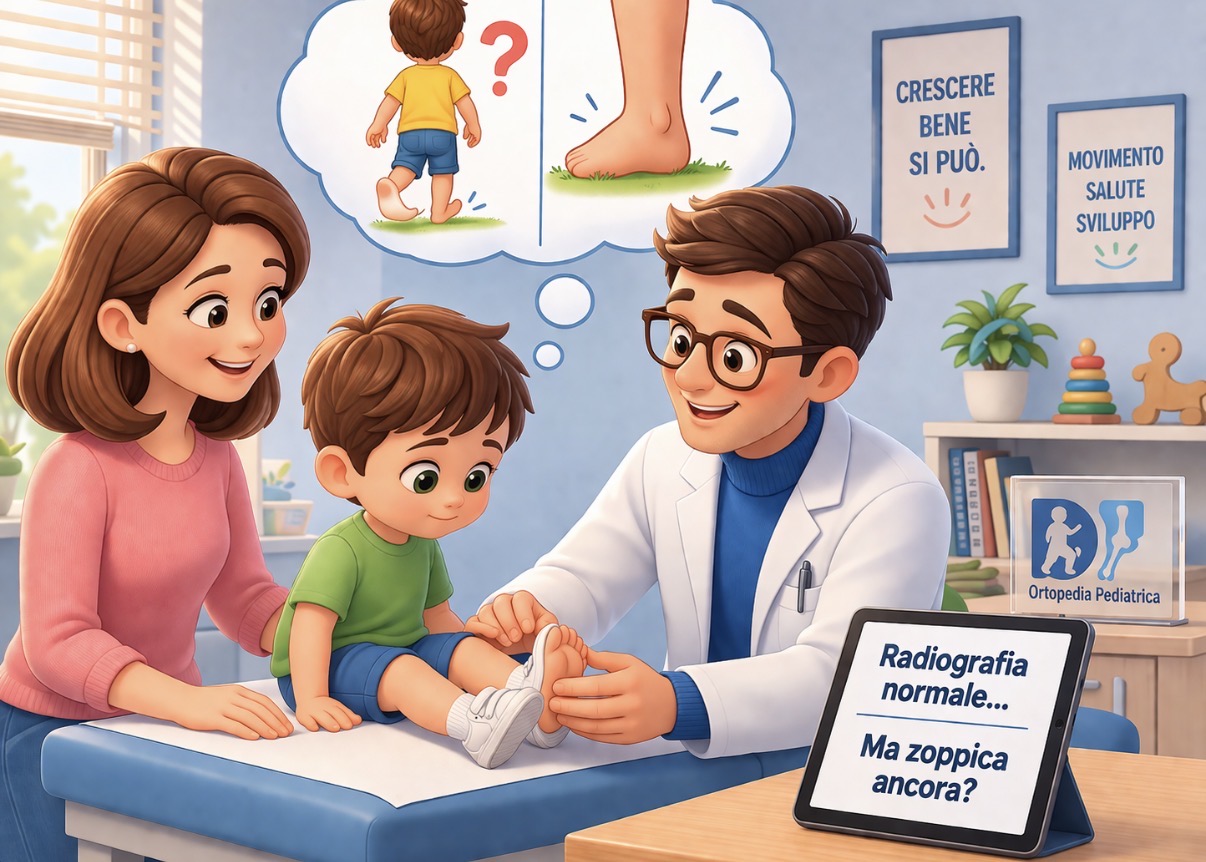
It's a very common scene. The child starts to limp, perhaps after a trivial fall or even without clear trauma. An X-ray is taken. The report says everything is fine. Yet, the child continues to limp. At that point, the question is almost always the same: if the X-ray is normal, then why is he limping? [1][2]
The first thing to say is this: limping is a sign, not a diagnosis. It can be due to pain, a small stiffness, a protective contracture, a problem with the foot, knee, hip, or even the back. And above all, in children, the point where the limp is observed does not always coincide with the point where the problem originates. An irritated hip, for example, can be referred to as knee pain. This often happens in the clinic and explains why a "correct" but too focused X-ray doesn't always truly close the case. [1][3]
Another important concept is that a normal X-ray doesn't rule out everything, especially in the initial stages. Some conditions may not be immediately visible: for example, a minimal tibial toddler's fracture, some early stages of osteomyelitis, transient synovitis of the hip, or an intra-articular problem without obvious bone alterations on the first image. For this reason, in a child's limp, the examination and observation of the course are as important as the X-ray examination. [1][2][4]
The good news is that, in most cases, the most common causes are not serious. The Royal Children's Hospital guidelines remind us that many pediatric limps are related to minor trauma, transient synovitis, or acute myositis, and that not all limping children immediately need a battery of tests. Transient synovitis, in particular, is one of the most frequent causes of atraumatic limping and often presents in a child who is generally well, not toxic-appearing, with pain and limitation but with a self-limiting course. [2][3][5]
That said, one must not fall into the opposite error, i.e., dismissing everything as benign just because the first X-ray is negative. There are some signs that deserve real attention. The most important is acute inability to walk or bear weight: Australian guidelines consider this a red flag. Also, fever, rapid worsening, significant night pain, general malaise, joint swelling, marked reduction in movement, or a limp that does not improve within a few days require re-evaluation. In particular, the combination of fever, refusal to bear weight, and joint limitation should also raise suspicion for orthopedically urgent conditions such as septic arthritis, which cannot be ruled out by a normal X-ray. [1][2][3]
A useful aspect to explain to parents is that age helps a lot in guiding the diagnosis. In young children, for example, a tibial toddler's fracture can present with limping or refusal to bear weight even after minimal trauma, and the initial X-ray can be normal in a significant proportion of cases. In one pediatric study, initial imaging was negative in about a quarter of children ultimately diagnosed with a toddler's fracture. This explains why, if clinical suspicion is high, sometimes observation, immobilization, or re-evaluation is necessary, even if the first image does not show an obvious fracture line. [4]
In slightly older children, however, other possibilities must also be kept in mind: transient synovitis, Perthes disease, osteoarticular infections, foot or knee problems, up to inflammatory or, more rarely, neoplastic causes if the history doesn't fit. The 2023 AAFP review insists on this very point: limping should be interpreted together with clinical history, pain location, fever, course over time, and a complete physical examination, not based on a single image. [3]
In practice, when can one be relatively reassured? In a child who continues to walk, perhaps with moderate discomfort, without fever, without worsening, without significant night pain, and with an examination consistent with a benign or minor post-traumatic picture, it is often reasonable to observe and re-evaluate if it does not improve. However, when the child is not bearing weight, has a fever, appears distressed, the limp worsens, the pain is intense, or always occurs in the same spot for days, the fact that the X-ray is normal is no longer enough to reassure. [1][2][3]
If I had to summarize the message in one sentence, I would say this: a normal X-ray is good news, but it is not always the end of the reasoning. In a child's limp, the context, the examination, and the evolution matter. And it is precisely this that allows us to avoid both unnecessary alarmism and delay in situations that truly deserve attention. [1][2][3]
Disclaimer
This content is for informational purposes only and does not replace individual clinical evaluation.
References
[1] Truong T, Chang D, Friedman S. Limping Child. Pediatrics in Review. 2024;45(8):476-478. doi:10.1542/pir.2023-006052. PMID: 39085187.
PubMed: https://pubmed.ncbi.nlm.nih.gov/39085187/
[2] Royal Children’s Hospital Melbourne. Clinical Practice Guidelines: The limping or non-weight bearing child.
Page: https://www.rch.org.au/clinicalguide/guideline_index/Child_with_limp/
[3] Morancie NA, Helton MR. Evaluating the Child With a Limp. American Family Physician. 2023;107(5):474-485. PMID: 37192073.
PubMed: https://pubmed.ncbi.nlm.nih.gov/37192073/
[4] Pujol M, et al. Current diagnosis and management of toddler’s fracture. An Pediatr (Barc). 2019;91(3):e1-e7. PMID: 31311775.
PubMed: https://pubmed.ncbi.nlm.nih.gov/31311775/
[5] Asche SS, van Rijn RM, Bessems JHJM, Krul M, Bierma-Zeinstra SMA. What is the clinical course of transient synovitis in children: a systematic review of the literature. Chiropr Man Therap. 2013;21:39. PMID: 24229447.