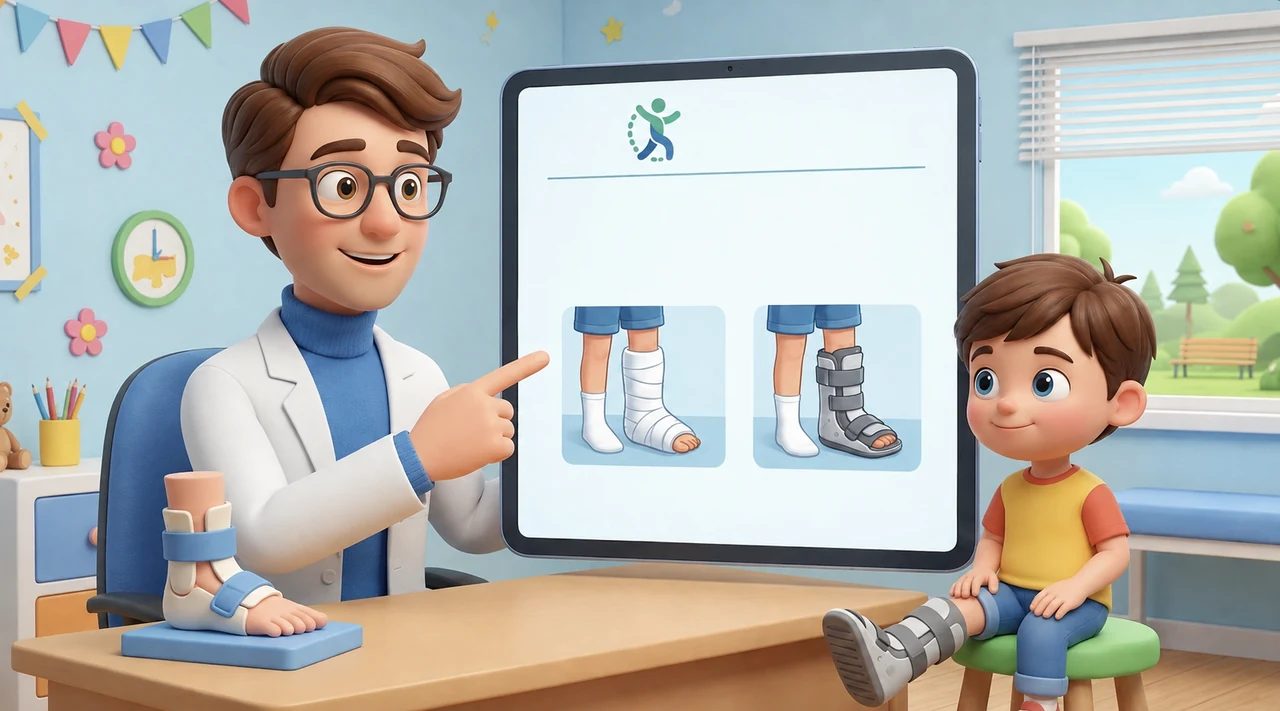
In stable, low-risk pediatric ankle injuries, rigid immobilization is not always necessary. Several trials have compared casts, removable braces, and bandages, with results favoring strategies that allow earlier mobilization. [1][2][4]
What the 2026 meta-analysis shows
The review by Badhe and colleagues included 7 randomized trials and 503 children with low-risk fractures, stable injuries, or suspected occult fractures managed non-surgically. [1]
Compared to casts, removable braces were associated with fewer unscheduled visits, with an RR of 0.26, and a return to activities approximately one week faster on average. Functional scores and satisfaction for both children and families were also better. [1]
In the included trials, there were no significant differences in pain or complications between the strategies within the low-risk categories selected. [1]
Previous data
An RCT published in Pediatrics in 2007 had already shown better functional recovery at 4 weeks and a faster return to activities with a removable brace compared to a cast. [2]
In 2016, another study evaluated children with lateral ankle pain and negative radiographs. True Salter-Harris I fractures of the distal fibula were rare; more often, MRI showed ligamentous sprains or small occult avulsions. Children treated with a removable brace and symptom-guided return to activities had a similar course even when MRI revealed an occult bone injury. [3]
A systematic review from 2019 had already reached conclusions favoring early mobilization, while highlighting the heterogeneity of definitions and protocols. [4]
The role of bandaging
A feasibility trial from 2025 compared supportive bandages, removable splints, and weight-bearing casts in children aged 5 to 15 years. [5] A definitive comparison is still needed to establish the minimum effective device for different subgroups.
Cases requiring caution
These results do not apply to all pediatric ankle fractures. Displacement, instability, joint involvement, certain physeal injuries, and more significant clinical presentations require different treatment.
In truly low-risk cases, however, a removable brace can offer sufficient protection with less stiffness and faster recovery. The choice depends on the correct identification of the injury type and clear instructions regarding weight-bearing, pain, and return to activity.
Disclaimer
Informational content; does not replace individual clinical evaluation.
References
[1] Badhe N, et al. Outcome of ankle fractures in children: an updated systematic review and meta-analysis. Ann R Coll Surg Engl. 2026. PMID: 41622914.
PubMed: https://pubmed.ncbi.nlm.nih.gov/41622914/
[2] Boutis K, et al. A randomized, controlled trial of a removable brace versus casting in children with low-risk ankle fractures. Pediatrics. 2007. PMID: 17545357.
PubMed: https://pubmed.ncbi.nlm.nih.gov/17545357/
[3] Boutis K, et al. Radiograph-Negative Lateral Ankle Injuries in Children: Occult Growth Plate Fracture or Sprain? JAMA Pediatr. 2016. PMID: 26747077.
PubMed: https://pubmed.ncbi.nlm.nih.gov/26747077/
[4] Marson BA, et al. Management of ‘low-risk’ ankle fractures in children: a systematic review. Ann R Coll Surg Engl. 2019. PMID: 30855167. PMCID: PMC6818065.
PubMed: https://pubmed.ncbi.nlm.nih.gov/30855167/
Full text: https://pmc.ncbi.nlm.nih.gov/articles/PMC6818065/
[5] Marson BA, et al. Supportive bandage, removable splint, or walking casts for low-risk ankle fractures in children: a feasibility randomized controlled trial. Bone Joint J. 2025. PMID: 39740682.