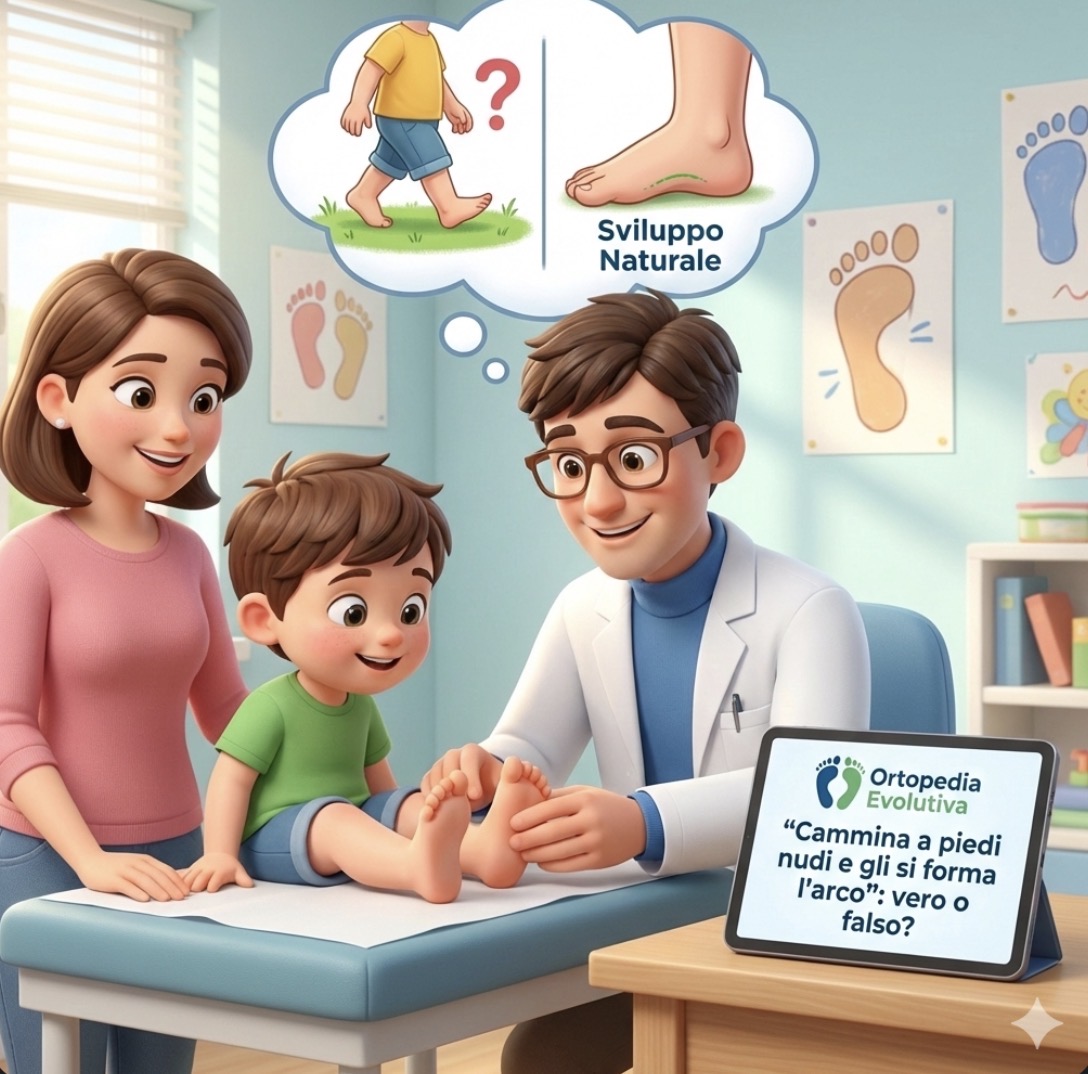
Today's Common Myth
"If I let him walk barefoot, his arch will form, and his flat feet will go away."
This is a phrase I hear often. And it's understandable: seeing a "flat" foot can make you think something needs to be fixed immediately. But in real life, for most young children, flat feet are simply a normal phase.
Why many children have flat feet (and it's not a disease)
In the first years of life, the plantar arch is not as "sculpted" as an adult's for two simple reasons:
- There's more fat under the sole, which "fills" the arch and makes it appear flat.
- Ligaments and muscles are still maturing, so the foot is "softer" and tends to collapse inward a bit.
Result: if you look at the child standing, the arch seems to have disappeared. But often, if you have them stand on their toes or sit down, the arch reappears: this is the classic flexible flat foot, which is physiological.
So, does walking barefoot help?
Walking barefoot is not a miraculous therapy that "creates an arch" out of nothing. However, it can have practical benefits:
- helps the child perceive the ground better,
- stimulates the foot muscles a bit more,
- often encourages a more "active" foot placement.
That said, the plantar arch develops primarily with growth, maturation, and movement over time. So: barefoot is fine, but not as a cure, and especially in safe environments (home, clean surfaces, no risks).
Do "first steps" shoes cause flat feet?
Another common myth: "shoes ruin the foot."
The truth is simpler: a good shoe shouldn't "correct" the foot; it should only:
- be comfortable,
- be flexible enough in the front (it should bend),
- have a wide toe box for the toes,
- and be the right size.
Rigid "mini-adult" shoes are often more annoying than useful, but they don't cause flat feet.
What about orthotics?
Here we need to be clear: most children with flexible flat feet and no symptoms do not need orthotics.
Orthotics can be useful primarily if:
- there is pain,
- significant fatigue,
- poor tolerance for walking/running compared to peers,
- or if the foot is not "soft" but appears rigid.
In other words: we treat the child, not the shape of the foot in a photo.
When to seek an evaluation (red flags)
Schedule an evaluation if you notice one or more of these signs:
- frequent pain in the foot, ankle, leg, or knee after activity
- child gets very tired or refuses to walk/run compared to before
- foot appears rigid (cannot stand on toes or the arch never appears)
- marked difference between the two feet
- persistent toe walking, limping, or progressive worsening
In practice: what you can do at home (without "DIY cures")
- Let the child move a lot (park, play, age-appropriate activities).
- Simple shoes: comfortable, flexible, not "orthopedic."
- Barefoot in safe environments: good, but don't expect miracles.
- If there's pain or concern, a visit is best: often, a few minutes are enough to understand if it's a physiological flat foot.
Disclaimer
This content is for informational purposes only and does not replace a medical visit. If your child has pain, limping, or evident worsening, a clinical evaluation is prudent.