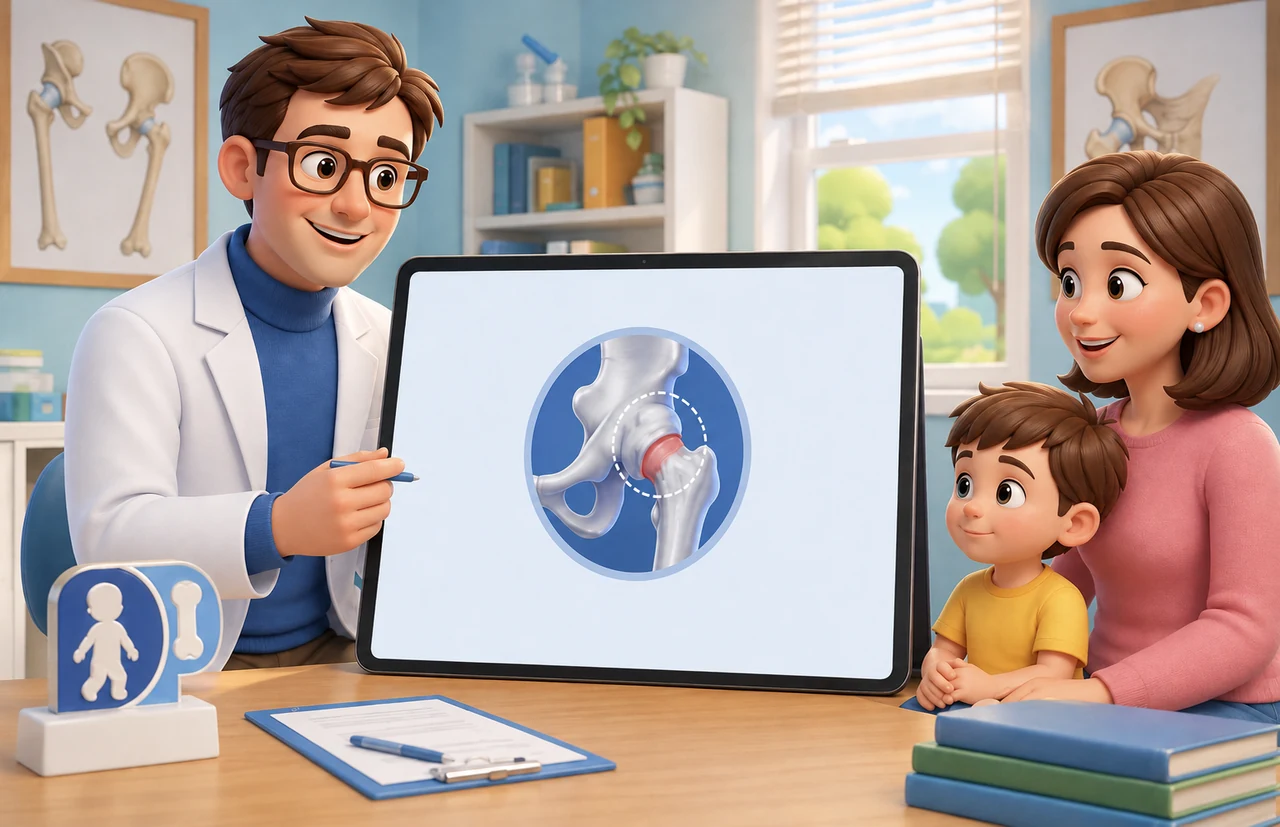
SCFE, or Slipped Capital Femoral Epiphysis, continues to be one of the pediatric orthopedic diagnoses where delay truly matters. During the waiting period, the slip can progress, increasing residual deformity and making treatment more complex. [1–6]
When the Pain is in the Knee
A significant number of adolescents with SCFE do not report hip pain. The symptom can be in the thigh or knee, which easily shifts attention to the wrong area.
A national cohort showed a greater diagnostic delay precisely in patients who presented with knee pain compared to those with hip pain or limping. [5]
For this reason, in adolescents with limping and knee pain, I always evaluate the hip as well. Reduced internal rotation and obligatory external rotation during flexion are particularly useful signs. [1–3]
Imaging Must Be Focused on the Hip
Standard knee X-rays are not helpful if the problem is proximal. In suspected cases, pelvic and hip views are needed that also show the slip in the sagittal plane.
In stable forms, AP pelvis and frog-leg lateral views are generally the most informative projections. In unstable forms, or when the patient cannot tolerate the position, a cross-table lateral view is preferable to avoid painful maneuvers. [1–3]
Classic signs, including Klein's line, may be insensitive in early stages. Comparison with the contralateral side and evaluation of the Southwick angle help in less obvious cases. [1–3]
What a Delay Entails
As the slip progresses, residual deformity increases, and in the medium to long term, so does the risk of femoroacetabular impingement, pain, functional limitation, and early osteoarthritis. [1–3]
In unstable forms, the most feared complication is osteonecrosis. A 2025 meta-analysis of 688 hips estimated an incidence of around 23% and identified a higher risk in males, moderate-to-severe slips, acute presentations, and cases subjected to reduction attempts, especially closed reductions. [6] The data are retrospective and should be interpreted considering the initial severity.
Why the Diagnosis is Still Missed
A 2023 review gathered very concrete causes: vague initial symptoms, first presentation in non-orthopedic settings, imaging requested for the wrong area, difficult interpretation of early forms, and variability in clinical presentation. [4]
Delay often arises from a sequence of small steps rather than a single error.
Three Situations Where I Pay Particular Attention
- Adolescent with limping, hip, thigh, or knee pain, and reduced internal rotation. [1–3][5]
- Non-targeted X-rays or those lacking an adequate lateral projection. [1–3]
- Convincing clinical picture with initial imaging that is not very conclusive: in these cases, a close re-evaluation or further investigation may be safer than dismissing the problem. [3][4]
In SCFE, clinical suspicion comes before the perfect X-ray. The simplest way to reduce delays is to remember that an adolescent with knee pain might have a hip problem.
Disclaimer
This content is for informational purposes only and does not replace an individual clinical evaluation.
References
[1] Webb CW, Liu R, Bouchereau-Lal N. Slipped Capital Femoral Epiphysis: Rapid Evidence Review. American Family Physician. 2025;112(4):414-423.
https://www.aafp.org/pubs/afp/issues/2025/1000/slipped-capital-femoral-epiphysis.html
[2] POSNA Study Guide – SCFE.
https://posna.org/physician-education/study-guide/scfe-%28slipped-capital-femoral-epiphysis%29
[3] Johns K, Mabrouk A, Tavarez MM. Slipped Capital Femoral Epiphysis. StatPearls. Updated 2023.
https://www.ncbi.nlm.nih.gov/books/NBK538302/
[4] Diagnosis of Slipped Capital Femoral Epiphysis: How to Stay out of Trouble? Children (Basel). 2023;10(5):778.
https://www.mdpi.com/2227-9067/10/5/778
[5] Perry DC, Metcalfe D, Costa ML, Van Staa T. Presentation and delay in diagnosis of slipped capital femoral epiphysis: a nationwide cohort study. Arch Dis Child. 2017.
https://pmc.ncbi.nlm.nih.gov/articles/PMC5754864/
[6] Xu Z, Zhu L, Kong L, et al. Risk factors associated with avascular necrosis following unstable slipped capital femoral epiphysis: a systematic review and meta-analysis. PLOS ONE. 2025;20(7):e0329275.