Hip

    Perthes Disease: Femoral Head in Children

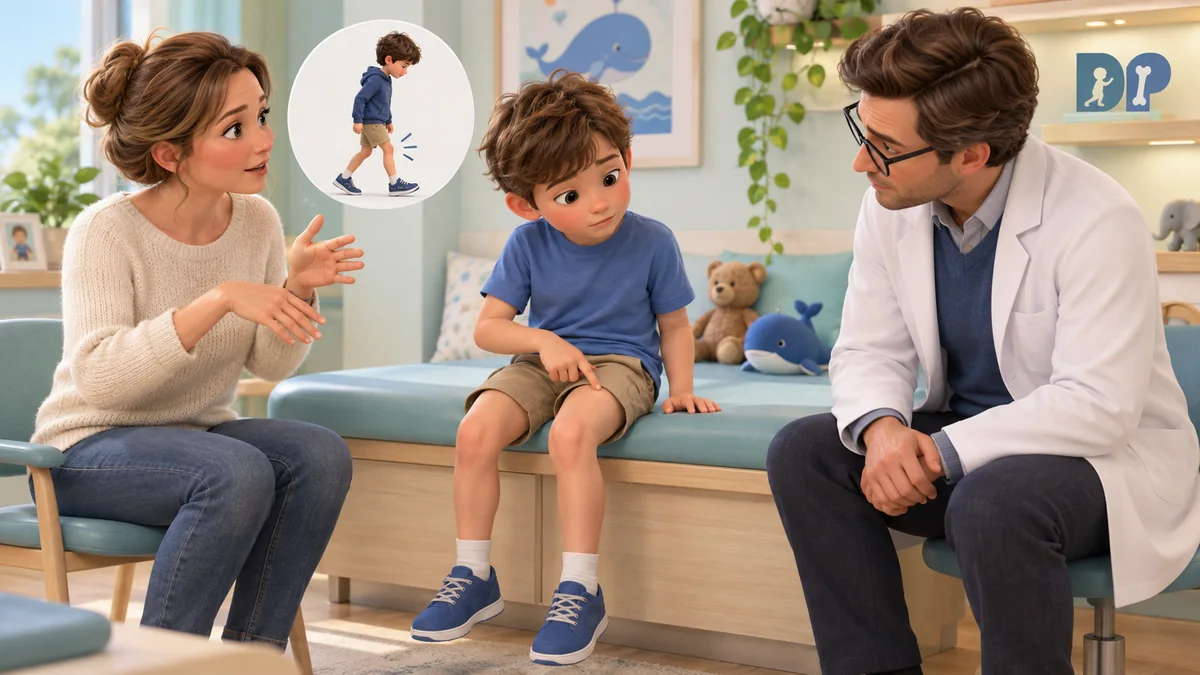
    Limping child 4-8 years without trauma. Seek evaluation if hip pain or morning stiffness. Pediatric hip specialist Milan.

    Medically reviewed: April 2026·Dott. Daniele Priano

    Quick Answers

    Does Perthes disease heal completely?
    Prognosis depends on age at onset, extent of femoral head involvement and how early the pathway is started. Younger children, generally under 6 years, have a more favorable prognosis thanks to greater remodeling potential. With a well-conducted pathway, many children achieve good hip function, although some radiological changes may remain visible.
    Can my child with Perthes play sports?
    During the most active phase of the disease it is generally appropriate to **limit high-impact activities** (intense running, repeated jumping, contact sports) so as not to overload the femoral head during remodeling. Activities such as **swimming** and **cycling** are usually well tolerated. Gradual return to more demanding sports is evaluated case by case, based on clinical and radiological progress.
    How long does Perthes disease last?
    The natural course can last several years, during which the femoral head goes through successive phases of avascular impairment, fragmentation, reossification and remodeling. For this reason follow-up is repeated over time, with personalized intervals, until full recovery of hip morphology.
    See all 7 questions →

    Legg-Calvé-Perthes disease is a temporary impairment of blood supply to the femoral head, typically affecting school-age children, more often males. The femoral head goes through several phases (avascular phase, fragmentation, reossification, remodeling) over a period that can last several years. It presents with persistent limping without clear trauma, hip or referred knee pain, morning stiffness, and sometimes the child becoming reluctant to run or play as before. Diagnosis is based on clinical assessment and imaging. The pathway is built case by case and aims to protect the femoral head during the remodeling phase, keep it well 'contained' within the acetabulum, and preserve hip mobility. Most children, especially the youngest, recover well; in cases with less favorable prognosis more structured options, including surgery, are considered.

    Dott. Daniele Priano - Ortopedico Pediatrico

    🩺Patience Is the Treatment

    Perthes disease can be scary, but with proper radiographic follow-up and respecting the biological healing timeline, most children resume all activities. Treatment is often conservative: rest, periodic check-ups, and sometimes physiotherapy to maintain hip mobility during natural repair.

    When to seek evaluation

    • Persistent limping without evident trauma
    • Hip or referred knee pain
    • Limited hip range of motion
    • Morning hip stiffness
    • Child refusing to play or run

    What is evaluated

    • Clinical hip examination (ROM, abduction, rotation)
    • Bilateral hip X-rays
    • MRI for staging and prognostic evaluation
    • Classification according to Catterall, Herring or Stulberg
    • Serial monitoring of evolution

    Treatment options

    • Observation and physical therapy for mild cases
    • Non-surgical containment (braces, casts)
    • Femoral or pelvic osteotomy in selected cases
    • Long-term monitoring until skeletal maturity
    🏥

    When Surgery Is Needed

    La maggior parte dei casi di Perthes viene gestita con trattamento conservativo. Tuttavia, in casi selezionati con prognosi sfavorevole (età maggiore, coinvolgimento esteso, sublussazione della testa), il trattamento chirurgico può migliorare il contenimento e la prognosi a lungo termine.
    🔗View surgical options for this condition →

    Frequently Asked Questions

    Does Perthes disease heal completely?
    Prognosis depends on age at onset, extent of femoral head involvement and how early the pathway is started. Younger children, generally under 6 years, have a more favorable prognosis thanks to greater remodeling potential. With a well-conducted pathway, many children achieve good hip function, although some radiological changes may remain visible.
    Can my child with Perthes play sports?
    During the most active phase of the disease it is generally appropriate to **limit high-impact activities** (intense running, repeated jumping, contact sports) so as not to overload the femoral head during remodeling. Activities such as **swimming** and **cycling** are usually well tolerated. Gradual return to more demanding sports is evaluated case by case, based on clinical and radiological progress.
    How long does Perthes disease last?
    The natural course can last several years, during which the femoral head goes through successive phases of avascular impairment, fragmentation, reossification and remodeling. For this reason follow-up is repeated over time, with personalized intervals, until full recovery of hip morphology.
    Why does Perthes occur? Is it anyone's fault?
    The exact cause is not yet clear: it is a temporary impairment of blood supply to the femoral head, probably multifactorial (individual predisposition, vascular and mechanical factors). **It is not the parents' fault, nor due to diet or sports practiced**. No effective prevention strategies have been demonstrated.
    Is Perthes hereditary?
    There are reports of family clustering in a small proportion of cases, but in the vast majority of children Perthes occurs sporadically, with no other cases in the family. Having a sibling or parent with Perthes does not mean the child will definitely develop the disease.
    What does 'containment' of the femoral head mean?
    **Containment** means keeping the femoral head well centered and covered by the acetabulum (the 'cup' of the pelvis) during the reconstruction phase. Good coverage helps the head remodel into a more spherical shape. Depending on the case, containment is achieved through selective rest, targeted exercises, braces or, in selected cases, surgery.
    Will there be hip problems in adulthood?
    Many children grown up after Perthes have a functionally good hip as adults. In some cases, especially in more extensive forms or those diagnosed at older ages, **hip changes may appear over time** (for example a greater predisposition to early arthritis). For this reason long-term follow-up is offered, up to and beyond skeletal maturity.

    Important Notice: The information on this page is for educational and informational purposes only and does not constitute medical advice. Each clinical case is unique: the appropriate treatment is determined during the specialist consultation, based on a thorough clinical examination and, where necessary, diagnostic imaging. For any doubts or concerns, please consult a specialist.

    We use technical cookies and, with your consent, aggregated statistics (Google Analytics, anonymized IP, no profiling/remarketing). Privacy Policy