SCFE: Hip Emergency in Adolescents
In an adolescent, hip, groin or knee pain with limping needs prompt assessment of the hip. A normal body weight does not exclude SCFE; suspected SCFE requires urgent assessment without weight-bearing.
Quick Answers
Why can hip pain be referred to the knee?
Is SCFE really an emergency?
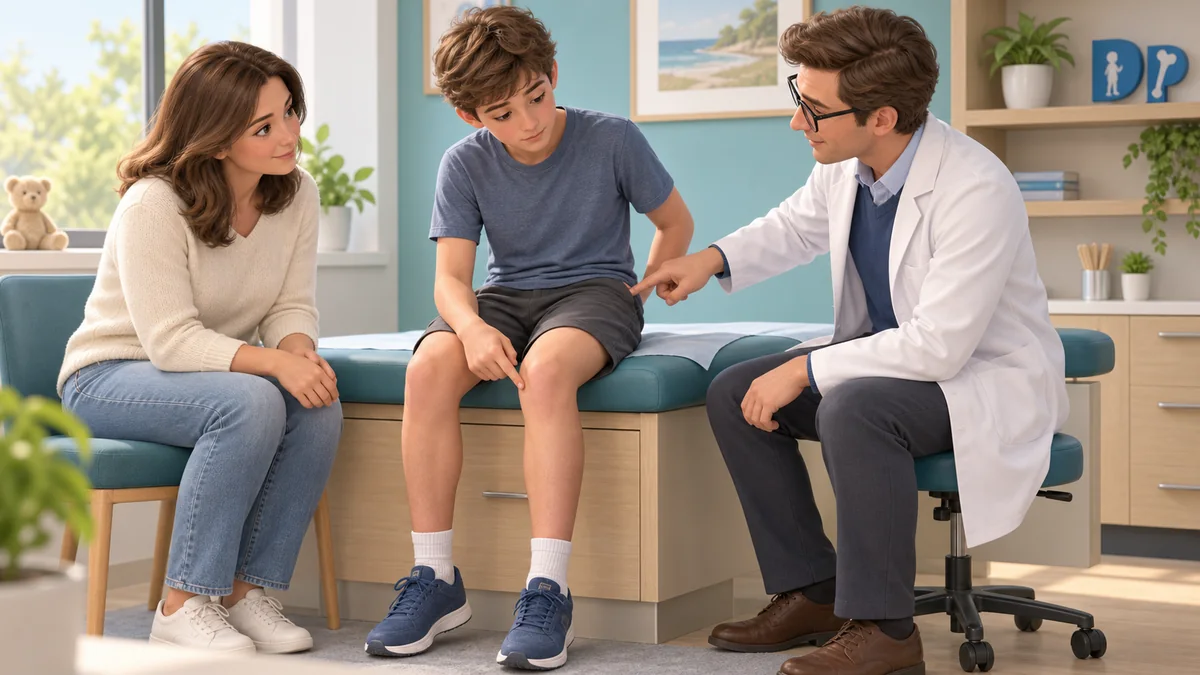
Knee pain may have hip origins
In adolescents, hip, thigh or knee pain with limping may originate in the hip. Prompt assessment is needed.
Read all the illustrated explanations →⚠️ Medical Emergency - Go to ER Immediately
SCFE (Slipped Capital Femoral Epiphysis) requires urgent evaluation. The child must NOT walk until seen.
Red Flags - Seek Immediate Care:
- Adolescent limping or refusing to walk
- Groin, thigh, or knee pain (may radiate)
- Leg turns outward when bending hip
- Overweight adolescent with hip symptoms
📞 Call 118 or go directly to the nearest Pediatric Emergency Department
Slipped capital femoral epiphysis (SCFE) is a slippage of the femoral head relative to the neck through the still-open growth plate. It typically affects adolescents in their growth spurt, more often males and overweight teens, and must be recognized quickly: it is considered a true orthopaedic emergency. Symptoms can be subtle: new-onset limping without clear trauma, hip, groin, or referred knee pain, difficulty rotating the limb internally, and a tendency to keep the foot turned outward. When an adolescent reports knee pain without a clear local cause, it is essential to also evaluate the hip. The suspicion is confirmed by clinical examination and targeted imaging. Care is generally surgical, aiming to stabilize the slip and prevent worsening; timing and modalities are decided rapidly, case by case, including monitoring of the contralateral hip.
If SCFE is suspected, the young person should not bear weight or perform exercises: urgent emergency assessment is needed. Adolescents of normal weight can also be affected.

🚨Watch the Overweight Teen with Limp
SCFE often affects adolescents during the pubertal growth spurt; excess weight is a risk factor but normal weight does not exclude it. Suspected SCFE requires stopping weight-bearing and urgent same-day assessment. Treatment aims to limit further slippage and complications but cannot eliminate every risk.
Assessment and treatment
When to seek evaluation
- Recent onset limping in adolescent
- Hip, groin or knee pain
- Limited hip internal rotation
- External rotation of the limb during hip flexion
- Overweight adolescent with joint symptoms
What is evaluated
- Careful clinical examination without forcing hip movements when SCFE is suspected
- History of limping and previous weight-bearing ability: the child is not asked to walk to test a suspected SCFE
- Hip X-rays in anteroposterior and lateral projection
- MRI only if X-rays are doubtful or negative and clinical suspicion persists, without delaying non-weight bearing, urgent referral and treatment
- Contralateral hip evaluation
Treatment options
- Early surgical stabilisation (in situ fixation)
- Non-weight bearing until surgery
- Contralateral hip monitoring
- Post-operative rehabilitation physical therapy
Frequently Asked Questions
Why can hip pain be referred to the knee?▼
Is SCFE really an emergency?▼
Can SCFE affect both hips?▼
Why is it more common in overweight teenagers?▼
How can families recognize early signs?▼
Can the child return to sports after surgery?▼
Important Notice: The information on this page is for educational and informational purposes only and does not constitute medical advice. Each clinical case is unique: the appropriate treatment is determined during the specialist consultation, based on a thorough clinical examination and, where necessary, diagnostic imaging. For any doubts or concerns, please consult a specialist.
Scientific references
- Loder RT, Dietz FR. What is the best evidence for the treatment of slipped capital femoral epiphysis? J Pediatr Orthop 2012;32 Suppl 2:S158-S165. PMID 22890456.
- Anghilieri FM et al. Contralateral slipped capital femoral epiphysis: a systematic review. EFORT Open Rev 2022;7(2):164-173. PMID 35192513.
- Khalifa A. Prophylactic fixation of the contralateral hip in slipped capital femoral epiphysis. Eur J Orthop Surg Traumatol 2025;35:84. PMID 40025359.