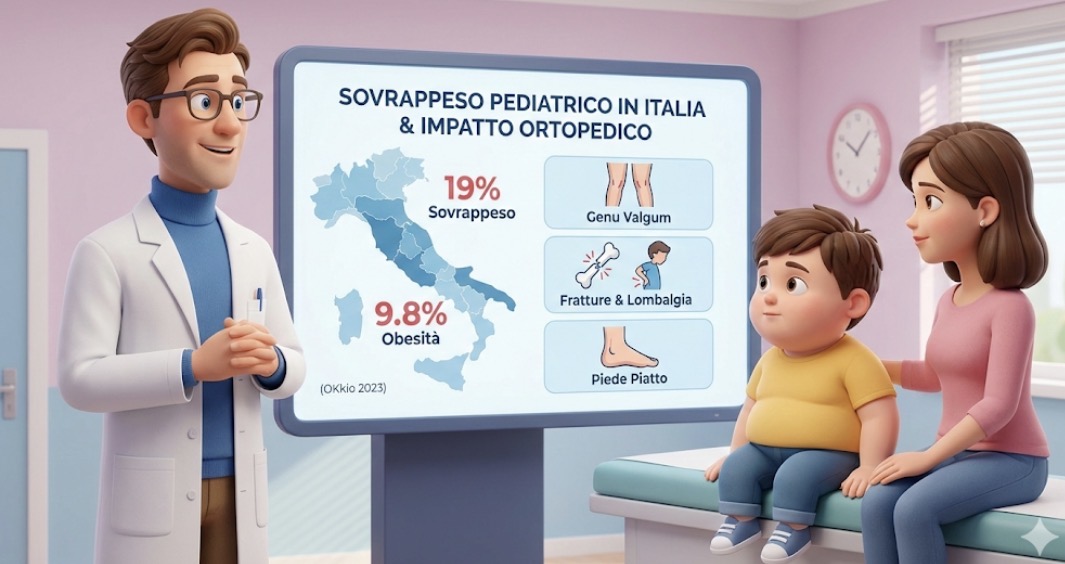
In Italy, childhood overweight and obesity remain very common, despite an improvement compared to the past. For pediatric orthopedics, this is not a "secondary" data point: recent literature links excess weight to more musculoskeletal pain, alignment alterations (particularly genu valgum and flat feet), more complex fractures, and greater management challenges. [1–7]
If we look at Italian numbers even before the clinic, the picture is clear: the problem is far from over. National surveillance data from OKkio alla SALUTE 2023 (ISS) report, in children aged 8–9 years, 19.0% overweight and 9.8% obesity, with a severe obesity rate of around 2.6%. The trend, compared to the first surveys, is improving, especially for overweight, but obesity has decreased less and in recent years shows substantial stabilization, with signs of a slight increase in some areas. Furthermore, there remains marked geographical variability, with higher prevalences in Central-Southern Italy. [1][2]
For those involved in pediatric orthopedics, this epidemiological data is not just a "public health" premise. It is a part of daily clinical practice. In recent years, the literature has consolidated a simple concept: childhood overweight not only increases the mechanical load on joints but modifies the behavior of the entire growing musculoskeletal system, with effects on alignment, pain, bone, and traumatology. [3][4][5][6][7]
A first point, often underestimated, is the relationship between excess weight and malalignments. The systematic review with meta-analysis by Molina-Garcia and colleagues (73 studies, over 1.7 million children/adolescents) showed a significant association between overweight/obesity and various postural/articular alterations. The most robust results concern genu valgum and flat feet, but an increased risk of lumbar hyperlordosis and, in general, joint malalignment also emerges. In particular, the signal for genu valgum is very strong (high RR compared to normal-weight peers), and it is one of the most useful pieces of information to remember when we encounter a child with genu valgum and symptoms of overload. [4]
This does not mean, of course, that every genu valgum is "caused" by weight. That would be a wrong simplification. Growth, the femoro-tibial axis, laxity, family history, and pubertal timing always matter. But the literature tells us that overweight can act as a biomechanical and functional amplifier: a mild or moderate alteration can become symptomatic earlier, and above all, less tolerated in daily and sporting activities. [4]
The second block of evidence concerns musculoskeletal pain, which is the real reason many families seek medical attention. The longitudinal study by Firman et al. on general practice data (a large pediatric cohort with linked clinical records) shows that children with obesity are more likely to consult for musculoskeletal symptoms during childhood, with a particularly evident signal in females. From a practical point of view, this is important data because it confirms what we often see: knee, back, ankle, and foot pain are not just "growing pains," but can be the early expression of persistent overload. [5]
On the topic of the spine, the 2024 meta-analysis on low back pain in pediatric and adolescent age adds another useful piece. The association between high BMI and back pain exists, even if the studies are heterogeneous and with varying risk of bias. In other words: pediatric low back pain cannot be reduced to weight, but ignoring body weight in the evaluation of an adolescent with recurrent low back pain means missing a relevant risk factor. [6]
The third area is traumatology. Here the point is not just "more fractures," but also different fractures and more complex management. Orthopedic reviews dedicated to pediatric obesity describe an increased risk of musculoskeletal injuries, fractures, and lower limb deformities, as well as an impact on bone quality and the response to conservative treatments (for example, immobilizations and braces that are less tolerated or less effective in some contexts). [3] A specific study on upper limb fractures confirms that overweight/obesity is associated with different fracture characteristics. [7]
Here, a more "cross-cutting" but often little-discussed topic also comes into play: bone health. A review of new developments in pediatric orthopedics emphasizes that obesity should not be interpreted as automatic protection for growing bone. The relationship between body mass, bone quality, low-grade chronic inflammation, vitamin D, physical activity, and fracture risk is more complex than it seems. This part is less immediate to explain to families, but clinically it is important: high weight does not necessarily equate to "stronger" bone. [8]
If we put this data together, the message for an updated approach is quite clear. In pediatric orthopedics, weight should not be treated as a separate chapter, nor as a final comment during the visit. It should be integrated into the initial assessment, especially when we talk about lower limb pain, genu valgum, symptomatic flat feet, low back pain, recurrent trauma, or difficulty in functional recovery. Not to blame, but to practice more comprehensive medicine.
Practically, this changes counseling. The point is not to tell the family "they just need to lose weight." The point is to explain that the orthopedic symptom is real, that it needs to be treated, and that weight can influence its intensity, persistence, and recurrence. In many cases, the best results come when working on multiple levels simultaneously: managing sports load, strengthening and motor control, daily habits, and — when possible — gradual improvement of lifestyle. It is a slower approach, but also more honest and more effective.
In summary: in Italy, the numbers of excess weight in pediatric age remain high, and orthopedic literature tells us that the clinical consequences are concrete. The issue does not only concern future metabolic prevention; it also concerns the pain, function, and quality of life of the children we see in the clinic today. [1–8]
Disclaimer
This content is for informational purposes only and does not replace an individual clinical evaluation.
References
[1] Istituto Superiore di Sanità. Rapporto ISTISAN 25/3: Stato ponderale e stili di vita di bambine e bambini. Risultati di OKkio alla SALUTE 2023. Dati nazionali (8–9 anni: 19,0% sovrappeso; 9,8% obesità) e trend 2008–2023.
[2] Sintesi ISS/agenzie stampa sui dati OKkio alla SALUTE 2023 (obesità grave ~2,6%; variabilità regionale; trend nel tempo).
[3] Tisano B, Anigian K, Kantorek N, et al. The Insidious Effects of Childhood Obesity on Orthopedic Injuries and Deformities. Orthop Clin North Am. 2022;53(4):461-472. doi:10.1016/j.ocl.2022.06.008.
PubMed: https://pubmed.ncbi.nlm.nih.gov/36208888/
[4] Molina-Garcia P, Miranda-Aparicio D, Ubago-Guisado E, et al. The Impact of Childhood Obesity on Joint Alignment: A Systematic Review and Meta-Analysis. Phys Ther. 2021;101(7):pzab066. doi:10.1093/ptj/pzab066.
PubMed: https://pubmed.ncbi.nlm.nih.gov/33580953/
Journal (abstract/results): https://academic.oup.com/ptj/article-abstract/doi/10.1093/ptj/pzab066/6134724
[5] Firman N, Homer K, Harper G, Robson J, Dezateux C. Are children living with obesity more likely to experience musculoskeletal symptoms during childhood? A linked longitudinal cohort study using primary care records. Arch Dis Child. 2024;109(5):414-421. doi:10.1136/archdischild-2023-326407.
PubMed: https://pubmed.ncbi.nlm.nih.gov/38471744/
[6] García-Moreno JM, Calvo-Muñoz I, Gómez-Conesa A, López-López JA. Obesity and overweight as risk factors for low back pain in children and adolescents: a meta-analysis. Int J Obes (Lond). 2024;48(5):612-625. doi:10.1038/s41366-024-01475-w.
PubMed: https://pubmed.ncbi.nlm.nih.gov/38273033/
Journal: https://www.nature.com/articles/s41366-024-01475-w
[7] Nhan DT, Leet AI, Lee RJ. Associations of childhood overweight and obesity with upper-extremity fracture characteristics. Medicine (Baltimore). 2021;100(18):e25302. doi:10.1097/MD.0000000000025302.
PubMed: https://pubmed.ncbi.nlm.nih.gov/33950919/
Full text (PMC): https://pmc.ncbi.nlm.nih.gov/articles/PMC8104144/
[8] Beck JJ, Mahan ST, Nowicki P, Schreiber VM, Minkowitz B. What Is New in Pediatric Bone Health. J Pediatr Orthop. 2021;41(8):e594-e599. doi:10.1097/BPO.0000000000001896.