Sports Traumatology
Sprains, strains and overload pain in young athletes: evaluation and criteria for return to sport.
Quick Answers
How much rest is needed to recover from a sports injury?
Can my child keep playing sports with knee pain?
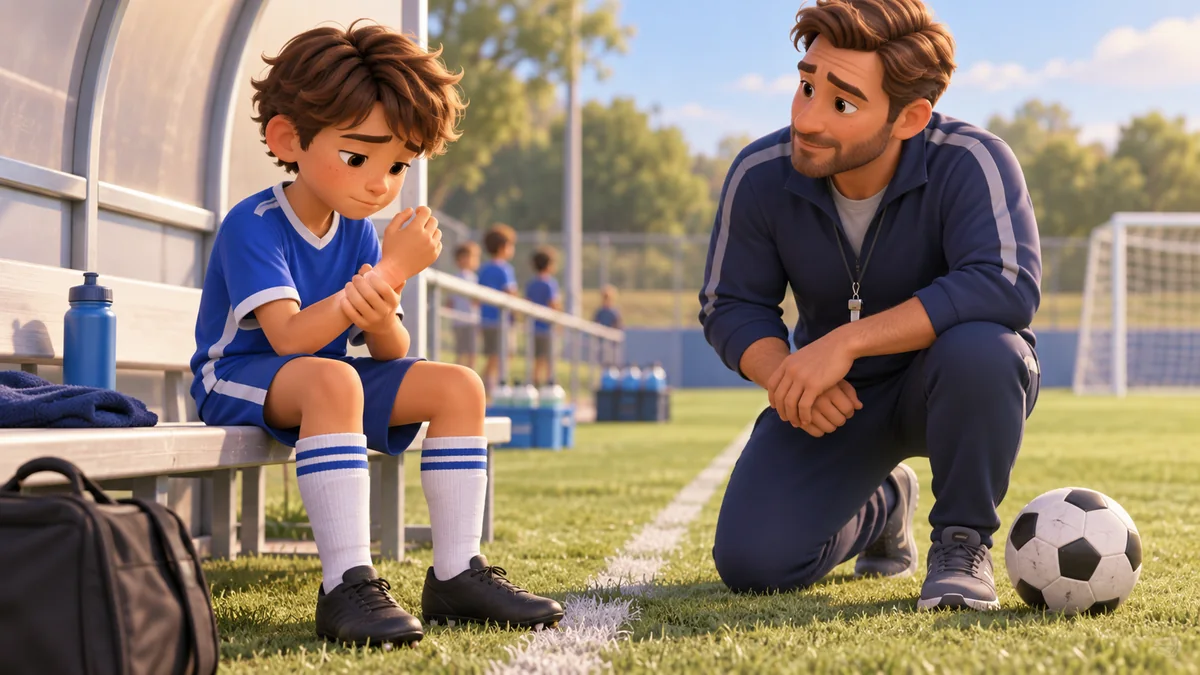
Stop after an injury
Pain, swelling or loss of function deserve attention. A growth area may also be injured in a child.
Read all the illustrated explanations →Sports injuries in children and adolescents are not simply "smaller adult injuries": the growing musculoskeletal system responds to load differently from the mature one, with specific points of vulnerability related to the growth plates, tendon insertions and the balance between muscular development and training rhythm.
Two large families can essentially be distinguished: acute injuries (sprains, contusions, strains, ligament lesions, impact fractures) and overuse disorders that develop gradually, typically at the sites where tendons attach to a still-growing bone (for a dedicated overview see juvenile osteochondroses). The two often coexist: poorly managed chronic overload may predispose to an acute episode.
The aim of the path is not just to "get the young athlete back on the field", but to do it the right way: identifying the real cause of pain, modulating training load, working on strength and mobility and defining a gradual and safe return to sport, reducing the risk of recurrences and long-term consequences on growth.
⚠️ Acute injuries: after an acute episode (a clear fall, twist or "pop") with swelling, giving way or inability to continue the activity, it is reasonable not to delay assessment. The timing of follow-up depends on the injury: some fractures or joint lesions need early re-evaluation, because they may displace or because reduction options change once healing begins. Urgent situations remain evident deformity, open wounds, neurovascular deficits or uncontrolled pain.
The athlete's knee: ligaments, meniscus and cartilage
In older children and adolescents practising sport, the knee may be involved in sprain trauma, changes of direction, jump landings, contact play or twisting episodes. Not all sprains are alike: in some cases ligaments, menisci or articular surfaces may be involved.
Persistent pain, swelling, a sense of giving way, joint locking, difficulty running or returning to sport deserve adequate assessment, especially when trauma occurs in sports with changes of direction such as football, basketball, skiing, volleyball, rugby or contact sports.
Anterior cruciate ligament injury in children and adolescents
Anterior cruciate ligament injury, or ACL, is one of the most important sports knee lesions. In adolescents it may appear after sprain trauma, a change of direction, a jump landing or an episode in which the knee "gives way".
In growing patients the reasoning differs from adults: skeletal age, growth plates, knee stability, sport practised, possible associated meniscal or cartilage lesions and functional goals must be considered. For this reason, a one-size-fits-all solution is not appropriate.
A knee that continues to feel unstable, swollen or difficult to return to sport after a sprain deserves specialist evaluation.
Collateral ligaments: MCL and LCL
Alongside the anterior cruciate, sports trauma may also involve the collateral ligaments. The medial collateral ligament, or MCL, lies on the inner side of the knee and is often stressed in valgus trauma or lateral contact. The lateral collateral ligament, or LCL, lies on the outer side and is less frequently isolated, but may be part of more complex knee trauma.
In children and adolescents, the evaluation concerns not only pain on the inner or outer side of the knee, but also stability, association with other lesions and any clinical or radiographic signs that require further assessment.
Meniscal lesions in sport
The menisci are important structures for load distribution and knee stability. In children and adolescents they may be injured after twisting trauma, sports sprains or in association with ligament lesions, particularly of the anterior cruciate ligament.
Localised pain, swelling, clicks, joint locking or difficulty fully extending the knee may require targeted evaluation. In young patients, when possible, reasoning tends to give particular importance to meniscus preservation, but every choice depends on the type of lesion, symptoms, age and the examinations performed.
Osteochondritis dissecans and pain in sport
Not all knee pain in sport comes from obvious trauma. In some sporting children and adolescents, persistent or recurrent pain may also be related to cartilage and subchondral bone problems, such as osteochondritis dissecans of the knee, often abbreviated as OCD.
OCD of the knee may cause pain during or after activity, swelling, difficulty with sports loading and, in more advanced forms, mechanical symptoms. It requires specific assessment because skeletal age, lesion stability and symptoms influence the pathway. For an overview of paediatric knee trauma see also knee trauma in children and adolescents.
When a paediatric orthopaedic check-up may be useful — After a sports knee trauma, a specialist evaluation may be useful if pain persists, if significant swelling appears, if the knee gives way, if there is joint locking, if the child struggles to return to sport, or if X-rays, ultrasound or MRI have already been performed with unresolved doubts.

⚠️Sports Are Good, But Watch for Signs
Sports injuries in children require special attention because they involve growth plates. Don't underestimate persistent pain after trauma: an early evaluation rules out growth plate injuries and helps plan a safe return to activity.
Assessment and treatment
When to seek evaluation
- Persistent pain during or after sports activity
- Recurrent joint swelling after each training session
- Feeling of instability, giving way or joint locking
- Drop in performance or difficulty with sport-specific movements
- Acute trauma during sports practice with persistent pain
What is evaluated
- Detailed sports history (discipline, training load, schedule)
- Targeted joint and muscular clinical examination
- Functional assessment of sport-specific movements
- Targeted imaging based on clinical suspicion
- Balance between load, recovery and the child's growth phase
Treatment options
- Modification of training load and periods of relative rest
- Targeted physical therapy and personalized recovery paths
- Management of overuse pain typical of the growing age
- Treatment of ligament, muscular and meniscal injuries
- Gradual, goal-oriented return-to-sport program
Frequently Asked Questions
How much rest is needed to recover from a sports injury?▼
Can my child keep playing sports with knee pain?▼
How can injuries be prevented in young athletes?▼
When is a sports injury not 'just growth'?▼
What does 'gradual return to sport' mean?▼
Important Notice: The information on this page is for educational and informational purposes only and does not constitute medical advice. Each clinical case is unique: the appropriate treatment is determined during the specialist consultation, based on a thorough clinical examination and, where necessary, diagnostic imaging. For any doubts or concerns, please consult a specialist.