Paediatric Orthopaedic Specialist
Congenital muscular torticollis
Home Exercise Program
Not every exercise listed here is suitable for every child: the selection is individual and is defined during the consultation.
For whom: After diagnosis of congenital muscular torticollis and early physiotherapy assessment. Direction, handling and dose must be demonstrated with the child. Do not infer the side from a photo; stop for persistent crying or resistance.
Dose and frequency: Perform only the exercises selected during the visit. The listed dosages are examples to adapt: follow the dose, frequency, rest and progression prescribed for age, symptoms and phase. Do not automatically perform the whole list.
Equipment and supervision: A stable, clear surface, an adult continuously present and an age-appropriate toy. The baby should be awake and calm; place them on their back for sleep. Follow the cast or harness programme.
Avoid: Forcing the head or a limb, persisting through crying or provoking joint clicks; Repeating manoeuvres not demonstrated with your baby; Changing straps, brace settings or wearing time without instructions.
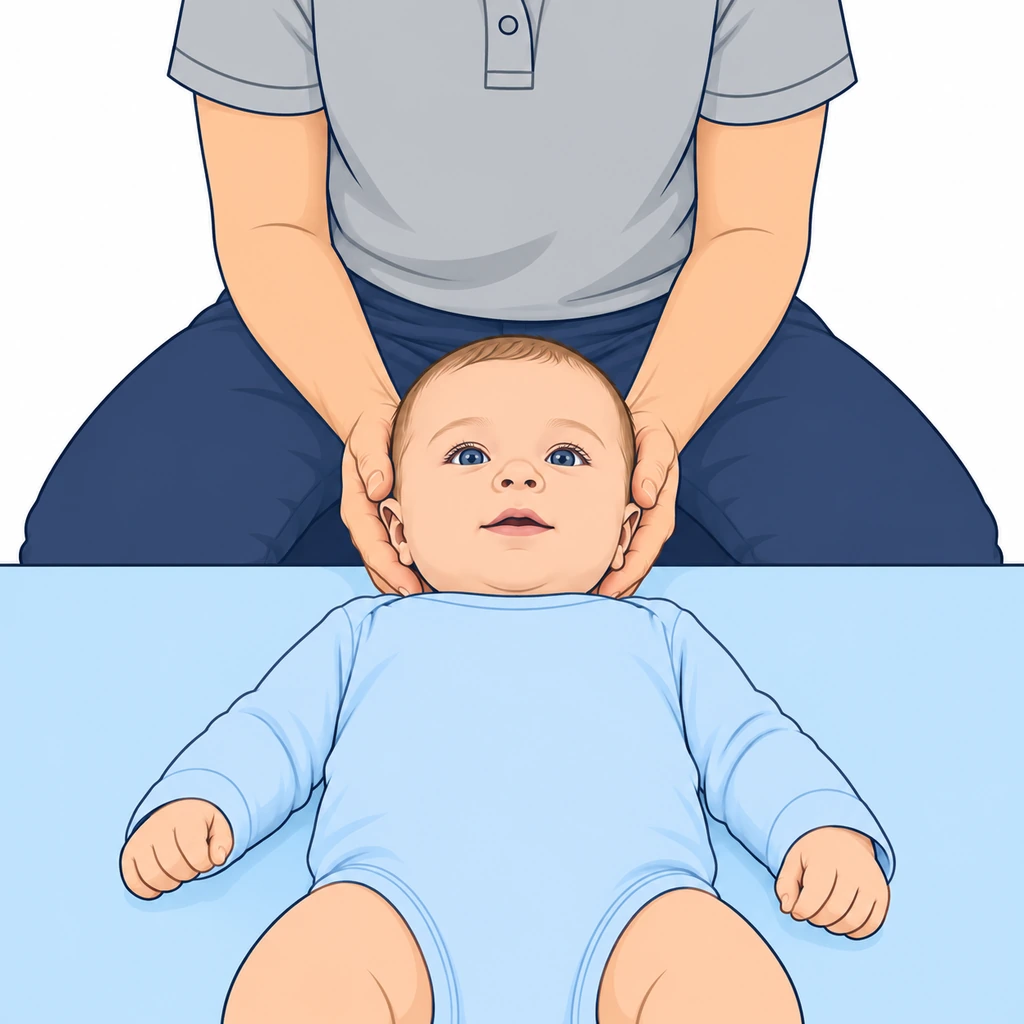
1.Sternocleidomastoid (SCM) stretching
Learn the stretch from a physiotherapist after the neck has been assessed.
The figure illustrates head support, not the stretch direction: the side and movement must be taught with your baby.
Repeat only the hand placement, side and movement demonstrated by the physiotherapist. In typical muscular torticollis, correction combines a head tilt away from the shortened muscle and chin rotation towards that muscle; do not determine the side from a photograph. Support the head without traction or sudden movements. Stop if the baby resists, cries or appears in pain.
Agree duration, repetitions and frequency with the physiotherapist; do not use a fixed dose at every nappy change.
2.Positioning and visual stimulation
Encourages baby to actively turn head toward correct side
During awake play, offer your face or a toy on the side where active rotation is limited, as identified at the assessment. In typical muscular torticollis this is the side of the shortened muscle. Let the baby follow the stimulus without turning the head with your hands. Vary positions during care. For sleep, always place the baby on their back on a flat surface, without pillows or positioning devices.
Short opportunities for play throughout the day, respecting fatigue and tolerance.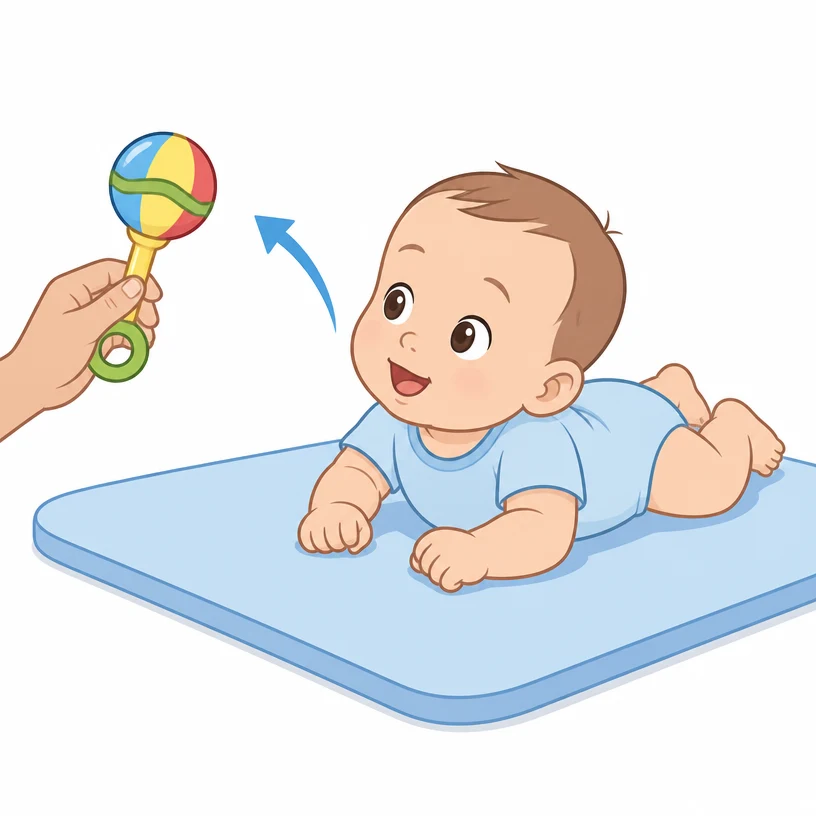
3.Guided tummy time
Strengthens neck muscles and promotes symmetry
Only while awake and continuously supervised by an adult: place the baby on their tummy on a stable, clear mat. Offer your voice or a toy in the direction recommended by the physiotherapist, without forcing the head. Stop when the baby tires or falls asleep; for sleep, place them on their back in their safe sleeping space.
Short, frequent sessions, initially even 1-2 minutes if tolerated; increase according to the baby’s response.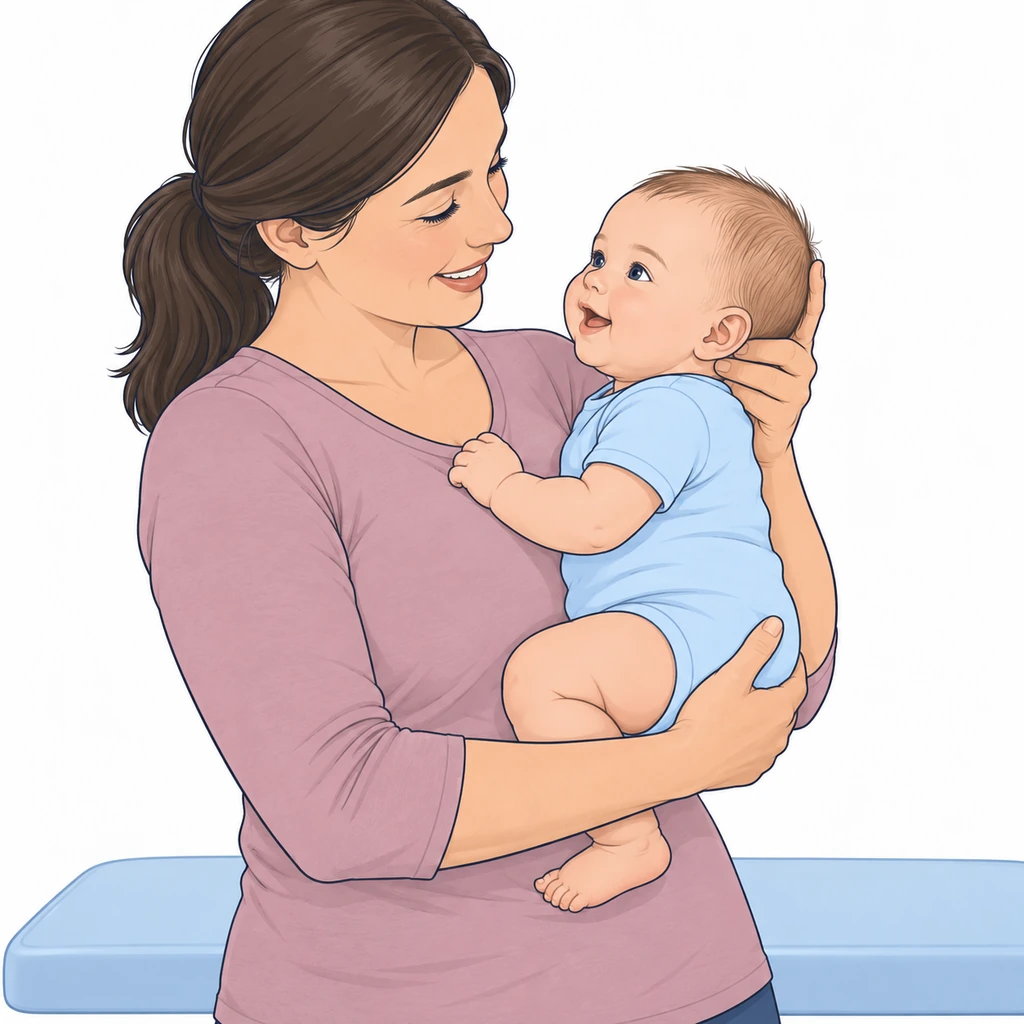
4.Carrying in corrective position
Carrying positions taught to encourage active, symmetrical movement.
Use the positions demonstrated by the physiotherapist, supporting the head and trunk appropriately for age. Encourage looking in the recommended direction without holding the neck tilted by pushing with your hand. Carrying is not a continuous passive stretch.
During care, alternating comfortable positions.
RED FLAGS - When to stop and contact the doctor immediately
Stop the exercises immediately and contact the specialist (or go to the emergency department if severe) if any of the following occur:
- Persistent crying, pain or resistance during handling: stop and contact the treating clinician.
- Fever, malaise, swelling or redness: seek prompt assessment.
- Sudden reduction of limb movement, cold or discoloured toes, or a compressive cast or harness: urgent assessment.
- Sudden head tilt, especially after injury or with fever, unusual eye movements or weakness: do not stretch and seek assessment.
In case of doubt, always prefer a check-up over continuing the exercises.
Dott. Daniele Priano
Paediatric Orthopaedics - ASST Gaetano Pini-CTO
Content version: 21 September 2026
ortopediaevolutiva.com • Printed: 18/10/2026
 Full sheet and videos
https://ortopediaevolutiva.com/en/parents-kids/exercises/parent-mobilizations/congenital-torticollis
Prepare the visit handout
Use the condition and phase indicated by your clinician. You can leave out individual exercises; instructions, illustrations and safety advice remain together.
Exclude exercises if needed
4 of 4 exercise cards included
The full web page remains available. Your selection is not saved or shared.
Before You Start
Who is this guide for?
After diagnosis of congenital muscular torticollis and early physiotherapy assessment. Direction, handling and dose must be demonstrated with the child. Do not infer the side from a photo; stop for persistent crying or resistance.
What you need
A stable, clear surface, an adult continuously present and an age-appropriate toy. The baby should be awake and calm; place them on their back for sleep. Follow the cast or harness programme.
Suggested frequency
Perform only the exercises selected during the visit. The listed dosages are examples to adapt: follow the dose, frequency, rest and progression prescribed for age, symptoms and phase. Do not automatically perform the whole list.
Common mistakes to avoid
- •Forcing the head or a limb, persisting through crying or provoking joint clicks
- •Repeating manoeuvres not demonstrated with your baby
- •Changing straps, brace settings or wearing time without instructions
⚠️ Red flags — when to stop and contact the doctor immediately
Stop exercises immediately and contact the specialist if any of the following occur:
- Persistent crying, pain or resistance during handling: stop and contact the treating clinician.
- Fever, malaise, swelling or redness: seek prompt assessment.
- Sudden reduction of limb movement, cold or discoloured toes, or a compressive cast or harness: urgent assessment.
- Sudden head tilt, especially after injury or with fever, unusual eye movements or weakness: do not stretch and seek assessment.
Detailed Exercises
- 1
Sternocleidomastoid (SCM) stretching
Learn the stretch from a physiotherapist after the neck has been assessed.
The figure illustrates head support, not the stretch direction: the side and movement must be taught with your baby.
Repeat only the hand placement, side and movement demonstrated by the physiotherapist. In typical muscular torticollis, correction combines a head tilt away from the shortened muscle and chin rotation towards that muscle; do not determine the side from a photograph. Support the head without traction or sudden movements. Stop if the baby resists, cries or appears in pain.
Agree duration, repetitions and frequency with the physiotherapist; do not use a fixed dose at every nappy change. - 2
Positioning and visual stimulation
Encourages baby to actively turn head toward correct side
During awake play, offer your face or a toy on the side where active rotation is limited, as identified at the assessment. In typical muscular torticollis this is the side of the shortened muscle. Let the baby follow the stimulus without turning the head with your hands. Vary positions during care. For sleep, always place the baby on their back on a flat surface, without pillows or positioning devices.
Short opportunities for play throughout the day, respecting fatigue and tolerance.Active head turn towards a toy
Press Play to load the video. Follow the instructions and precautions on this exercise sheet.
Only active head turning towards a toy during awake play, on the side selected at assessment. It does not demonstrate the full positioning programme or sleep guidance.
- 3
Guided tummy time
Strengthens neck muscles and promotes symmetry
Only while awake and continuously supervised by an adult: place the baby on their tummy on a stable, clear mat. Offer your voice or a toy in the direction recommended by the physiotherapist, without forcing the head. Stop when the baby tires or falls asleep; for sleep, place them on their back in their safe sleeping space.
Short, frequent sessions, initially even 1-2 minutes if tolerated; increase according to the baby’s response.Supervised tummy-time play
Press Play to load the video. Follow the instructions and precautions on this exercise sheet.
Brief illustration of awake, supervised tummy-time play. It does not demonstrate an individual therapeutic side or dose; follow the physiotherapist’s instructions. For sleep, always supine in a safe sleep space.
- 4
Carrying in corrective position
Carrying positions taught to encourage active, symmetrical movement.
Use the positions demonstrated by the physiotherapist, supporting the head and trunk appropriately for age. Encourage looking in the recommended direction without holding the neck tilted by pushing with your hand. Carrying is not a continuous passive stretch.
During care, alternating comfortable positions.
Frequently Asked Questions
Does congenital torticollis correct on its own?
Early assessment by a physiotherapist experienced in infants helps identify the movement limitation and teach a programme suited to the child. Do not wait for home stretches to fail. The clinician also checks for causes other than muscular torticollis.