Paediatric Orthopaedic Specialist
After wrist cast
Home Exercise Program
Not every exercise listed here is suitable for every child: the selection is individual and is defined during the consultation.
For whom: After cast removal and confirmation of healing: start only authorised movements. Loading, resistance and sport need fracture-specific instructions; avoid forced passive manoeuvres. Gradual daily activities are sufficient in many uncomplicated cases.
Dose and frequency: Perform only the exercises selected during the visit. The listed dosages are examples to adapt: follow the dose, frequency, rest and progression prescribed for age, symptoms and phase. Do not automatically perform the whole list.
Equipment and supervision: A stable, clear surface, comfortable clothing and a secure support. Check resistance-band anchors. Adult supervision; avoid marbles and small objects if the child may put them in their mouth, using a towel instead.
Avoid: Forcing a painful or unauthorised movement; Increasing load, resistance or frequency without the agreed rest periods; Doing balance exercises without stable support or supervision.
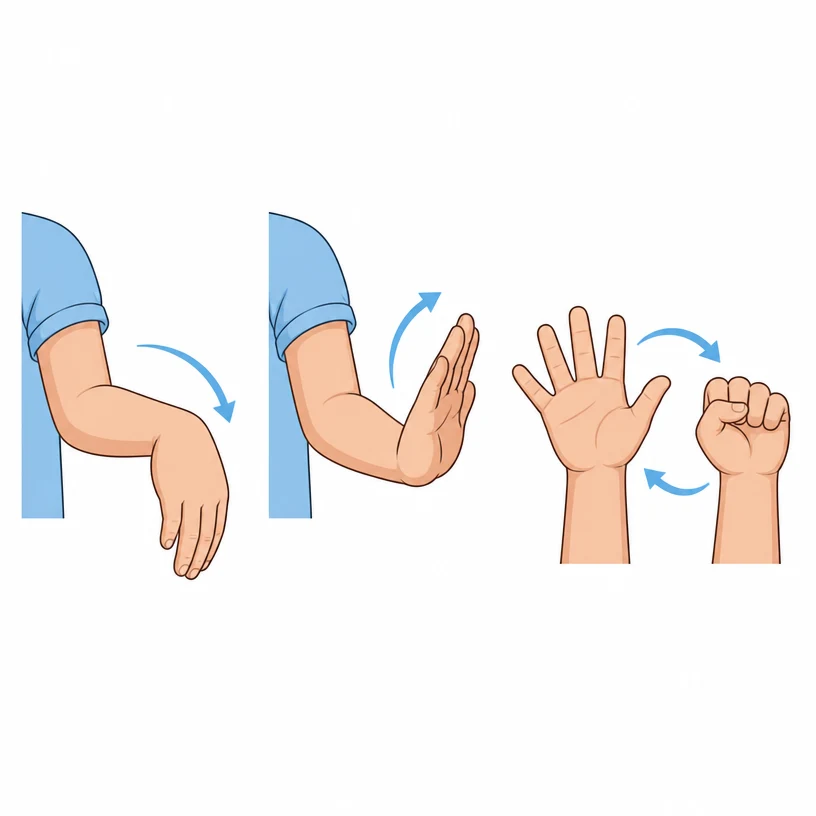
1.Wrist and finger mobility recovery
After immobilization, wrist and fingers are stiff
When movement is permitted, open and close the hand, touch each fingertip with the thumb and slowly move the wrist in permitted directions. Start within a comfortable range; mild stiffness may be normal. Reduce or stop if pain or swelling increases.
Individual dose to complete with the clinician: repetitions or duration ___; sets ___; rest ___; times per day/week ___. Complete before using this sheet as an exercise programme.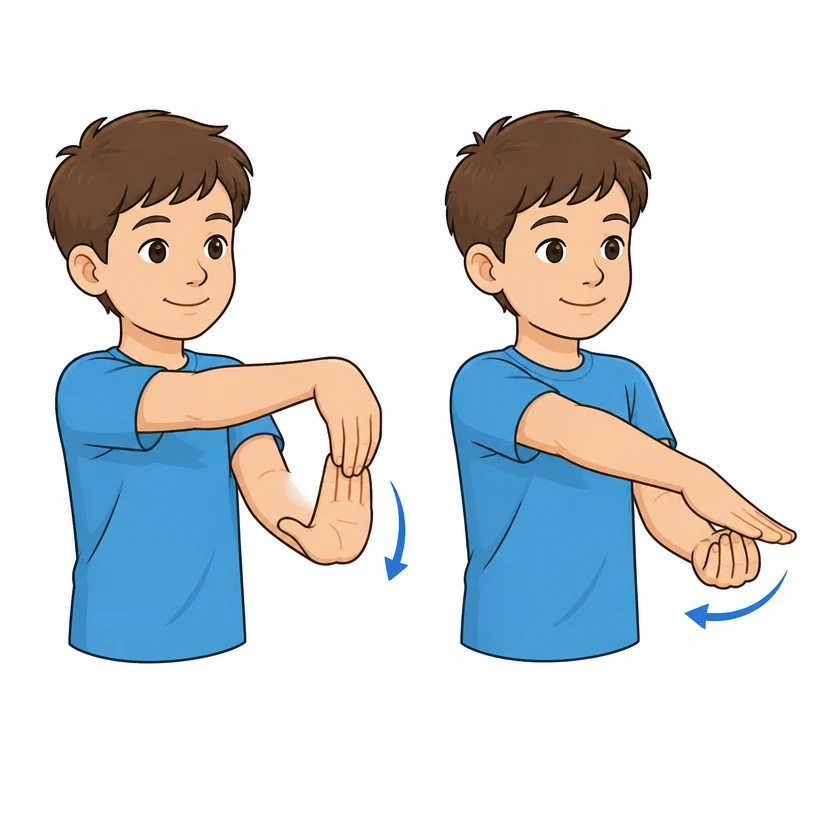
2.Forearm stretch (flexors/extensors)
Assisted stretching only if advised for this injury
Assisted stretching only if prescribed and demonstrated for this fracture. Support the forearm and guide a small wrist movement in the indicated direction with the other hand, without pulling the fingers or pushing through pain or resistance.
Individual dose to complete with the clinician: repetitions or duration ___; sets ___; rest ___; times per day/week ___. Complete before using this sheet as an exercise programme.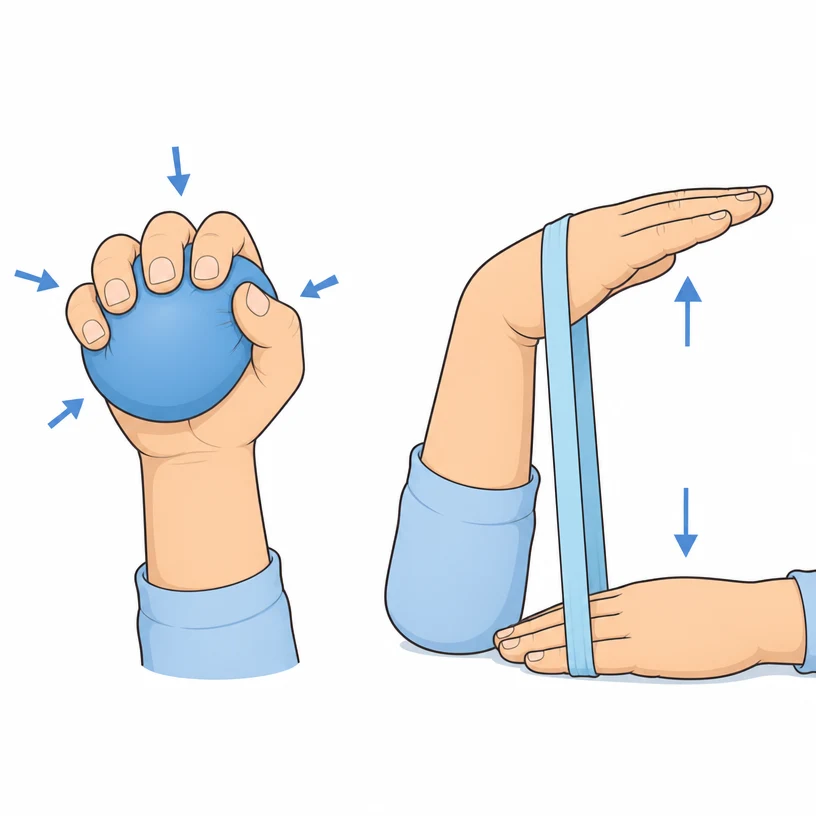
3.Progressive strengthening
Gradually recover hand and forearm strength
Only when resistance is authorised: squeeze a soft ball or move the wrist against a light band in the direction demonstrated by the clinician. Increase load according to symptoms and individual advice; daily use may already be enough.
Individual dose to complete with the clinician: repetitions or duration ___; sets ___; rest ___; times per day/week ___. Complete before using this sheet as an exercise programme.
RED FLAGS - When to stop and contact the doctor immediately
Stop the exercises immediately and contact the specialist (or go to the emergency department if severe) if any of the following occur:
- Acute or sudden pain during exercise
- Significant swelling after exercises
- Pain that progressively worsens over days
- Fever or general malaise
- Difficulty walking or using the limb after exercises
- Any neurological symptoms (tingling, numbness, sudden weakness)
- A red or hot joint, or inability to bear weight: seek prompt assessment; use emergency care if severe.
In case of doubt, always prefer a check-up over continuing the exercises.
Dott. Daniele Priano
Paediatric Orthopaedics - ASST Gaetano Pini-CTO
Content version: 24 September 2026
ortopediaevolutiva.com • Printed: 18/10/2026
 Full sheet and videos
https://ortopediaevolutiva.com/en/parents-kids/exercises/post-cast/after-wrist-cast
Prepare the visit handout
Use the condition and phase indicated by your clinician. You can leave out individual exercises; instructions, illustrations and safety advice remain together.
Exclude exercises if needed
3 of 3 exercise cards included
The full web page remains available. Your selection is not saved or shared.
Before You Start
Who is this guide for?
After cast removal and confirmation of healing: start only authorised movements. Loading, resistance and sport need fracture-specific instructions; avoid forced passive manoeuvres. Gradual daily activities are sufficient in many uncomplicated cases.
What you need
A stable, clear surface, comfortable clothing and a secure support. Check resistance-band anchors. Adult supervision; avoid marbles and small objects if the child may put them in their mouth, using a towel instead.
Suggested frequency
Perform only the exercises selected during the visit. The listed dosages are examples to adapt: follow the dose, frequency, rest and progression prescribed for age, symptoms and phase. Do not automatically perform the whole list.
Common mistakes to avoid
- •Forcing a painful or unauthorised movement
- •Increasing load, resistance or frequency without the agreed rest periods
- •Doing balance exercises without stable support or supervision
⚠️ Red flags — when to stop and contact the doctor immediately
Stop exercises immediately and contact the specialist if any of the following occur:
- Acute or sudden pain during exercise
- Significant swelling after exercises
- Pain that progressively worsens over days
- Fever or general malaise
- Difficulty walking or using the limb after exercises
- Any neurological symptoms (tingling, numbness, sudden weakness)
- A red or hot joint, or inability to bear weight: seek prompt assessment; use emergency care if severe.
Detailed Exercises
- 1
Wrist and finger mobility recovery
After immobilization, wrist and fingers are stiff
When movement is permitted, open and close the hand, touch each fingertip with the thumb and slowly move the wrist in permitted directions. Start within a comfortable range; mild stiffness may be normal. Reduce or stop if pain or swelling increases.
Individual dose to complete with the clinician: repetitions or duration ___; sets ___; rest ___; times per day/week ___. Complete before using this sheet as an exercise programme.Open and close your hand
Press Play to load the video. Follow the instructions and precautions on this exercise sheet.
Shows opening and closing the hand only, when permitted by the clinician; finger opposition and wrist movements are separate components.
Wrist up-and-down movement
Press Play to load the video. Follow the instructions and precautions on this exercise sheet.
Shows wrist up-and-down movement only, after confirmed healing and clinician clearance. It does not demonstrate every component of the exercise sheet.
- 2
Forearm stretch (flexors/extensors)
Assisted stretching only if advised for this injury
Assisted stretching only if prescribed and demonstrated for this fracture. Support the forearm and guide a small wrist movement in the indicated direction with the other hand, without pulling the fingers or pushing through pain or resistance.
Individual dose to complete with the clinician: repetitions or duration ___; sets ___; rest ___; times per day/week ___. Complete before using this sheet as an exercise programme. - 3
Progressive strengthening
Gradually recover hand and forearm strength
Only when resistance is authorised: squeeze a soft ball or move the wrist against a light band in the direction demonstrated by the clinician. Increase load according to symptoms and individual advice; daily use may already be enough.
Individual dose to complete with the clinician: repetitions or duration ___; sets ___; rest ___; times per day/week ___. Complete before using this sheet as an exercise programme.