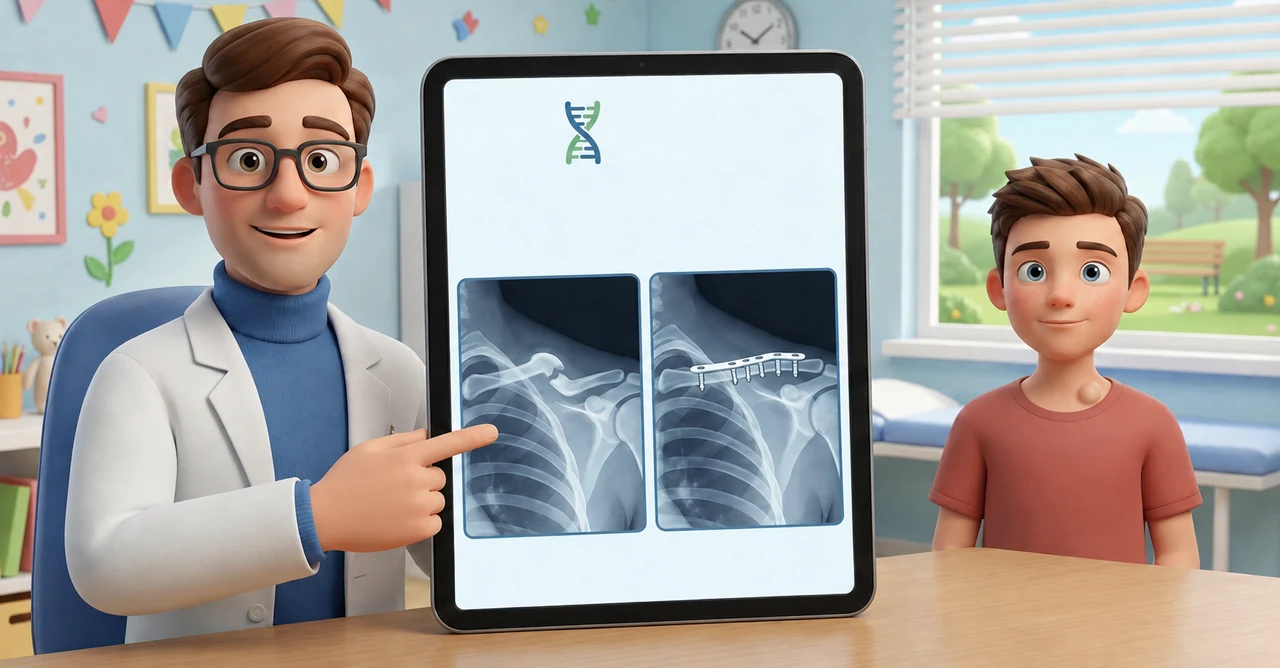
Diaphyseal clavicle fractures in adolescents often heal well without surgery, even when X-rays show significant displacement. In recent years, surgical fixation has become more frequent, partly by analogy with adult treatment, but pediatric data require a more cautious selection. [1–4]
The Strongest Indications
Open fracture, neurovascular compromise, and a real threat to the skin are situations where surgical indication is strong. Some complex shoulder girdle injuries and polytrauma may also require stabilization. [3][4]
Simple skin tenting must be distinguished from true skin compromise. In the 2025 FACTS cohort, among 88 adolescents with completely displaced fractures and tenting, about one-third were initially treated non-surgically, and none developed skin complications; 10% then underwent early fixation. [5]
Severely Displaced Fractures
Complete displacement, shortening, and comminution make surgical discussion understandable, especially in adolescents close to skeletal maturity. However, these alone do not constitute an absolute indication.
The multicenter prospective FACTS data have scaled back the idea that surgical fixation systematically improves patient-reported outcomes compared to conservative treatment. [1]
Surgery realigns the clavicle and can make the course more predictable in selected cases, but it introduces specific risks: plate irritation, wound problems, altered skin sensation, and possible second surgery to remove the hardware. [1–3]
Sports and Skeletal Maturity
For adolescent athletes, the type of sport, competitive level, season, and skeletal maturity are important. An adolescent nearing the end of growth has less remodeling potential than a younger child.
However, surgery does not guarantee a faster return to sport in every case. This aspect should be discussed without turning competitive demands into an automatic indication. [2][4]
When Conservative Treatment Remains Appropriate
In the absence of absolute indications, with intact skin, normal neurovascular function, and manageable pain, non-surgical treatment remains appropriate for many even severely displaced fractures. [1–3]
Follow-up serves to monitor pain, function, and skin condition, and to ensure that the recovery path remains consistent with initial expectations.
How I Discuss the Choice
In borderline situations, I consider fracture morphology, biological age, functional demands, surgical risk, and family preferences together. The X-ray is part of the decision, but does not replace it.
Disclaimer
Informational content; does not replace an individual clinical evaluation.
References
[1] Heyworth BE, et al. Prospective multicenter (FACTS): operative vs nonoperative in adolescent midshaft clavicle fractures. PubMed:
https://pubmed.ncbi.nlm.nih.gov/35984091/
[2] Patel M, et al. Clavicular Fractures in the Adolescent. JBJS. 2023. PubMed:
https://pubmed.ncbi.nlm.nih.gov/36753567/
[3] Markes AR, et al. Management of Displaced Midshaft Clavicle Fractures in Pediatrics and Adolescents. Open access:
https://pmc.ncbi.nlm.nih.gov/articles/PMC9636878/
[4] Fanter NJ, et al. Surgical Treatment of Clavicle Fractures in the Adolescent Athlete. Open access:
https://pmc.ncbi.nlm.nih.gov/articles/PMC4332647/
[5] Completely Displaced Midshaft Clavicular Fractures with Skin Tenting in Adolescents: Results from the FACTS Multicenter Prospective Cohort Study. J Bone Joint Surg Am. 2025. PMID: 40446020.
PubMed: https://pubmed.ncbi.nlm.nih.gov/40446020/
[6] Abbas AM, Abzug JM, Dunham AM, Stepanovich M, Ruzzi S, Herman MJ. Pediatric and Adolescent Clavicle Fractures: To Fix or Not to Fix? Instr Course Lect. 2026;75:571-576. PMID: 41289478.