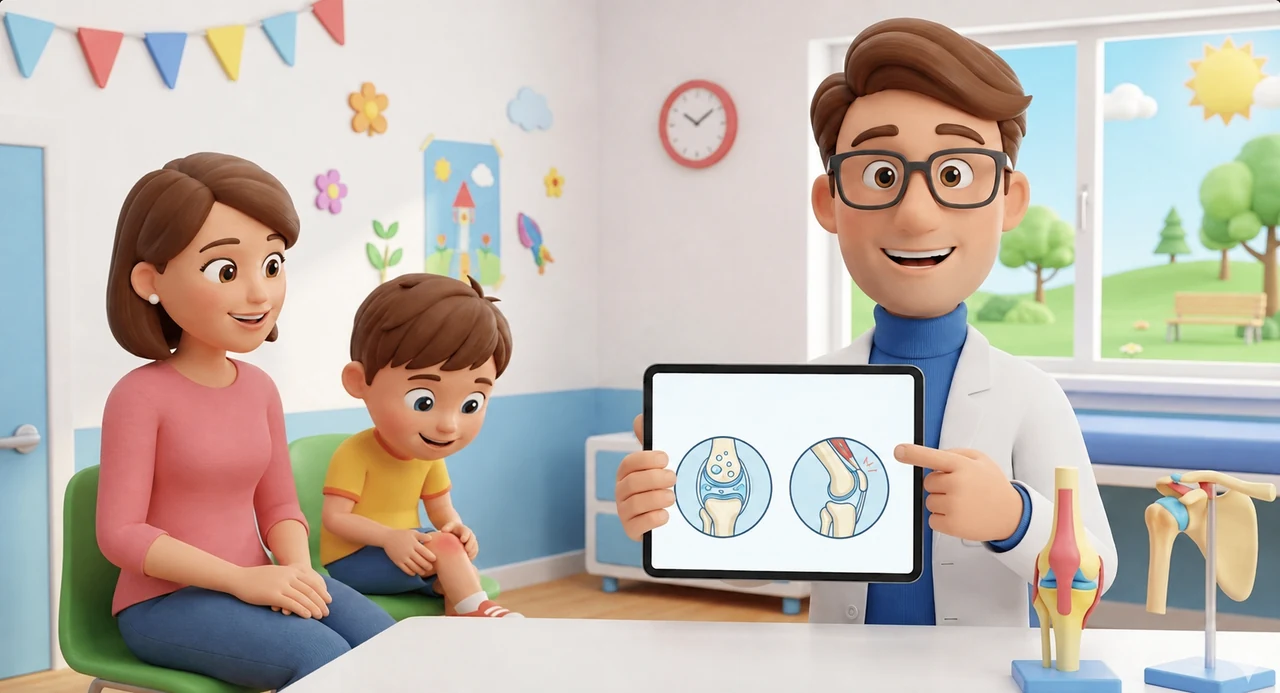
Noises, clicks, and joint popping are very common in children and adolescents. If the joint is not painful, does not swell, and functions normally, an isolated noise often has little clinical significance.
Where the popping comes from
There isn't a single mechanism.
When fingers are voluntarily cracked, the most studied phenomenon is the rapid formation of a gas cavity in the synovial fluid during the separation of joint surfaces, known as tribonucleation. Some details about the exact mechanism of the sound remain debated. [1]
In other joints, the noise can result from the gliding of a tendon or a capsulo-ligamentous structure over a bony prominence. This can be more evident in very flexible or hypermobile children.
Does cracking knuckles cause arthritis?
Available studies have not shown an association between the habit of cracking knuckles and hand osteoarthritis. The evidence is primarily observational, but overall it is reassuring. [1]
However, a movement that causes pain should not be repeatedly forced.
Knee noises
The knee can make noise during squats, climbing stairs, running, or after sitting for a while. Without pain, swelling, giving way, or locking, isolated crepitus is often benign.
A painful click or one associated with locking and swelling, however, warrants evaluation. Symptomatic discoid meniscus, patellofemoral problems, and osteochondral lesions can produce clicks, but the diagnosis depends on the overall symptoms and clinical examination.
Hip click in newborns
A small click felt during diaper changes is not equivalent to the clunk of an unstable hip detected with appropriate clinical maneuvers.
In a prospective study, the vast majority of newborns referred solely for "clicky hip" had a normal ultrasound; the few pathological cases showed other clinical elements, particularly limited abduction. [2]
Risk factors and findings from the hip examination therefore remain more important than just the noise.
When to get it checked
It is appropriate to investigate further if the popping is associated with persistent pain, swelling, warmth, limping, reduced activity, joint locking, loss of movement, a painful click always in the same spot, significant recent trauma, or fever with joint pain.
However, if the child runs, jumps, and uses the joint normally, no specific tests, supplements, or exercises are needed just to eliminate a painless noise.
References
[1] Boutin RD, Netto AP, Nakamura D, Bateni C, Szabo RM, Cronan M, et al. Let's get a hand on this: Review of the clinical anatomy of knuckle cracking. Clin Anat. 2018;31(7):942-945. PMID: 30080300.
[2] Nie K, Rymaruk S, Paton RW. Clicky hip alone is not a true risk factor for developmental dysplasia of the hip. Bone Joint J. 2017;99-B(11):1533-1536. doi:10.1302/0301-620X.99B11.BJJ-2017-0416.R1. PMID: 29092995.
Disclaimer: this content is for informational purposes only and does not replace an individual clinical evaluation.