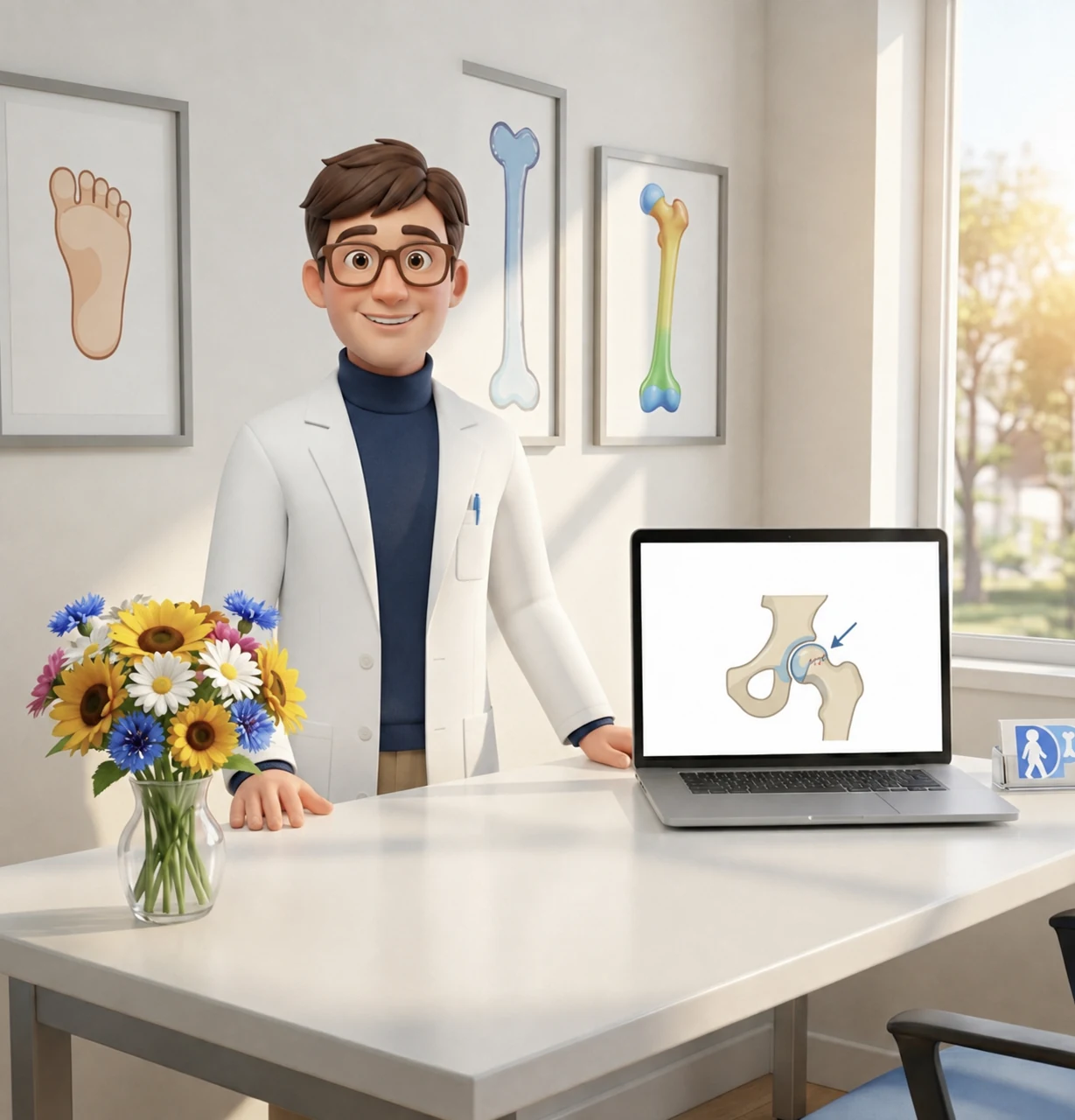
Legg-Calvé-Perthes disease is an idiopathic osteonecrosis of the femoral head that goes through phases of necrosis, revascularization, resorption, reossification, and healing. The clinical challenge lies primarily in predicting which hips will maintain a spherical and congruent femoral head and which will develop a residual deformity capable of affecting the long-term outcome [1].
The review by Gilbert, Laine, Martin, Sankar, and Kim, published in the Journal of the American Academy of Orthopaedic Surgeons, reminds us that the natural history is often more favorable in younger children, especially under 6 years old, and more problematic with increasing age, particularly over 8–10 years. Age, disease stage, hip mobility, extent of epiphyseal involvement, and acetabular congruency must be considered together [1].
The historical concept of containment remains central. The goal is to keep the femoral head as well-centered and congruent as possible within the acetabulum while it goes through the revascularization and remodeling phase. Many strategies stem from this: maintaining range of motion, reducing load during symptomatic periods, using exercises, braces, or casts in selected cases, and in higher-risk patients, considering femoral osteotomies, pelvic osteotomies, or combined procedures [1].
Containment alone does not define the therapeutic choice. A recent surgical review highlights how difficult it is to demonstrate the clear superiority of a single strategy, because the disease is relatively rare, has a variable natural history, and requires many years to evaluate its final outcome [3]. Patient selection and the stage of the disease remain crucial.
Here, the analysis published in 2026 in the Bone & Joint Journal, based on data from a large prospective multicenter study and a modern measure of sphericity, the sphericity deviation score, also becomes interesting. The authors report that, in patients with a bone age over 6 years, proximal femoral osteotomy or Salter osteotomy were associated with better sphericity scores compared to no treatment or mobility exercises alone. Furthermore, in the regression tree analysis, patients with a chronological age over 7.6 years treated with femoral osteotomy had better outcomes than those not treated surgically [2]. This data does not establish a universal surgical indication but supports the rationale for surgical containment in older children and in cases with a less favorable prognosis.
A 7–8-year-old child who arrives after weeks of intermittent limping, with reduced abduction and internal rotation and already evident radiographic signs, represents a different problem compared to a much younger child with good mobility. In this age group, the prognostic risk weighs more heavily and makes early and complete evaluation more important.
The JAAOS review also dedicates increasing attention to imaging predictors and the biological processes that follow the initial vascular insult [1]. Containment remains central, but research is no longer limited to mechanical aspects. A 2025 review in Frontiers in Physiology also moves in this direction, discussing the disease from a molecular and cellular biology perspective: not yet something that will change tomorrow's visit, but a clear sign that the future of Perthes will not only be about osteotomies and braces [4].
This is also important for communicating with non-pediatric colleagues. Perthes is not a "prolonged synovitis" nor is it a diagnosis to be filed away with a single initial X-ray if the clinical picture doesn't fit. A child with persistent limping, hip or knee pain, limited abduction or internal rotation deserves a careful hip evaluation. The sooner the problem is identified, the more realistic it is to preserve mobility, containment, and remodeling potential.
Many areas of uncertainty still remain. More predictive imaging, more refined measures of the final femoral head shape, long-term follow-ups, and multicenter studies are needed. The choice between observation, physiotherapy, load limitation, bracing, and surgery depends on the combination of age, stage, mobility, severity, and hip congruency [1–3].
Disclaimer
This content is for informational purposes only and does not replace an individual clinical evaluation.
References
[1] Gilbert SR, Laine JC, Martin BD, Sankar WN, Kim HKW. Legg-Calvé-Perthes Disease. J Am Acad Orthop Surg. 2026;34(4):e488-e497. Epub 2025 Sep 24. doi:10.5435/JAAOS-D-24-01469. PMID: 40991851.
PubMed: https://pubmed.ncbi.nlm.nih.gov/40991851/
[2] Herring JA, Kim HKW, et al. The outcomes of treatment and prognostic determinants of patients with Perthes’ disease: reanalyses of large prospective multicentre study data using the sphericity deviation score. Bone Joint J. 2026. PMID: 41619794.
PubMed: https://pubmed.ncbi.nlm.nih.gov/41619794/
[3] Braun S, Adolf S, Brenneis M, Boettner F, Meurer A, et al. Legg-Calvé-Perthes disease – surgical treatment options. Arch Orthop Trauma Surg. 2025;145:186. doi:10.1007/s00402-025-05801-3.
Journal: https://link.springer.com/article/10.1007/s00402-025-05801-3
[4] Zheng X, Dong Z, Ding X, Huang Q, Tang S, Zhang Y, Li B, Liao S. Progress in understanding Legg–Calvé–Perthes disease etiology from a molecular and cellular biology perspective. Front Physiol. 2025;16:1514302. doi:10.3389/fphys.2025.1514302.
Journal: https://www.frontiersin.org/journals/physiology/articles/10.3389/fphys.2025.1514302/full