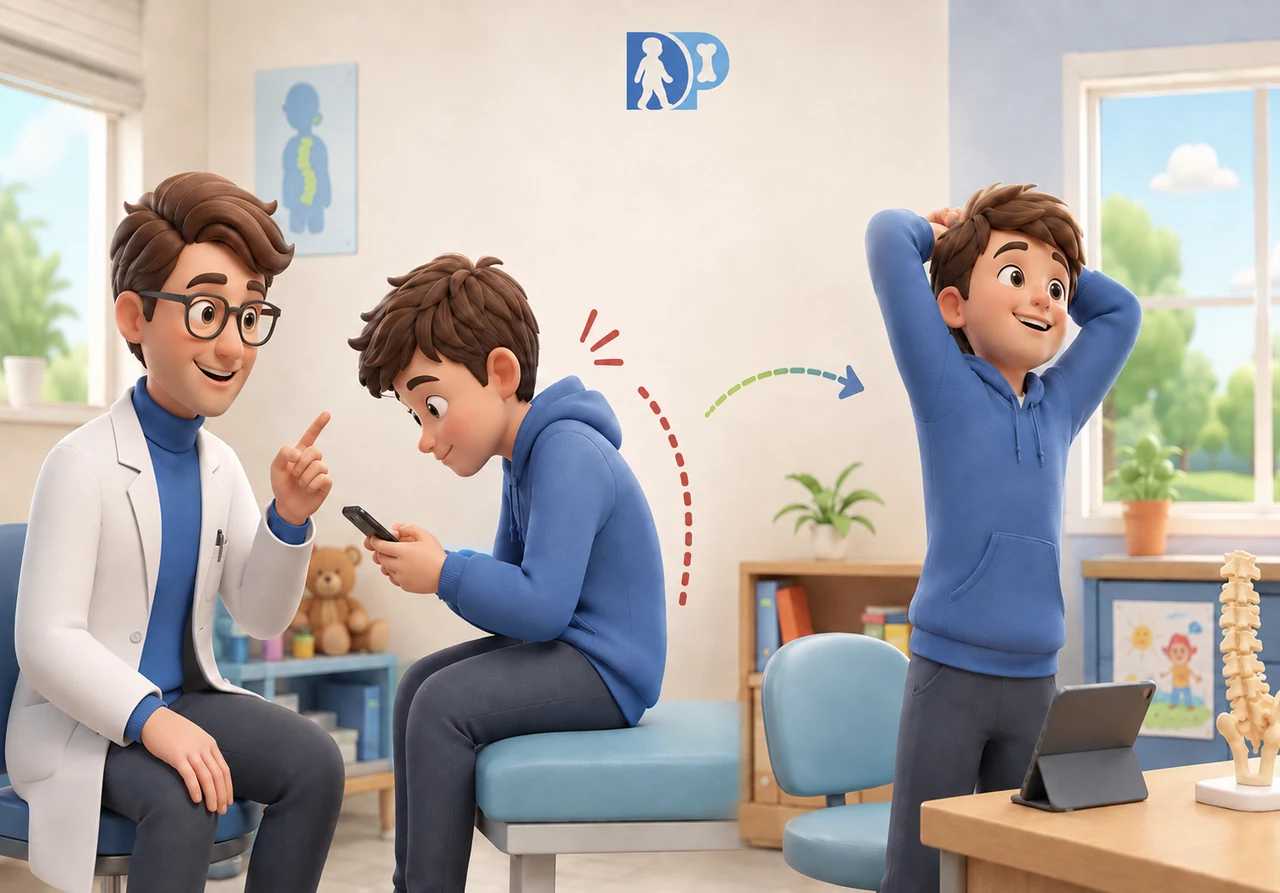
It's easy to attribute an adolescent's back pain to hours spent in front of a screen. The connection seems plausible: a lot of sitting time, neck flexed over the phone, little physical activity. The data, however, tells a less straightforward story.
What the Review Shows
In 2025, the British Journal of Sports Medicine published a systematic review with meta-analysis on the relationship between sedentary behavior and spinal pain in children and adolescents. The authors included 129 studies: over 697,000 participants in cross-sectional studies and 8,433 in longitudinal studies. [1]
In cross-sectional studies, those who reported more sedentary time also reported cervical, thoracic, or lumbar pain slightly more often. The association was modest, with an adjusted odds ratio of 1.25. [1]
The data changes when looking at longitudinal studies, which follow young people initially without pain over time. In this group, sedentary behavior was not associated with a significant increase in the risk of developing spinal pain: adjusted risk ratio 1.07, with a confidence interval compatible with no effect. [1]
Sedentary behavior and back pain can therefore appear together without one necessarily being the cause of the other.
"Text Neck" Is Too Simple an Explanation
Maintaining a posture for a long time can cause discomfort. After hours in the same position, it's normal to feel stiffness or muscle tension, especially in the neck and shoulders. This is different from claiming that looking at a phone inherently causes a spinal disease or structural damage.
The BJSM review specifically advises caution on this point. The available evidence is of low certainty, and longitudinal studies are still few, but it does not support a strong causal relationship between sedentary behavior and clinically relevant spinal pain. [1]
Back Pain in Adolescence Has Many Possible Explanations
In many young people, the pain is non-specific. Sports activity, training loads, sleep, stress, body weight, previous painful episodes, and psychological factors can all contribute. In an athlete who develops low back pain with repeated extension movements, for example, the reasoning is different from that of a boy who feels discomfort in the evening after many hours of school and computer use.
For this reason, I would not automatically attribute persistent pain to posture or a smartphone. If it limits sports, wakes them at night, worsens, is associated with neurological symptoms, or has characteristics inconsistent with simple mechanical pain, it should be evaluated as such.
Movement and Breaks Remain Useful
The fact that sedentary behavior is not proven to be a direct cause of back pain does not make movement irrelevant. An adolescent who alternates study and screens with regular physical activity, walking, and frequent breaks is making a favorable choice for many aspects of their health.
Regarding posture, I also prefer a less rigid approach. There is no perfect position to maintain for hours. Changing position, getting up, and moving is more realistic than constantly pursuing an ideal alignment.
If Pain Appears Especially After Many Hours of Sitting
For a young person with mild discomfort and no warning signs, some practical modifications can be helpful: a comfortable workstation, breaks, movement throughout the day, and regular physical activity.
If, however, the pain persists or interferes with activities and sports, it's better to understand the situation more thoroughly before concluding that it's the phone's fault. The BJSM review precisely scales back this shortcut: in adolescents, the relationship between screens, sedentary behavior, and back pain is more complex than the most intuitive explanation suggests.
References
[1] Montgomery LRC, Swain M, Dario AB, et al. Does sedentary behaviour cause spinal pain in children and adolescents? A systematic review with meta-analysis. Br J Sports Med. 2025;59(6):409-419. doi:10.1136/bjsports-2024-108648.
Disclaimer: Content for general informational purposes only. It does not replace an individual medical evaluation.