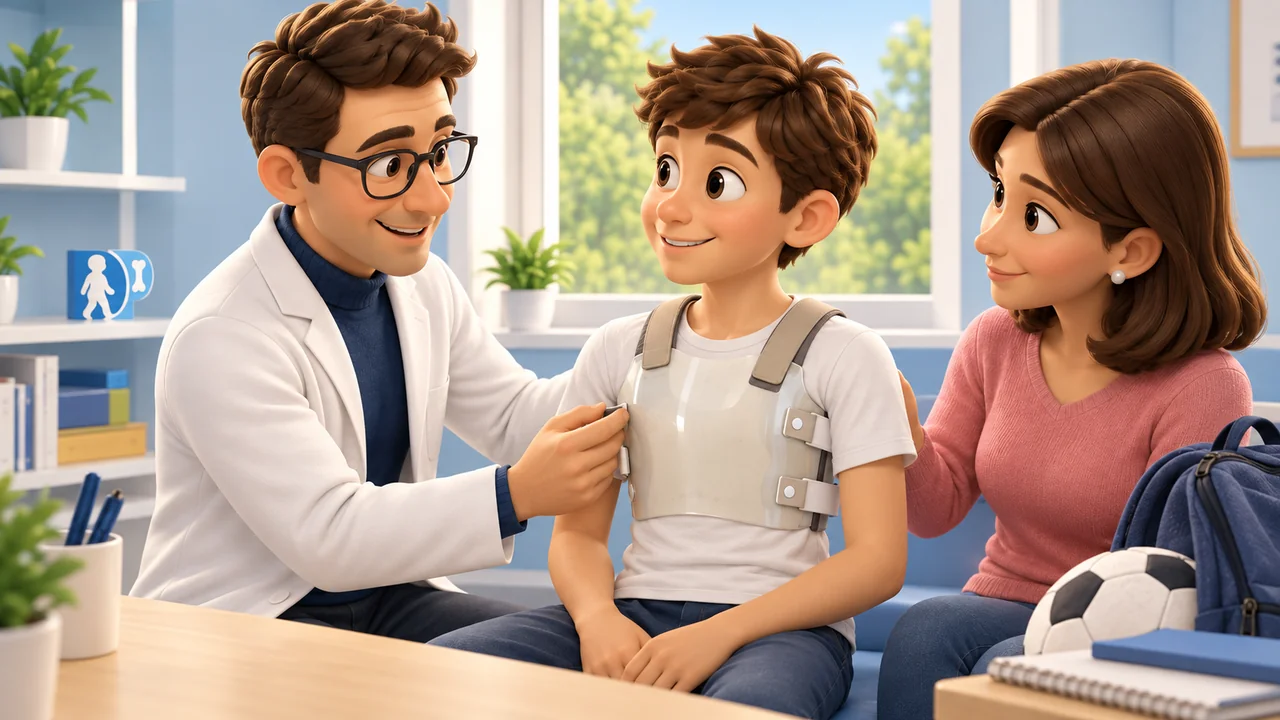
For flexible pectus carinatum, compression bracing is an established first-line non-operative treatment. The principle is straightforward: apply gradual pressure to the prominent breastbone while the chest wall is still flexible.
In an adolescent's daily life, it is less straightforward. The brace has to fit around school, hot weather, sport, clothing and skin care, at an age when body image can be especially important.
Following the programme is therefore more than a matter of discipline. It is part of the treatment.
My role and the thoracic surgeon's role
Surgery for pectus carinatum is the responsibility of a thoracic surgeon and is not part of my surgical practice. When a surgical assessment is needed, I work with thoracic surgeons as part of the young person's care.
Wearing hours vary between programmes
One of the most frequent questions is how many hours a day the brace should be worn.
Bracing programmes are not yet standardised. A 2024 international survey of Chest Wall International Group members found differences between centres in brace type, age at treatment, prescribed wearing hours and treatment duration. Most responding centres considered compression bracing their first-line treatment, but actual wearing time was often shorter than prescribed. [1]
Some programmes are intensive and others less so. Wearing hours should not be changed independently based on information online. The prescription depends on the brace, chest wall stiffness, response to treatment and the team following the adolescent.
Pressure should not become a test of endurance
Some pressure is necessary for treatment to work. Significant pain, skin damage or being unable to tolerate the brace for hours are not treatment goals.
Reported adverse effects include skin irritation, discomfort, pain and difficulties tolerating the brace. In a long-term study published in 2026, almost one-third of respondents who had undergone bracing reported at least one negative effect, particularly discomfort, pain and skin problems. [2]
These difficulties can reduce how long the adolescent actually manages to wear the brace. Comfort and skin checks therefore directly affect treatment management.
Persistent redness, abrasions, increasing pain or unusual pressure areas call for a review of the fit, rather than simply being told to persevere.
At school, visibility can matter
Many adolescents can wear the brace under a T-shirt or sweatshirt, although its bulk and visibility depend on the model and body shape.
Being able to conceal it is not a trivial detail. A study from Bambino Gesù Children's Hospital examined a thinner, lighter bivalve brace partly because a less noticeable and more acceptable device might improve adherence. [3]
If an adolescent avoids wearing the brace throughout the school day because they feel self-conscious, adding more theoretical hours to the prescription does not solve the problem. Discuss it openly with the treating team. Adjustments to the device, clothing or timing may make the programme easier to follow.
Sport and the brace
For most adolescents, pectus carinatum itself is not a reason to avoid physical activity. The practical question is whether the brace should be worn during a particular sport.
A rigid device may be uncomfortable or unsuitable for activities involving contact, falls or large trunk movements. Advice should come from the team that prescribed it and may differ between sports.
Removing the brace for training does not automatically compromise treatment if that time is allowed for in the overall programme. Independently reducing prescribed wear for many hours every day, however, may affect treatment.
Hot weather, sweat and skin
Heat and sweating can make the programme harder to follow. A thin, breathable layer beneath the brace may reduce rubbing and sweat build-up when compatible with the device. Keep the skin dry and check it regularly.
I would not apply creams or thick padding beneath pressure points without discussing it with the professional who made or adjusted the brace, as these can change pressure distribution.
If a skin problem develops, the team needs to distinguish temporary irritation from a sign that the brace requires adjustment.
Body image is part of treatment
Pectus carinatum is often described as an appearance concern, but that does not make it unimportant. Adolescence, changing rooms, swimming and clothing can have a substantial effect on self-image.
A prospective study of 225 patients aged 10–21 found improvements in quality of life, psychological health and self-esteem among those successfully treated with dynamic compression bracing. [4]
Conversely, if the brace becomes a persistent source of embarrassment, family conflict or refusal, ignoring those difficulties may undermine treatment. The 2026 study also reported a negative effect on self-esteem in an individual respondent. [2]
Following the programme over time
A single day with fewer wearing hours does not determine the outcome. The agreed programme needs to be manageable over time.
The literature identifies adherence as an important practical issue, but it does not establish one effective wearing schedule for everyone. In the 2026 survey, a longer overall treatment duration was associated with reported improvement, whereas daily hours and days per week were not significant predictors. This observational finding does not justify changing an individual prescription. [1–3]
It is more useful to understand why the adolescent cannot follow the programme: pain, visibility, sport, heat, school or sleep. A specific difficulty can often be addressed.
When can bracing stop?
Not simply when the chest appears straight for a few minutes after removing the brace.
Initial correction and maintenance are not necessarily the same phase. Recurrence during puberty is not uncommon, and centres use different approaches to reducing brace wear and monitoring patients. The CWIG survey highlighted variation between programmes and the importance of follow-up through the end of puberty. [1]
The 2026 long-term study also reported recurrence after stopping treatment, supporting the need to decide reductions and cessation with the treating team. [2]
An effective programme needs to provide the prescribed corrective pressure while remaining tolerable enough to follow for the required months. If pain, skin problems, school or social discomfort lead to the brace being gradually abandoned, those difficulties need to be addressed as part of treatment.
References
[1] Omanik P, Sesia SB, Kozlikova K, Schmidtova V, Funakova M, Haecker FM. Bracing of Pectus Carinatum in Children: Current Practices. Children (Basel, Switzerland). 2024. PubMed: 38671687 · DOI.
[2] McArthur M, Lee SL, Chiu MZ, Benavente R, Murtadi G, Cohen R, Bartkus K, Gironda J, Fallon B, Madenci AL, Demehri FR. Bracing for Success: Long-term Patient-reported Outcomes of Bracing Therapy for Pectus Carinatum. The Journal of surgical research. 2026. PubMed: 42419066 · DOI.
[3] Frediani S, Zarfati A, Pardi V, Aloi I, Bertocchini A, Accinni A, Beati F, Pasanisi M, Inserra A. A new custom-made bivalve brace for pectus carinatum in children and adolescents: preliminary promising experience of 140 patients from a tertiary center. Frontiers in pediatrics. 2024. PubMed: 38633328 · DOI.
[4] van Braak H, de Beer SA, Twisk JWR, Zwaveling S, Oomen MWN, de Jong JR, Ernest van Heurn LW. Improving Quality of Life With Dynamic Compression Bracing in Patients With Pectus Carinatum. Journal of pediatric surgery. 2025. PubMed: 39370381 · DOI.
Disclaimer: this article provides general information. Wearing hours, adjustments, permitted activities and stopping bracing must be determined by the team caring for the patient.
Related information
For diagnosis, assessment of chest wall flexibility and general treatment indications, see pectus carinatum.