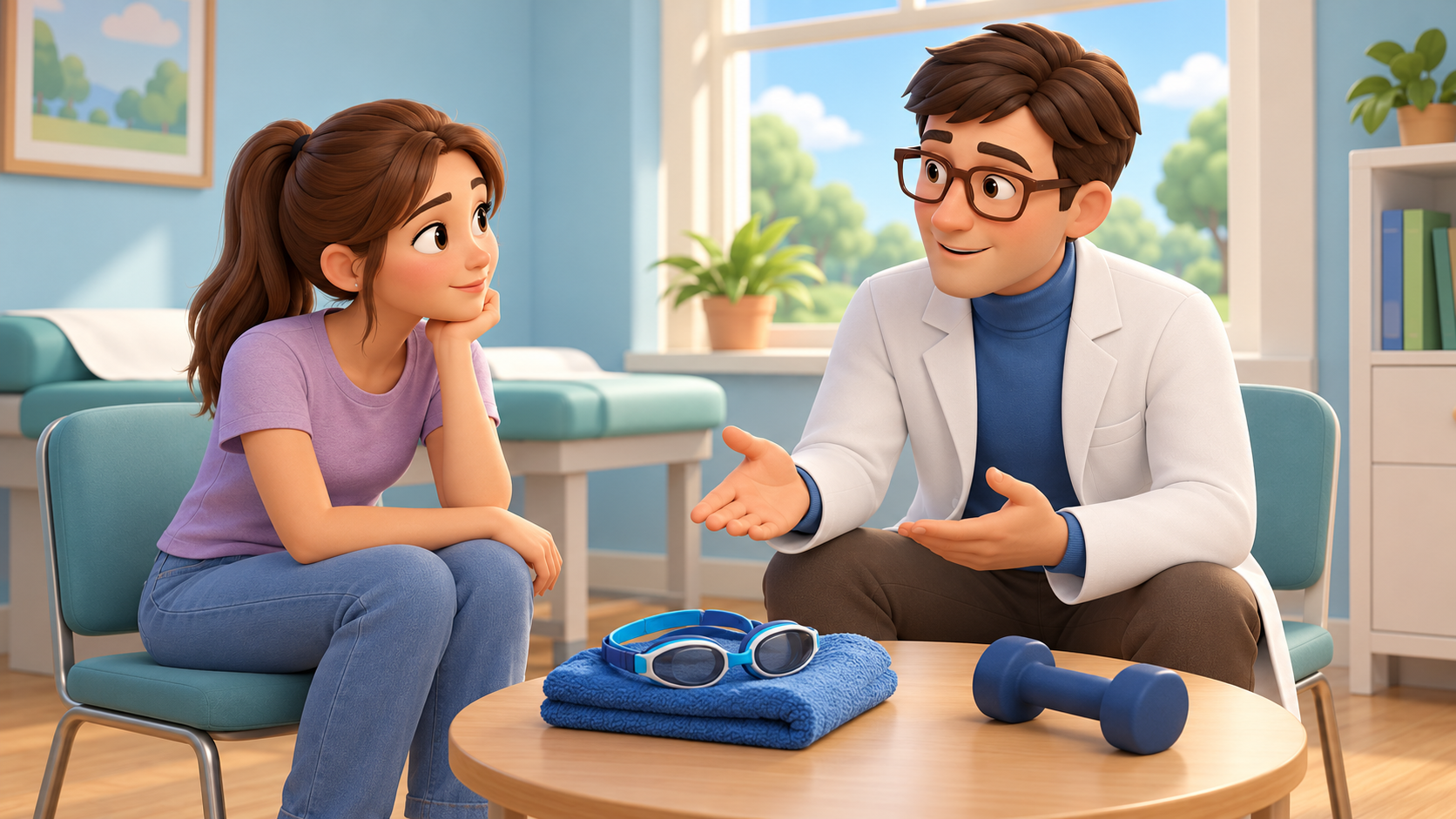
Swimming is not a treatment that straightens the spine, and a scoliosis diagnosis does not mean an adolescent has to give up the gym. Choosing an activity depends on the young person, the training involved and their treatment, rather than the name of the sport alone. [1,2]
This discussion concerns idiopathic scoliosis during growth. Advice after spinal surgery or for other conditions follows a separate pathway.
Is swimming good for scoliosis?
It can remain an option if the adolescent enjoys it and there are no clinical reasons to advise otherwise. It should not be chosen with the expectation that it will correct the curve or replace a brace.
The idea of a sport that straightens the back confuses two aims. Physical activity supports fitness and wellbeing; managing scoliosis involves assessing the curve and its course during growth. Guidelines explicitly distinguish sport from scoliosis-specific exercises. [1]
Equally, studies observing asymmetries in competitive swimmers do not establish that swimming causes scoliosis. They are not a reason to automatically ban swimming for every adolescent with the diagnosis. [1]
What about the gym and weights?
Going to the gym can mean very different activities: an instructor-led class, bodyweight exercises, strength training or attempts at heavy lifting without adequate preparation.
Paediatric guidance on resistance training emphasises technique, supervision and progression suited to age and ability. It concerns young people generally, however: it does not automatically make every exercise suitable for someone with scoliosis. [3]
The diagnosis alone therefore neither rules out the gym nor approves a programme. Pain, curve characteristics, current treatment and the actual demands of training all matter. The broader question of weights and growth is discussed in the article on gym and resistance training in adolescents.
A universal list of good and bad exercises would not be very useful. Even an exercise demonstrated correctly in a video may not be appropriate for that adolescent at that stage.
Sport and specific exercises are not interchangeable
Scoliosis-specific exercises are selected and taught for the individual, with the treating clinician and a suitably trained physiotherapist. They are not simply general back strengthening, and should not be copied from another patient's programme. [1]
Sport can complement these exercises, but does not replace them when prescribed. Neither activity allows an adolescent to stop bracing or follow-up appointments independently.
An observational study involving 511 adolescents with mild curves found a favourable association between sport participation and the course of scoliosis. It was not a comparison that could establish whether swimming was better than gym training. An association also does not establish that sport caused the outcome. [4]
The practical question remains which activity is appropriate and sustainable, without attributing a corrective effect that has not been demonstrated for that particular sport.
Can sport continue during bracing?
A brace does not automatically mean giving up sport. Activity is organised around prescribed treatment and the demands of training. Any time out of the brace needs to be agreed: prescribed wearing hours should not be reduced on the assumption that swimming or exercise will compensate. [1,2]
Recreational and competitive activity also need different consideration. Training hours, intensity, repeated movements and contact risk are not described by the words swimming or gym alone.
What helps with the decision?
Assessment benefits from knowing which sport the adolescent already practises, whether symptoms occur and what training involves. Bringing a gym programme can help; for swimming, clarify whether participation is recreational or competitive.
Persistent or increasing pain during activity should be reported to the treating clinician rather than pushing through the movement that provokes it. New changes in strength, sensation or walking require prompt assessment.
Diagnosis, follow-up and conservative treatment are explained on the scoliosis page. Sport choice fits within that pathway, without asking a sporting activity to do the work of treatment.
Author: Dr Daniele Priano, paediatric orthopaedic surgeon.
General information only: this does not replace an individual medical assessment or a prescription for exercise or sport.
Sources
- Negrini S, Donzelli S, Aulisa AG, et al. 2016 SOSORT guidelines: orthopaedic and rehabilitation treatment of idiopathic scoliosis during growth. Scoliosis Spinal Disord. 2018;13:3. DOI: 10.1186/s13013-017-0145-8. Full text, sports section and Table 15.
- Scoliosis Research Society. Living with Scoliosis.
- Stricker PR, Faigenbaum AD, McCambridge TM; Council on Sports Medicine and Fitness. Resistance Training for Children and Adolescents. Pediatrics. 2020;145(6):e20201011. DOI: 10.1542/peds.2020-1011. PMID: 32457216. Clinical report reaffirmed in November 2024; not specific to scoliosis.
- Negrini A, Donzelli S, Vanossi M, et al. Sports participation reduces the progression of idiopathic scoliosis and the need for bracing. An observational study of 511 adolescents with Risser 0–2 maturation stage. Eur J Phys Rehabil Med. 2023;59:222–227. DOI: 10.23736/S1973-9087.23.07489-0. PMID: 36892518.