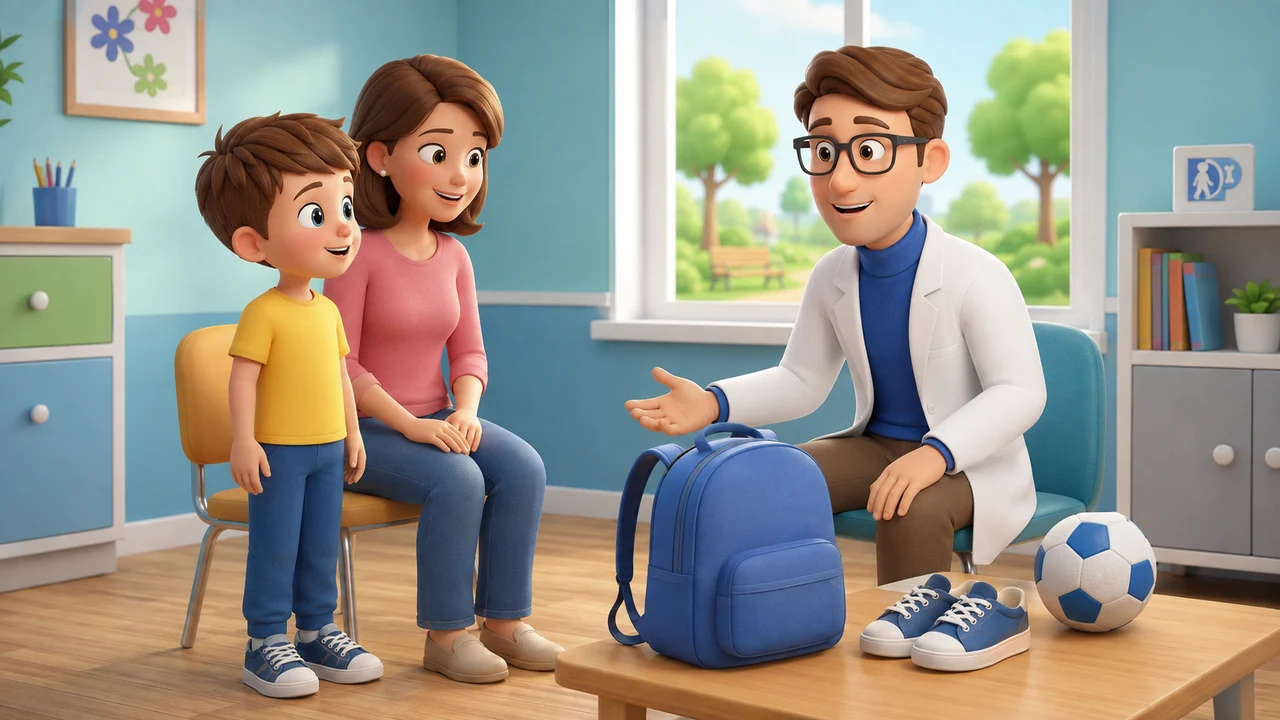
Shoes, backpacks, and sports load are often blamed when a child experiences foot, knee, or back pain. Some daily choices can improve comfort and load tolerance, but their causal role is often more limited than commonly thought.
Shoes
For a healthy child, rigid or "corrective" footwear is not routinely necessary.
Available reviews show that shoes modify some gait parameters compared to barefoot walking, but they do not identify a characteristic capable of ensuring better foot development or preventing orthopaedic conditions. [1][2]
In daily life, I primarily choose a correct size, sufficient toe space, comfort, a sole appropriate for the activity, and flexibility that does not unnecessarily hinder movement.
Asymmetrical sole wear, on its own, tells us little. It becomes more interesting if associated with pain, limping, stiffness, or reduced activity.
Backpacks and Back Pain
A 2018 systematic review found no convincing evidence that backpack weight, model, or carrying method increases the risk of developing back pain in children and adolescents. [3]
A subsequent meta-analysis with individual data from over 9,000 young people found no association, even when using the 10% body weight threshold, often cited as a limit. [4]
This does not make an unnecessarily heavy backpack useful. Reducing superfluous material and using both shoulder straps can improve comfort. However, if a child has recurrent low back pain, attributing it solely to the backpack is an oversimplification.
Sports and Increased Loads
Many overload problems appear when training volume increases rapidly: returning after a break, changing teams, training camps, tournaments, or adding extra sessions.
The American Academy of Pediatrics' 2024 clinical report highlights the relationship between repeated stress and insufficient recovery in overuse injuries. [5]
Progression must be adapted to the child. An athlete who has trained regularly for years tolerates different loads than a peer returning after months of inactivity.
How to Interpret Pain
So-called growing pains have fairly typical characteristics: intermittent episodes, especially in the evening or at night, the child feels well during the day, and absence of limping.
Pain always in the same spot, persistent in the morning, associated with swelling, stiffness, limping, or progressive reduction in sports activity requires a different assessment.
In practice, a change in function is often more informative than the object the child uses. If they stop running, cut training short, or start limping, it's worth understanding why.
When to Seek Further Evaluation
Persistent limping, inability to bear weight, progressive pain, joint swelling, fever, or general symptoms require evaluation. After trauma, obvious deformity, very intense pain, or changes in sensation and perfusion should be evaluated more quickly.
References
[1] Cranage S, Perraton L, Bowles KA, Williams C. The impact of shoe flexibility on gait, pressure and muscle activity of young children: a systematic review. Journal of Foot and Ankle Research. 2019;12:55. doi:10.1186/s13047-019-0365-7.
[2] Wang Y, Jiang H, Yu L, et al. Understanding the Role of Children's Footwear on Children's Feet and Gait Development: A Systematic Scoping Review. Healthcare. 2023;11(10):1418. doi:10.3390/healthcare11101418.
[3] Yamato TP, Maher CG, Traeger AC, Williams CM, Kamper SJ. Do schoolbags cause back pain in children and adolescents? A systematic review. British Journal of Sports Medicine. 2018;52(19):1241-1245. doi:10.1136/bjsports-2017-098927.
[4] Calvo-Muñoz I, Kovacs FM, Roqué M, Seco-Calvo J. The association between the weight of schoolbags and low back pain among schoolchildren: a systematic review, meta-analysis and individual patient data meta-analysis. European Journal of Pain. 2020;24(1):91-109. doi:10.1002/ejp.1471.
[5] Brenner JS, Watson A; Council on Sports Medicine and Fitness. Overuse Injuries, Overtraining, and Burnout in Young Athletes. Pediatrics. 2024;153(2):e2023065129. doi:10.1542/peds.2023-065129.
Disclaimer: content for general informational purposes only. It does not replace an individual medical evaluation.