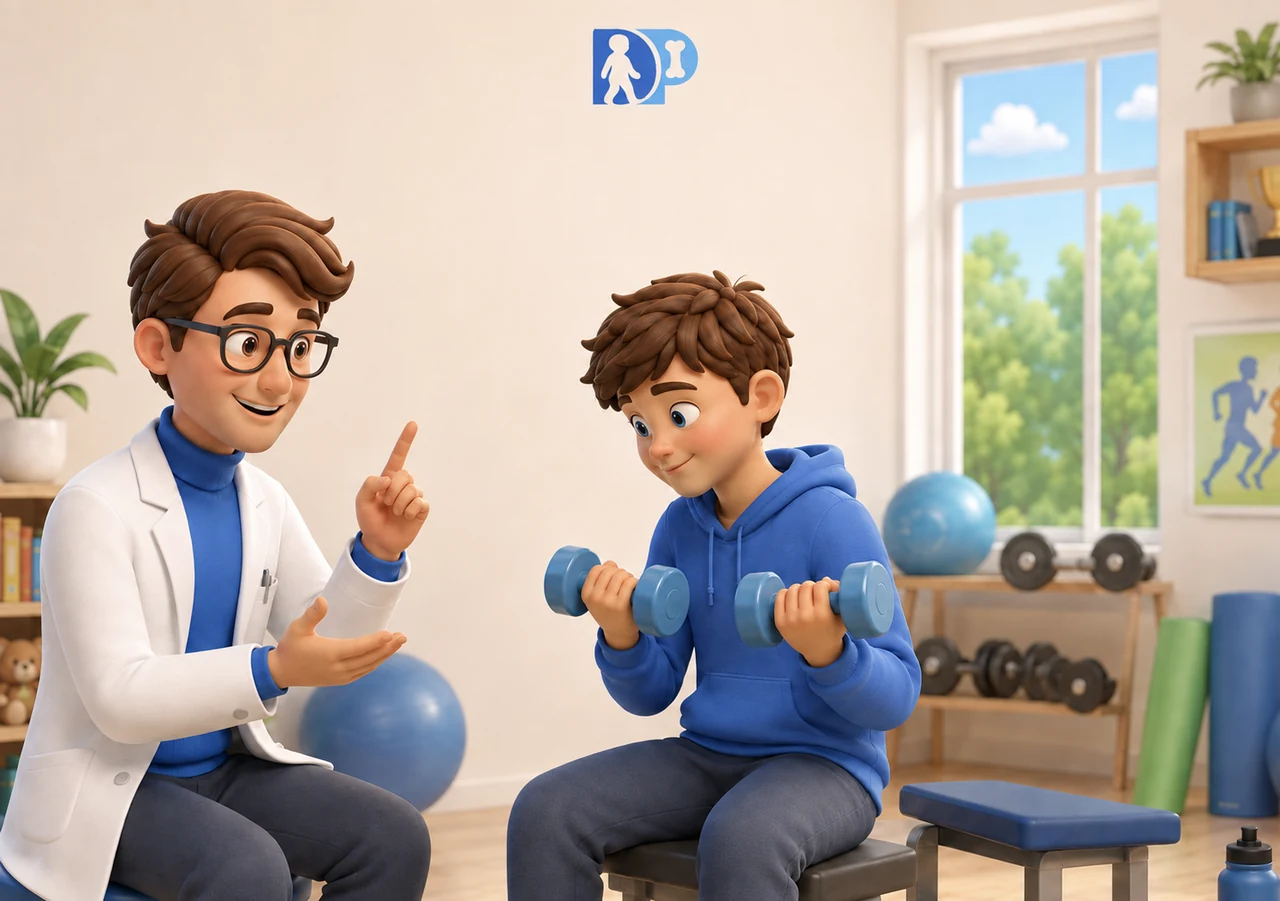
The fear that weights can “stunt growth” is still widespread. Modern guidance, however, does not prohibit strength training before skeletal maturity. A well-designed, supervised programme can be safe and useful for children and adolescents. [1]
Problems arise particularly when two very different things are confused: training against resistance and attempting heavy loads without proper technique, progression or supervision.
What strength training actually means
It does not necessarily mean lifting a barbell at maximum effort. Strength training also includes bodyweight exercises, resistance bands, machines, dumbbells and free weights, at very different intensities.
The American Academy of Pediatrics explains that children and adolescents can improve strength and fitness with low injury rates when programmes are well designed, technique is correct and training is supervised. Its 2020 clinical report was reaffirmed in 2024. [1]
A 2025 meta-analysis of supervised programmes found improvements in muscle strength and several measures of fitness. [2]
The growth plate
The growth plate, or physis, is a vulnerable part of the growing skeleton and can be damaged by an injury. This explains much of parents’ concern.
Reviews of controlled training programmes, however, have not shown harmful effects on height growth or maturation. [1][3]
Growth plate injuries associated with weights are a different issue. They can happen when equipment falls, a movement is performed incorrectly or a load is excessive. They are not an inevitable consequence of a normal strength training programme.
For an adolescent who wants to start, the quality of movement and gradual progression of load therefore matter most.
Injuries happen, but the figures need context
A 2024 American analysis examined emergency department visits related to weight training among people aged 11–21 between 2002 and 2021. The national estimate was around 541,000 injuries over twenty years. Sprains and strains were the most common injuries. Fractures accounted for around 10% and mainly affected fingers and toes. [4]
Some of these injuries result from the equipment itself or from accidents during exercise. Without knowing how many young people took part and their total training hours, those 541,000 cases cannot tell us an individual’s risk. They do, however, describe the kinds of problems involved: poor technique, uncontrolled loads, falling weights and progressing too quickly.
Rushing is often the main problem
Many adolescents arrive at the gym with examples taken from social media: personal records, rapid transformations and extreme workouts. It is easy to compare themselves with adults who have trained for years and try to copy programmes that have little to do with their own level.
Squats, lunges, pull-ups and pushing exercises can be learned with manageable loads. At the start, technique matters more than the number on the barbell. Movement control, consistency and gradual increases in load come next.
A young person who is learning has no need to rush into testing their maximum lift.
When to stop and reassess
Persistent joint pain, very localised pain around a growth plate, pain that progressively worsens with loading or loss of function should not be treated as normal effects of training.
The overall workload matters too. An adolescent who has four or five team training sessions a week and adds strength sessions without recovery is in a different situation from someone doing two well-planned sessions.
During periods of rapid growth, training volume and intensity may need to be adjusted temporarily, particularly if pain or difficulty recovering develops.
At what age can training start?
There is no age threshold beyond which weights suddenly become safe. It is more useful to assess whether the young person can follow instructions, perform movements with control and train in an appropriately supervised environment. [1]
For beginners, simple exercises and manageable loads are enough. With good technique and gradually increasing loads, there is no evidence that strength training stunts growth. [1][3]
References
[1] Stricker PR, Faigenbaum AD, McCambridge TM, et al. Resistance Training for Children and Adolescents. Pediatrics. 2020;145(6):e20201011. Clinical Report reaffirmed November 2024. doi:10.1542/peds.2020-1011.
[2] Moreno-Torres JM, García-Roca JA, Abellan-Aynes O, Diaz-Aroca A. Effects of Supervised Strength Training on Physical Fitness in Children and Adolescents: A Systematic Review and Meta-Analysis. J Funct Morphol Kinesiol. 2025;10(2):162. doi:10.3390/jfmk10020162.
[3] Malina RM. Weight training in youth-growth, maturation, and safety: an evidence-based review. Clin J Sport Med. 2006;16(6):478-487.
[4] Gupta R, Ojea Quintana J, Reddy N, Ayotte S, Lawrence JTR. A National 20-year Analysis of Weight Lifting-related Injuries and Fractures Among Adolescents. J Pediatr Orthop. 2024;44(6):373-378. doi:10.1097/BPO.0000000000002685.
Disclaimer: This content is for general information and does not replace an individual medical assessment.