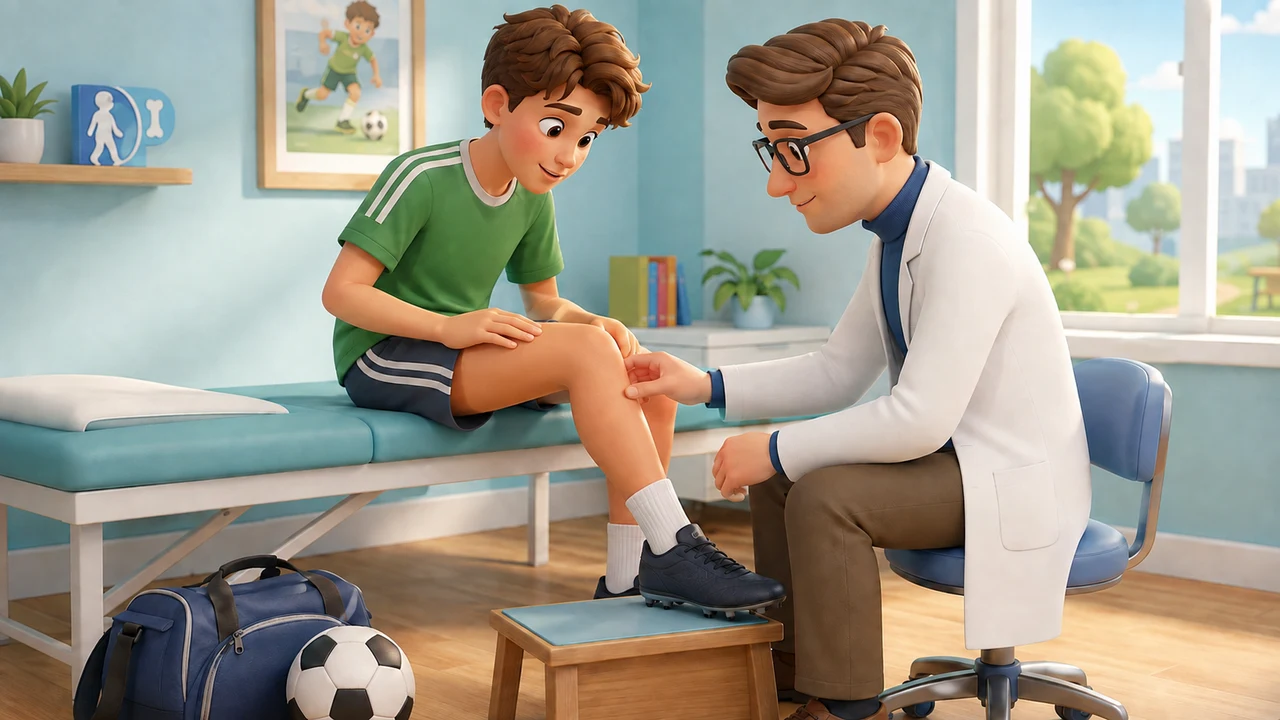
The term osteochondrosis encompasses very different conditions of growing bone. Perthes, Osgood-Schlatter, and Freiberg's disease all occur during growth, but differ in location, natural history, prognosis, and treatment.
A 2026 review summarizes recent developments in lower limb osteochondroses. [1]
Osgood-Schlatter
In the adolescent athlete, management remains predominantly conservative: load modulation, recovery of strength and mobility, and time. [2]
Injections with dextrose or PRP have been studied, but the evidence remains heterogeneous and does not support their routine use. Surgery is primarily reserved for cases persistent after skeletal maturity. [2]
Perthes
In Perthes, the prognostic problem concerns the final shape of the femoral head and hip congruency. Age, extent of involvement, disease phase, mobility, and containment influence the course.
Perfusion MRI is being studied as a possible prognostic tool, but a sufficiently standardized protocol does not yet exist to make it necessary for every child. [1][3]
A 2026 scoping review showed considerable variability among studies in the assessment, diagnosis, and outcome measures of Perthes. [3]
Freiberg
Freiberg's disease most often affects the head of the second metatarsal. Initial management is generally conservative, with modification of load and activities.
In persistent or advanced cases, surgery is chosen based on the stage and articular morphology. A 2026 meta-analysis compared autologous osteochondral transplantation and dorsiflexion osteotomy of the metatarsal, confirming that even within the same diagnosis, the choice depends on the type of lesion. [4]
What They Have in Common
Age and residual growth influence prognosis, but anatomical location is critical. Management of many osteochondroses begins with conservative treatment; others require prolonged follow-up or surgery in selected subgroups.
Advanced imaging is valuable when it changes prognosis or treatment. It should not be automatically added just because it is available.
Well-localized sports pain that improves with reduced load has a different meaning than persistent limping, joint stiffness, or progressive pain. In these latter scenarios, it is useful to define the diagnosis before generically attributing symptoms to an osteochondrosis or to growth.
References
[1] Beber SA, Groff KD, Doyle SM. From growing pains to growing evidence: a 2025 update on novel insights in lower limb osteochondroses. Curr Opin Pediatr. 2026;38(1):100-107. doi:10.1097/MOP.0000000000001523. PMID: 41133728.
[2] Ndjonko LCM, Klein JH, Chakraborty Y, et al. Treatments for Osgood Schlatter Disease: A Systematic Review of the Literature. Orthop J Sports Med. 2026;14(3):23259671251387354. doi:10.1177/23259671251387354. PMID: 41788553.
[3] Ball S, Thomas R, Davies LM, et al. Variation in assessment, diagnosis and outcome measurement in Perthes disease: a scoping review. J Child Orthop. 2026;20(3):247-255. doi:10.1177/18632521261432861. PMID: 41907834.
[4] Tham A, Rubin J, Lowton E, et al. Autologous osteochondral transplantation versus dorsiflexion closing wedge metatarsal osteotomy for Freiberg's disease: A systematic review and meta-analysis. Foot Ankle Surg. 2026;32(4):333-342. doi:10.1016/j.fas.2025.12.008. PMID: 41421958.
Disclaimer: This content is for informational purposes and does not replace an individual clinical evaluation.