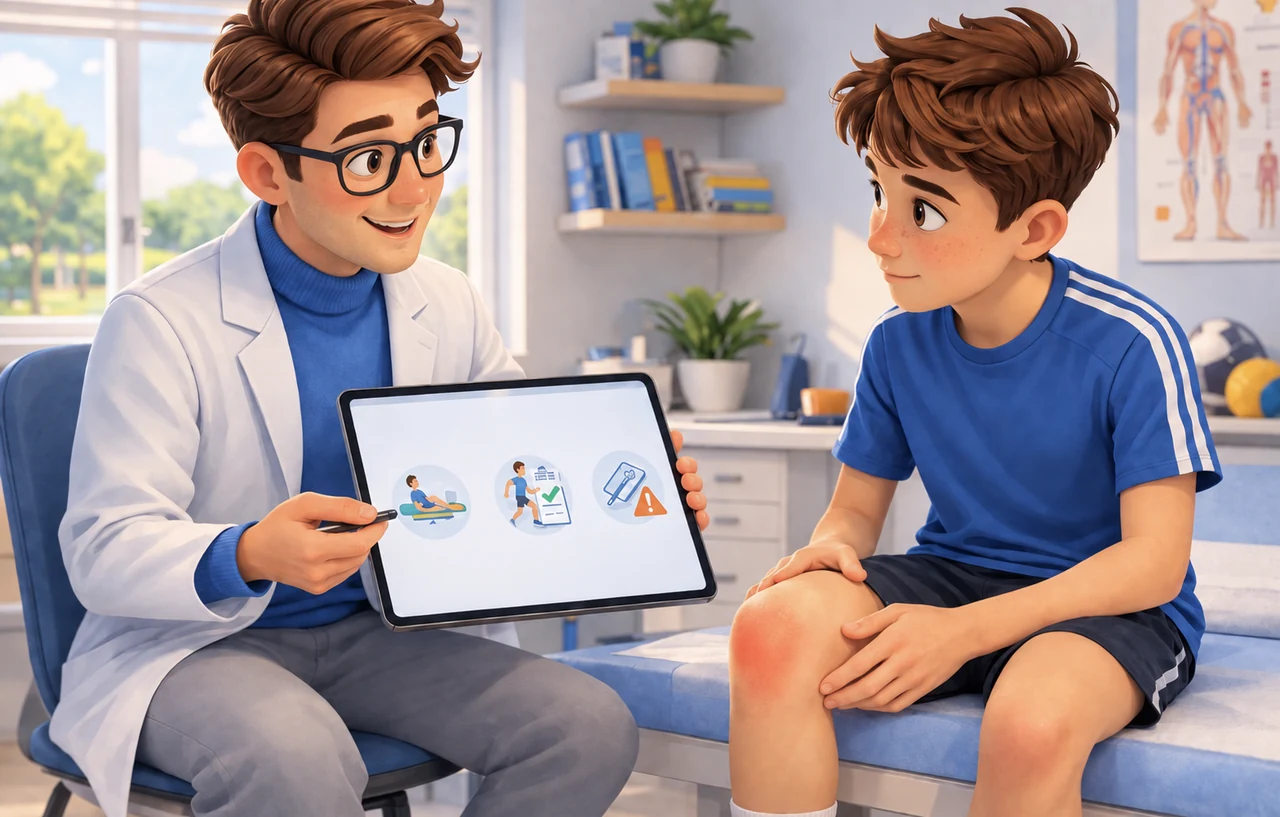
Osgood-Schlatter is very common in athletic adolescents and in most cases has a favorable course, but symptoms can last for months and interfere with training and competitions.
A systematic review published in 2026 in the Orthopaedic Journal of Sports Medicine collected 15 studies and 712 patients, including conservative treatments, injections, and surgery. [1] The literature is heterogeneous and does not allow for the identification of a single superior strategy for all patients.
Conservative Treatment Remains the Foundation
Load management, adaptation of sports activity, recovery of flexibility and strength, and progressive return to sport are still the most commonly used elements. [1]
Prolonged absolute rest is not necessarily helpful. For many young people, it is more practical to temporarily reduce activities that trigger pain and increase the load again when symptoms allow.
Difficulty often arises from returning too quickly to the previous volume: the pain improves, the young person immediately resumes full training, and symptoms reappear. A more gradual progression tends to be more manageable.
Injections: Data Still Weak
The review also includes studies on PRP and dextrose. Some report improvements, but samples, protocols, and outcomes are too diverse to consider these injections a standard treatment. [1]
The absence of relevant complications in the small available studies does not demonstrate superiority over conservative management. For now, the evidence is insufficient to propose them routinely.
When We Talk About Surgery
Surgery is rare and mainly concerns selected patients with persistent symptoms after skeletal maturity, often in the presence of residual ossicles or symptomatic prominence. [1]
In a still-growing young person, a long duration of symptoms alone does not constitute a surgical indication. First, the sports load, diagnosis, and the conservative pathway followed should be re-evaluated.
Timelines and Return to Sport
Osgood-Schlatter does not have an identical healing time for everyone. Pain can decrease quickly or flare up again during growth spurts and periods of intense training.
For return to sport, I consider load tolerance more useful than a fixed deadline: the child must gradually become able to run, jump, and perform sport-specific movements without a significant increase in symptoms in the following hours.
The 2026 review does not substantially change current management. It primarily reinforces the idea that, in most patients, more invasive procedures have limited indications and that load control remains the cornerstone of treatment. [1]
Disclaimer
This content is for informational purposes only and does not replace an individual clinical evaluation.
References
[1] Ndjonko LCM, Klein JH, Chakraborty Y, Kata S, Alinda A, Abuelenein I, Kalluvila AT, Green DW, Fowowe O, Simpson S, Wooldridge T. Treatments for Osgood Schlatter Disease: A Systematic Review of the Literature. Orthop J Sports Med. 2026;14(3):23259671251387354. doi:10.1177/23259671251387354. PMID: 41788553.