Paediatric Orthopaedic Specialist
Clubfoot (post-Ponseti treatment)
Home Exercise Program
Not every exercise listed here is suitable for every child: the selection is individual and is defined during the consultation.
For whom: During Ponseti treatment, follow the team’s cast and brace instructions. Do not reproduce corrective manipulations from text or images, force plantarflexion or change brace angles.
Dose and frequency: Perform only the exercises selected during the visit. The listed dosages are examples to adapt: follow the dose, frequency, rest and progression prescribed for age, symptoms and phase. Do not automatically perform the whole list.
Equipment and supervision: A stable, clear surface, an adult continuously present and an age-appropriate toy. The baby should be awake and calm; place them on their back for sleep. Follow the cast or harness programme.
Avoid: Forcing the head or a limb, persisting through crying or provoking joint clicks; Repeating manoeuvres not demonstrated with your baby; Changing straps, brace settings or wearing time without instructions; Changing or stopping the brace without consulting the team.
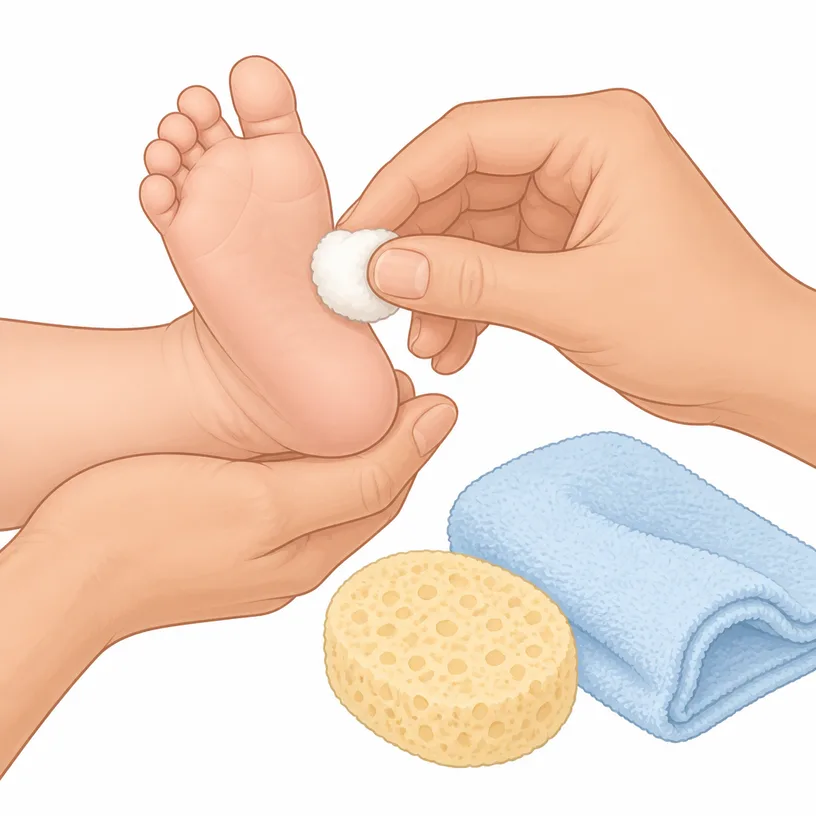
1.Desensitising massage after cast removal
A foot just out of the cast is hypersensitive and must be re-accustomed to touch
Only during already authorised brace breaks, gently stroke intact skin to help it become used to contact. Do not add time out of the brace for exercises. Do not massage wounds, blisters or persistently red areas: have them checked.
Brief contact according to tolerance and the brace schedule.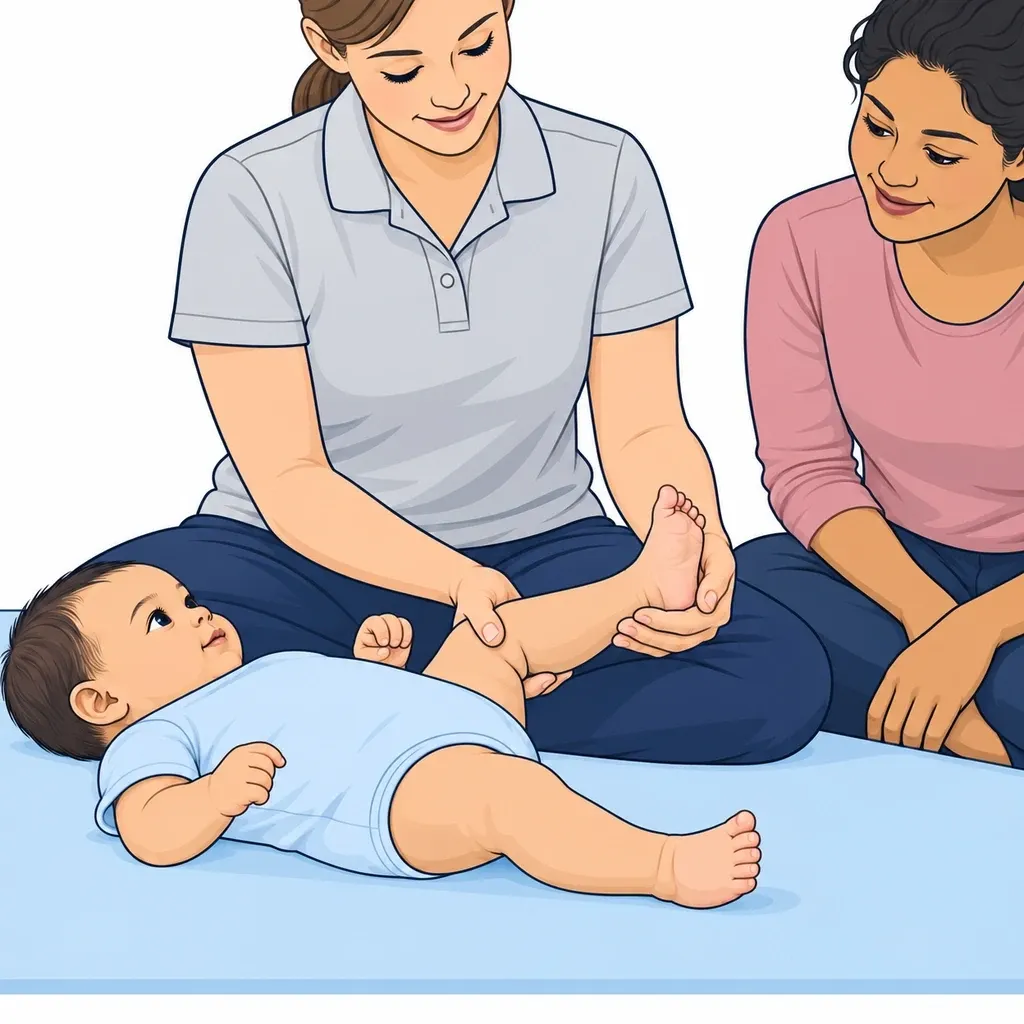
2.Abduction + dorsiflexion stretch (last cast position)
Any mobilisation is an adjunct to bracing, prescribed by the treating Ponseti team.
The figure shows support during demonstration. Do not reconstruct the final-cast correction from this picture.
Repeat only the manoeuvre demonstrated by the treating team on your baby’s foot. Do not try to reproduce the last cast position from a picture or lever through the midfoot or heel. After tenotomy, follow the prescribed healing restrictions. Exercises do not replace the brace or allow fewer hours of wear.
Use only the hand placement, range and dosage prescribed by the Ponseti team.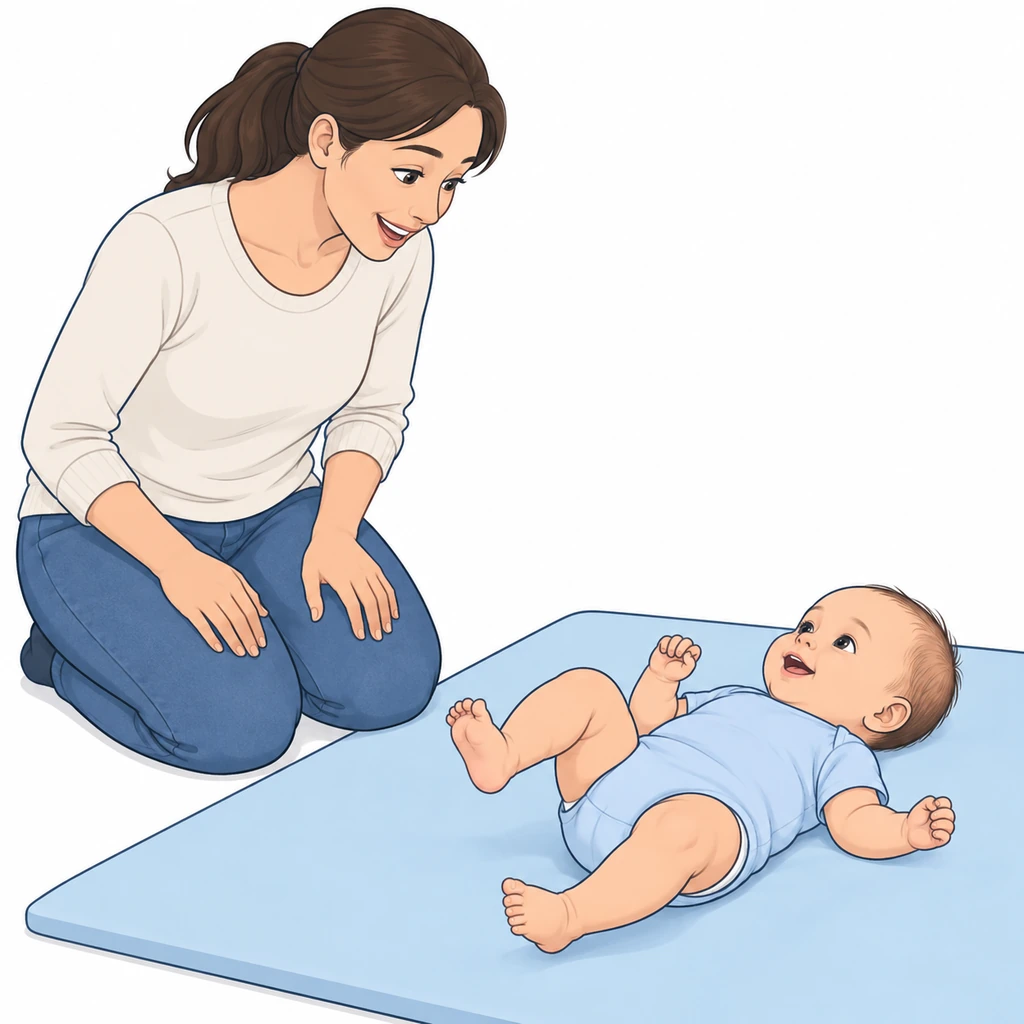
3.Spontaneous movement during authorised brace breaks
A home stretch into maximum plantarflexion is not prescribed here.
Free movement only during a brace-free interval authorised by the treating team.
During prescribed brace breaks, let the baby move the foot spontaneously. Do not push the foot into a fully pointed position to “balance” the cast. If it seems stiff or loses correction, contact the Ponseti team instead of introducing new manoeuvres.
Only during already prescribed brace breaks.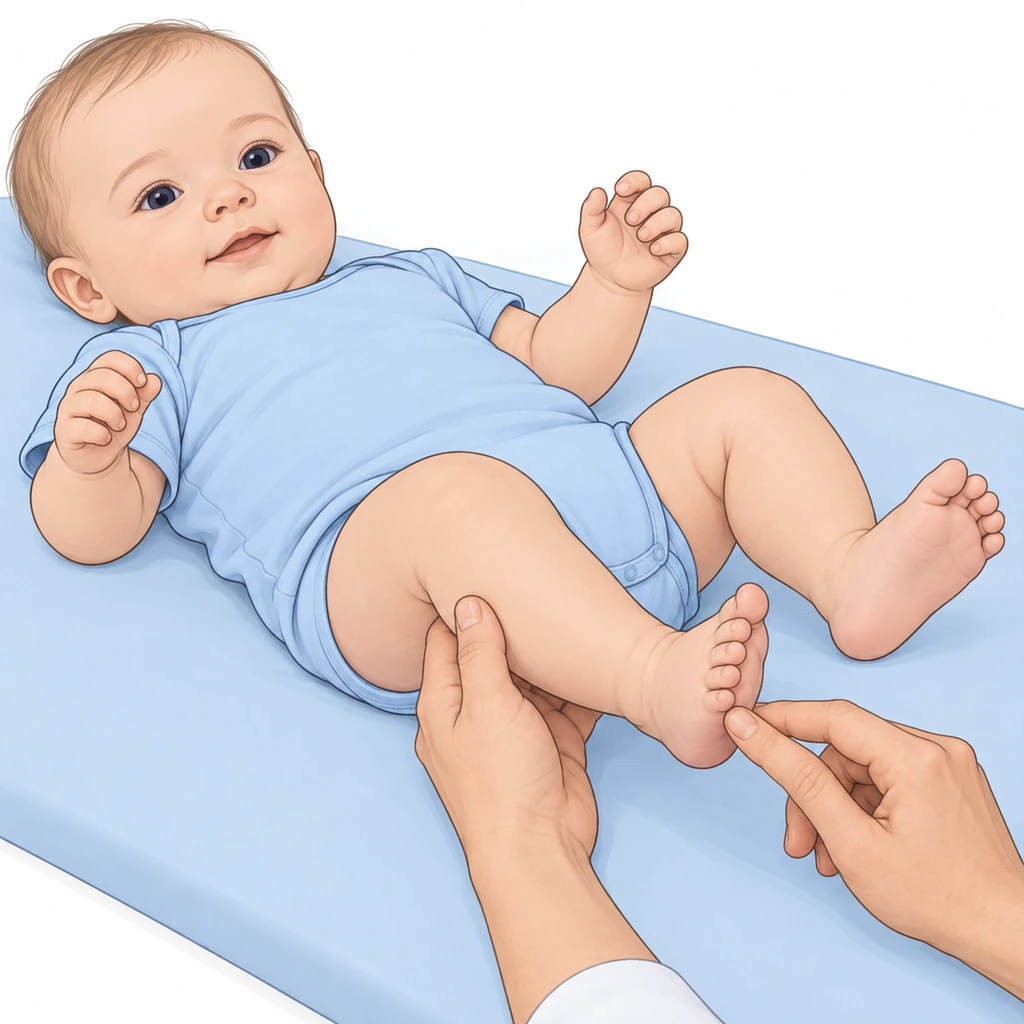
4.Active peroneal stimulation (outer border)
Active play without forcing a muscle response.
Gently stroke the foot and encourage spontaneous movement while the baby is awake and settled. Do not insist on an outward movement or increase time out of the brace. Report reduced movement or a new deviation to the treating team.
Short periods of play during authorised breaks.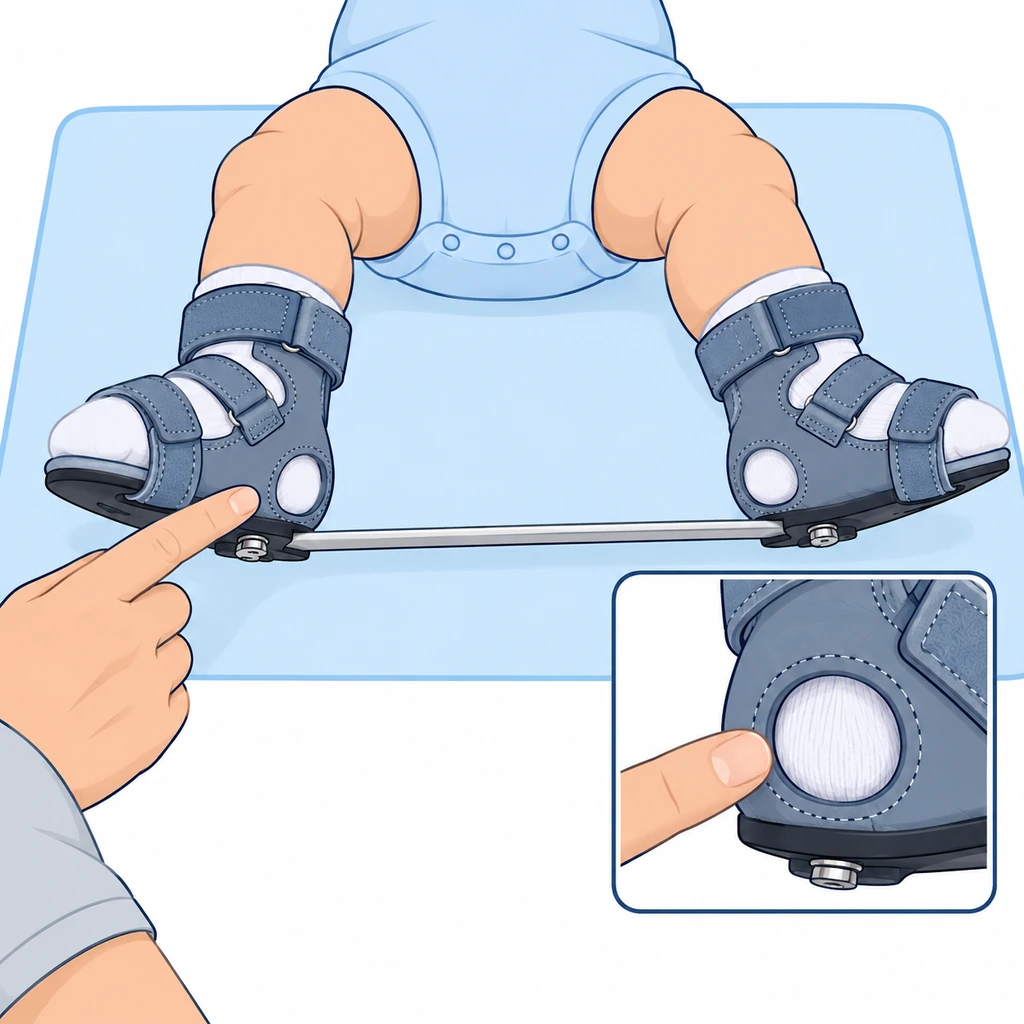
5.Correct brace use and skin check
The brace maintains the correction: exercises never replace it
Illustrative model: check the heel as taught, without forcing it or changing the bar settings.
Follow the wearing hours prescribed by the Ponseti team, without reducing them or adjusting the bar yourself. At each application, check heel position and fastenings as demonstrated by the orthotist: do not force the heel down or overtighten the straps. Initially, the heel may not touch the bottom of the boot completely; the treating team must confirm correct positioning. Report the foot slipping, persistent redness, blisters or the foot turning inward again. Use the socks and skin-check routine recommended for your brace.
At every brace application, every day
RED FLAGS - When to stop and contact the doctor immediately
Stop the exercises immediately and contact the specialist (or go to the emergency department if severe) if any of the following occur:
- Persistent crying, pain or resistance during handling: stop and contact the treating clinician.
- Fever, malaise, swelling or redness: seek prompt assessment.
- Sudden reduction of limb movement, cold or discoloured toes, or a compressive cast or harness: urgent assessment.
- Sudden head tilt, especially after injury or with fever, unusual eye movements or weakness: do not stretch and seek assessment.
In case of doubt, always prefer a check-up over continuing the exercises.
Dott. Daniele Priano
Paediatric Orthopaedics - ASST Gaetano Pini-CTO
Content version: 21 September 2026
ortopediaevolutiva.com • Printed: 18/10/2026
 Full exercise sheet
https://ortopediaevolutiva.com/en/parents-kids/exercises/parent-mobilizations/clubfoot
Prepare the visit handout
Use the condition and phase indicated by your clinician. You can leave out individual exercises; instructions, illustrations and safety advice remain together.
Exclude exercises if needed
5 of 5 exercise cards included
The full web page remains available. Your selection is not saved or shared.
Before You Start
Who is this guide for?
During Ponseti treatment, follow the team’s cast and brace instructions. Do not reproduce corrective manipulations from text or images, force plantarflexion or change brace angles.
What you need
A stable, clear surface, an adult continuously present and an age-appropriate toy. The baby should be awake and calm; place them on their back for sleep. Follow the cast or harness programme.
Suggested frequency
Perform only the exercises selected during the visit. The listed dosages are examples to adapt: follow the dose, frequency, rest and progression prescribed for age, symptoms and phase. Do not automatically perform the whole list.
Common mistakes to avoid
- •Forcing the head or a limb, persisting through crying or provoking joint clicks
- •Repeating manoeuvres not demonstrated with your baby
- •Changing straps, brace settings or wearing time without instructions
- •Changing or stopping the brace without consulting the team
⚠️ Red flags — when to stop and contact the doctor immediately
Stop exercises immediately and contact the specialist if any of the following occur:
- Persistent crying, pain or resistance during handling: stop and contact the treating clinician.
- Fever, malaise, swelling or redness: seek prompt assessment.
- Sudden reduction of limb movement, cold or discoloured toes, or a compressive cast or harness: urgent assessment.
- Sudden head tilt, especially after injury or with fever, unusual eye movements or weakness: do not stretch and seek assessment.
Detailed Exercises
- 1
Desensitising massage after cast removal
A foot just out of the cast is hypersensitive and must be re-accustomed to touch
Only during already authorised brace breaks, gently stroke intact skin to help it become used to contact. Do not add time out of the brace for exercises. Do not massage wounds, blisters or persistently red areas: have them checked.
Brief contact according to tolerance and the brace schedule. - 2
Abduction + dorsiflexion stretch (last cast position)
Any mobilisation is an adjunct to bracing, prescribed by the treating Ponseti team.
The figure shows support during demonstration. Do not reconstruct the final-cast correction from this picture.
Repeat only the manoeuvre demonstrated by the treating team on your baby’s foot. Do not try to reproduce the last cast position from a picture or lever through the midfoot or heel. After tenotomy, follow the prescribed healing restrictions. Exercises do not replace the brace or allow fewer hours of wear.
Use only the hand placement, range and dosage prescribed by the Ponseti team. - 3
Spontaneous movement during authorised brace breaks
A home stretch into maximum plantarflexion is not prescribed here.
Free movement only during a brace-free interval authorised by the treating team.
During prescribed brace breaks, let the baby move the foot spontaneously. Do not push the foot into a fully pointed position to “balance” the cast. If it seems stiff or loses correction, contact the Ponseti team instead of introducing new manoeuvres.
Only during already prescribed brace breaks. - 4
Active peroneal stimulation (outer border)
Active play without forcing a muscle response.
Gently stroke the foot and encourage spontaneous movement while the baby is awake and settled. Do not insist on an outward movement or increase time out of the brace. Report reduced movement or a new deviation to the treating team.
Short periods of play during authorised breaks. - 5
Correct brace use and skin check
The brace maintains the correction: exercises never replace it
Illustrative model: check the heel as taught, without forcing it or changing the bar settings.
Follow the wearing hours prescribed by the Ponseti team, without reducing them or adjusting the bar yourself. At each application, check heel position and fastenings as demonstrated by the orthotist: do not force the heel down or overtighten the straps. Initially, the heel may not touch the bottom of the boot completely; the treating team must confirm correct positioning. Report the foot slipping, persistent redness, blisters or the foot turning inward again. Use the socks and skin-check routine recommended for your brace.
At every brace application, every day
Frequently Asked Questions
How long should I do clubfoot mobilizations?
The need for and duration of home manoeuvres are agreed with the Ponseti team; they are not automatically prescribed throughout bracing. Follow the child’s prescribed brace schedule.
Can I hurt the baby with mobilizations?
An incorrect manoeuvre can cause harm even if it seems gentle. Perform only what has been demonstrated with your child, without forcing, and stop for pain, persistent crying or resistance. If unsure of the technique, ask for another demonstration before repeating it.
Can mobilizations replace the brace?
No. Exercise or massage does not replace the brace prescribed after Ponseti correction. Do not reduce wear time or change settings without the team; agree home activities separately.