Paediatric Orthopaedic Specialist
Panner disease (elbow)
Home Exercise Program
Not every exercise listed here is suitable for every child: the selection is individual and is defined during the consultation.
For whom: Children aged 5-10 with Panner disease (osteochondrosis of the humeral capitellum). Conservative programme: the main therapeutic factor is relative rest from sports loading the elbow.
Dose and frequency: Perform only the exercises selected during the visit. The listed dosages are examples to adapt: follow the dose, frequency, rest and progression prescribed for age, symptoms and phase. Do not automatically perform the whole list.
Equipment and supervision: A stable, clear surface, comfortable clothing and a secure support. Check resistance-band anchors. Adult supervision; avoid marbles and small objects if the child may put them in their mouth, using a towel instead.
Avoid: Forcing a painful or unauthorised movement; Increasing load, resistance or frequency without the agreed rest periods; Doing balance exercises without stable support or supervision.
1.Relative rest from elbow loading (phase 1)
This is the real treatment: removing repetitive load from the capitellum
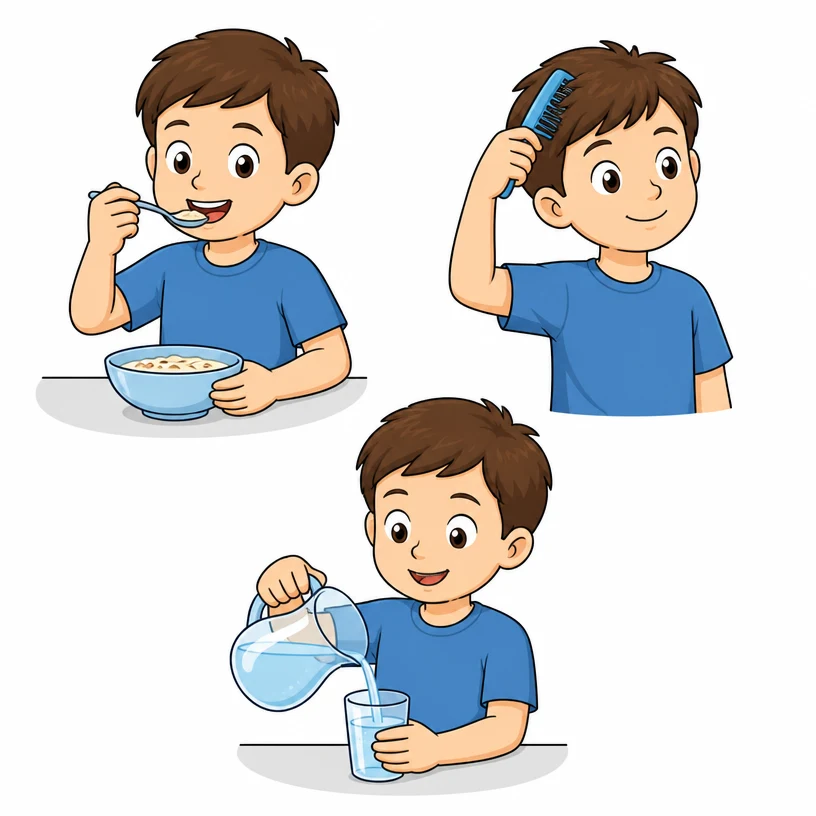
Suspend artistic gymnastics, handstands, cartwheels, rolls, climbing, throwing and overhead sports while the elbow is painful. Keep daily life normal: writing, eating and dressing are not harmful. Immobilization is not needed, except for short periods advised by the specialist in case of acute pain: prolonged immobilization promotes stiffness.
Throughout the painful phase, usually 6-12 weeks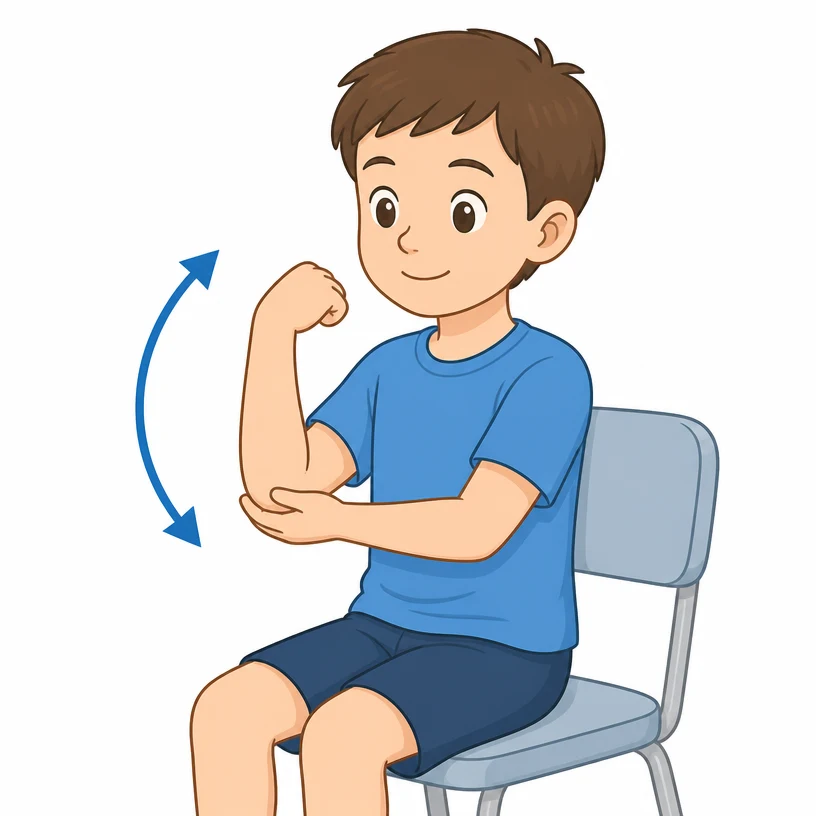
2.Gentle flexion-extension mobility
Prevents loss of extension, the most frequent complication of Panner disease
Seated, arm relaxed at the side. Bend and straighten the elbow slowly, within the PAIN-FREE range, without weights and without forcing the last degrees. The other hand may only guide the movement, never push. Compare weekly with the healthy arm to detect any loss of extension early.
10-15 repetitions, 3-4 times daily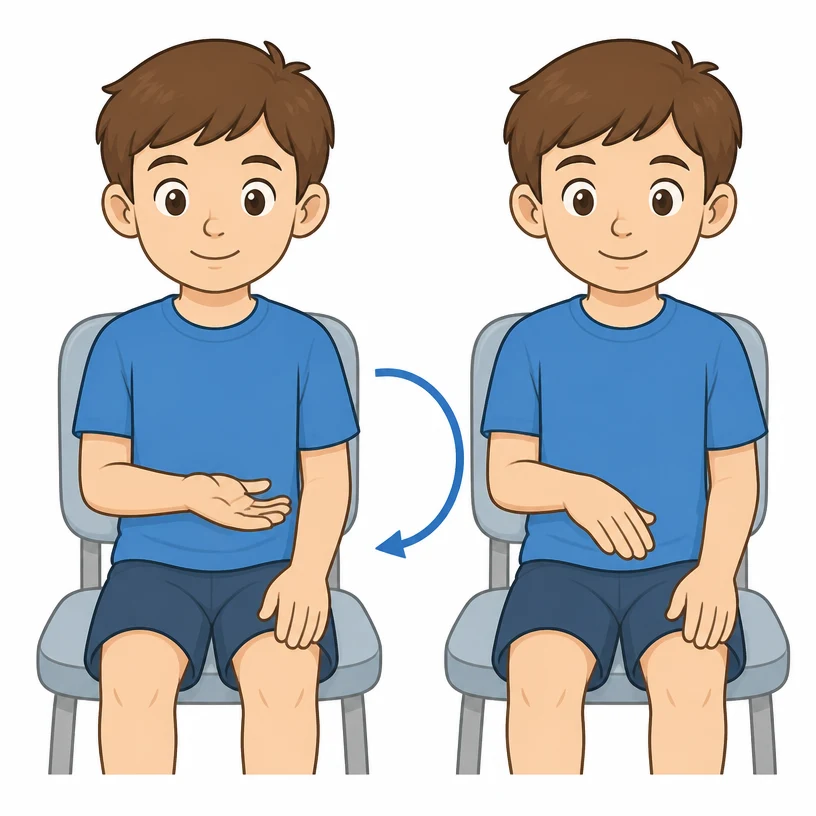
3.Forearm pronation-supination
Maintains rotation, often limited by joint effusion
Elbow bent to 90 degrees and held at the side, slowly rotate the palm up and then down, keeping the elbow still against the body. Slow movement, as wide as pain allows. No weights at this stage.
10-15 complete rotations, 3 times daily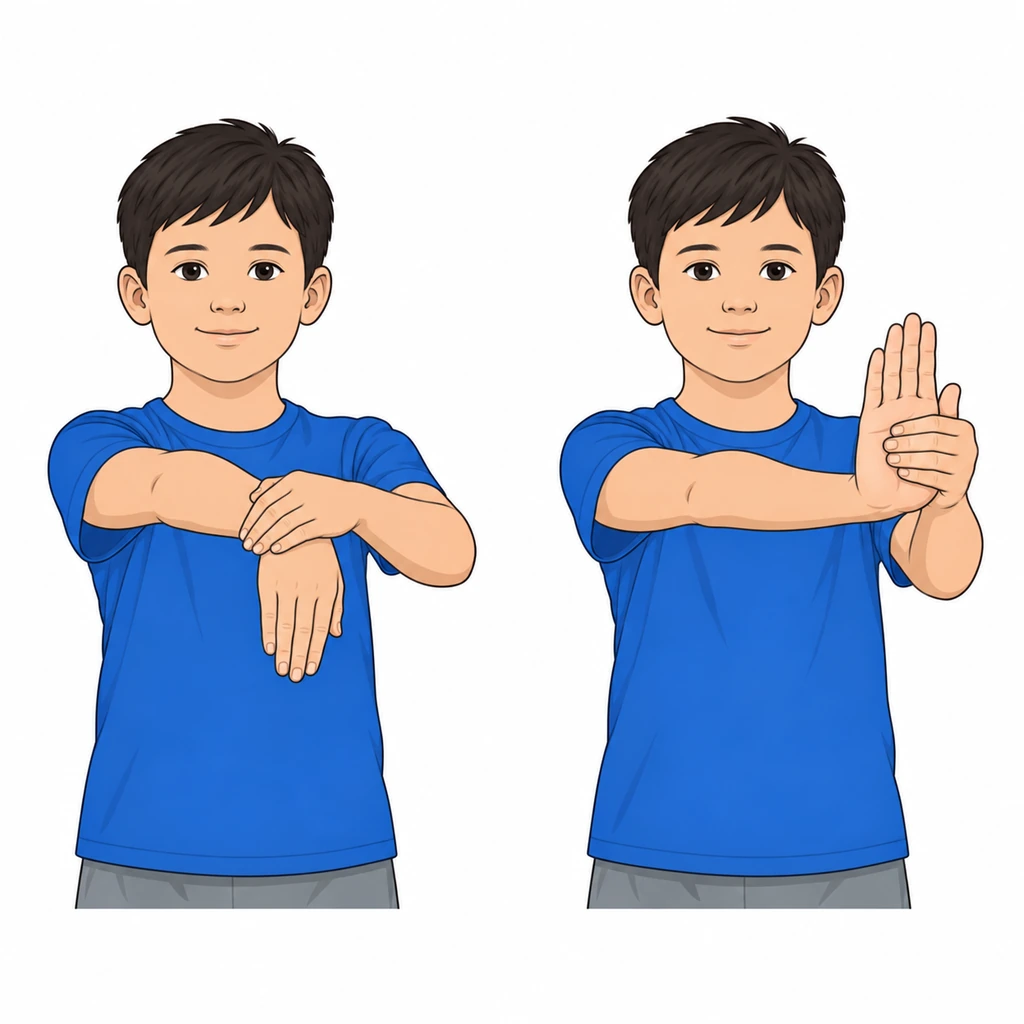
4.Gentle wrist flexor and extensor stretching
Reduces tension of the muscles inserting on the elbow
Arm straight forward with the elbow as extended as possible without pain. EXTENSORS: palm down, gently pull the fingers toward the body. FLEXORS: palm up, gently pull the fingers downward. The stretch must be felt in the forearm, never in the elbow: if the elbow hurts, reduce arm extension.
3 x 20-30 seconds each direction, twice daily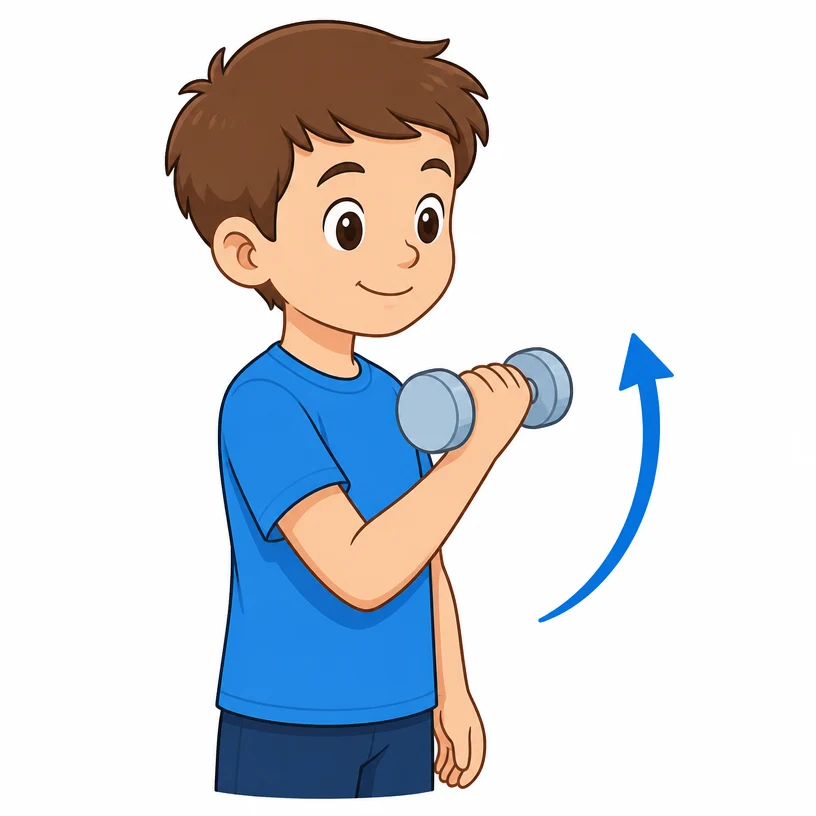
5.Progressive isometric strengthening (phase 2)
To start only when the elbow is pain-free and mobility is complete
Phase A: isometric contractions, push the hand against the other hand in elbow flexion and extension without the arm moving, 5 seconds per contraction. Phase B: when isometrics are pain-free, elbow curls with a light weight (0.5 L bottle). Do not progress if pain returns within the following 24 hours.
3 x 10 repetitions, every other day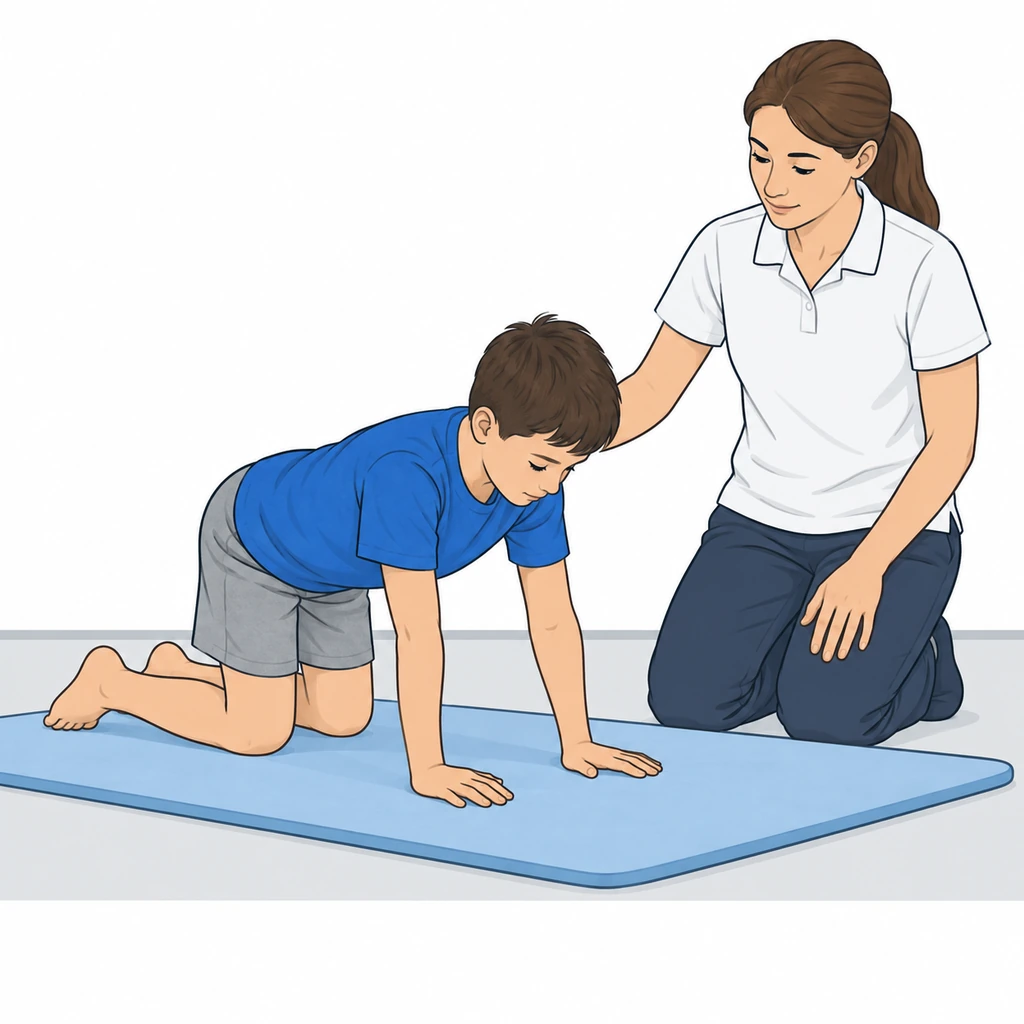
6.Gradual return to sport (phase 3)
Progressive reintroduction of upper limb loading
Example of early hand weight bearing after clearance. It does not indicate clearance for handstands, cartwheels or throwing.
Start only after specialist clearance, based on pain and recovery of elbow bending and straightening. The physiotherapist selects the first tolerated activity and initial load; if authorised, the quadruped position shown is one possible step for light hand weight bearing. Increase one element at a time according to the agreed programme, checking the response during activity and the following day. Handstands, cartwheels and throwing need specific clearance and do not automatically follow this step. If pain, swelling or reduced movement return, stop the provoking load and contact the treating clinician.
Individual progression based on clinical review and response to loading
RED FLAGS - When to stop and contact the doctor immediately
Stop the exercises immediately and contact the specialist (or go to the emergency department if severe) if any of the following occur:
- Acute or sudden pain during exercise
- Significant swelling after exercises
- Pain that progressively worsens over days
- Fever or general malaise
- Difficulty walking or using the limb after exercises
- Any neurological symptoms (tingling, numbness, sudden weakness)
- A red or hot joint, or inability to bear weight: seek prompt assessment; use emergency care if severe.
- Elbow pain increasing during or within 24 hours after the exercises
- Progressive loss of extension compared with the healthy arm
- Sudden joint locking or painful catching (suspected loose body)
- Swelling, warmth or redness of the elbow
- Tingling or loss of strength in the hand
In case of doubt, always prefer a check-up over continuing the exercises.
Dott. Daniele Priano
Paediatric Orthopaedics - ASST Gaetano Pini-CTO
Content version: 9 September 2026
ortopediaevolutiva.com • Printed: 14/09/2026
 Web version
 Google
 MioDottore
Prepare the visit handout
Use the condition and phase indicated by your clinician. You can leave out individual exercises; instructions, illustrations and safety advice remain together.
Exclude exercises if needed
6 of 6 exercise cards included
The full web page remains available. Your selection is not saved or shared.
Before You Start
Who is this guide for?
Children aged 5-10 with Panner disease (osteochondrosis of the humeral capitellum). Conservative programme: the main therapeutic factor is relative rest from sports loading the elbow.
What you need
A stable, clear surface, comfortable clothing and a secure support. Check resistance-band anchors. Adult supervision; avoid marbles and small objects if the child may put them in their mouth, using a towel instead.
Suggested frequency
Perform only the exercises selected during the visit. The listed dosages are examples to adapt: follow the dose, frequency, rest and progression prescribed for age, symptoms and phase. Do not automatically perform the whole list.
Common mistakes to avoid
- •Forcing a painful or unauthorised movement
- •Increasing load, resistance or frequency without the agreed rest periods
- •Doing balance exercises without stable support or supervision
⚠️ Red flags — when to stop and contact the doctor immediately
Stop exercises immediately and contact the specialist if any of the following occur:
- Acute or sudden pain during exercise
- Significant swelling after exercises
- Pain that progressively worsens over days
- Fever or general malaise
- Difficulty walking or using the limb after exercises
- Any neurological symptoms (tingling, numbness, sudden weakness)
- A red or hot joint, or inability to bear weight: seek prompt assessment; use emergency care if severe.
- Elbow pain increasing during or within 24 hours after the exercises
- Progressive loss of extension compared with the healthy arm
- Sudden joint locking or painful catching (suspected loose body)
- Swelling, warmth or redness of the elbow
- Tingling or loss of strength in the hand
Detailed Exercises
- 1
Relative rest from elbow loading (phase 1)
This is the real treatment: removing repetitive load from the capitellum
Suspend artistic gymnastics, handstands, cartwheels, rolls, climbing, throwing and overhead sports while the elbow is painful. Keep daily life normal: writing, eating and dressing are not harmful. Immobilization is not needed, except for short periods advised by the specialist in case of acute pain: prolonged immobilization promotes stiffness.
Throughout the painful phase, usually 6-12 weeks - 2
Gentle flexion-extension mobility
Prevents loss of extension, the most frequent complication of Panner disease
Seated, arm relaxed at the side. Bend and straighten the elbow slowly, within the PAIN-FREE range, without weights and without forcing the last degrees. The other hand may only guide the movement, never push. Compare weekly with the healthy arm to detect any loss of extension early.
10-15 repetitions, 3-4 times daily - 3
Forearm pronation-supination
Maintains rotation, often limited by joint effusion
Elbow bent to 90 degrees and held at the side, slowly rotate the palm up and then down, keeping the elbow still against the body. Slow movement, as wide as pain allows. No weights at this stage.
10-15 complete rotations, 3 times daily - 4
Gentle wrist flexor and extensor stretching
Reduces tension of the muscles inserting on the elbow
Arm straight forward with the elbow as extended as possible without pain. EXTENSORS: palm down, gently pull the fingers toward the body. FLEXORS: palm up, gently pull the fingers downward. The stretch must be felt in the forearm, never in the elbow: if the elbow hurts, reduce arm extension.
3 x 20-30 seconds each direction, twice daily - 5
Progressive isometric strengthening (phase 2)
To start only when the elbow is pain-free and mobility is complete
Phase A: isometric contractions, push the hand against the other hand in elbow flexion and extension without the arm moving, 5 seconds per contraction. Phase B: when isometrics are pain-free, elbow curls with a light weight (0.5 L bottle). Do not progress if pain returns within the following 24 hours.
3 x 10 repetitions, every other day - 6
Gradual return to sport (phase 3)
Progressive reintroduction of upper limb loading
Example of early hand weight bearing after clearance. It does not indicate clearance for handstands, cartwheels or throwing.
Start only after specialist clearance, based on pain and recovery of elbow bending and straightening. The physiotherapist selects the first tolerated activity and initial load; if authorised, the quadruped position shown is one possible step for light hand weight bearing. Increase one element at a time according to the agreed programme, checking the response during activity and the following day. Handstands, cartwheels and throwing need specific clearance and do not automatically follow this step. If pain, swelling or reduced movement return, stop the provoking load and contact the treating clinician.
Individual progression based on clinical review and response to loading
Frequently Asked Questions
Does my child have to stop sport completely?
Activities that load the elbow (artistic gymnastics, throwing, weight-bearing on the arms) should be suspended until pain resolves, usually 6-12 weeks. Activities that do not load the upper limb, such as running or football, can generally continue unless the specialist advises otherwise.
Do exercises cure the disease?
No. The humeral capitellum revascularizes on its own over time: exercises serve to maintain elbow mobility, which is the real risk in this phase, and to prepare the return to sport. The main therapeutic factor remains relative rest.
When can sport be resumed?
When the elbow is pain-free even on pressure, mobility is complete and symmetrical to the healthy side, and the specialist's clinical or radiographic check allows it. Return must always be gradual, increasing loads over 4-6 weeks.