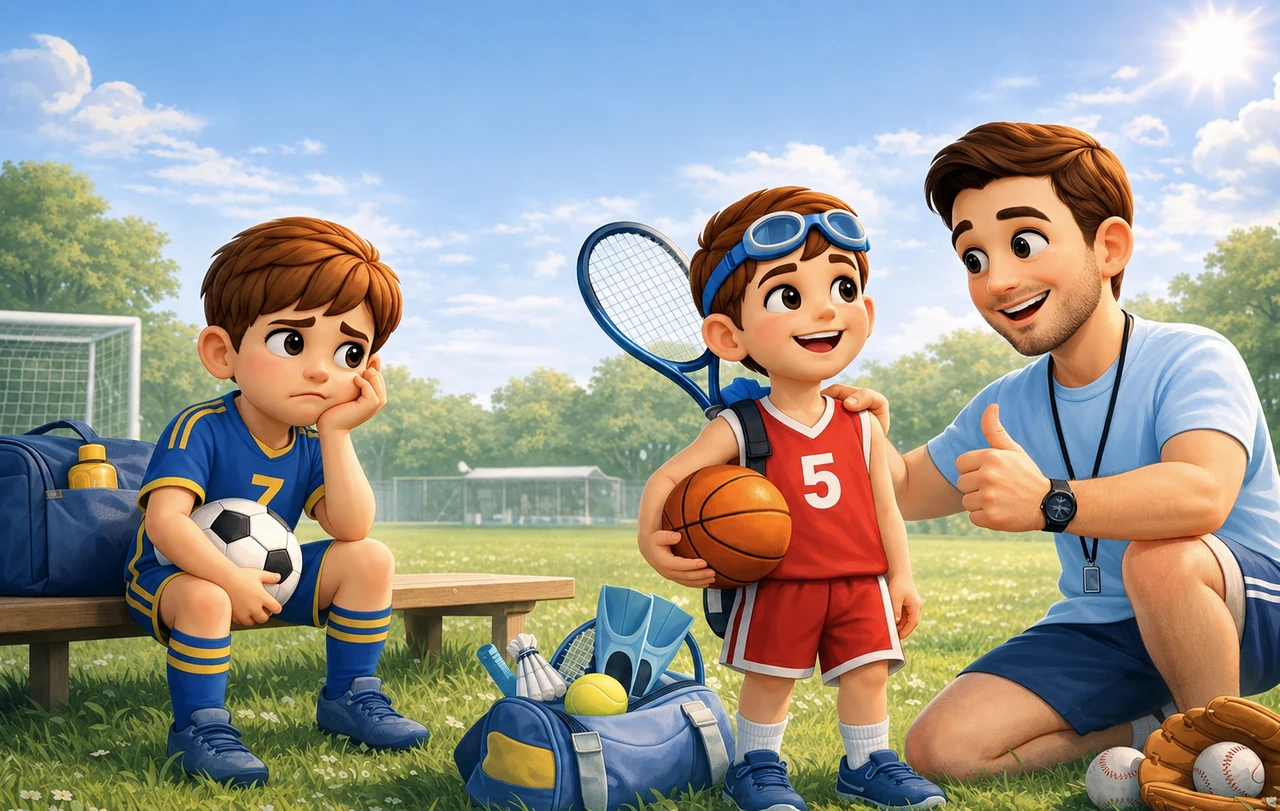
In many youth sports, specialization comes early: more training sessions, competitions for most of the year, and gradually giving up other activities. The idea is that starting earlier increases the chances of reaching higher levels.
The available literature is much less conclusive. In most sports, there is no convincing evidence that early specialization improves long-term success; instead, there is more solid data on an increased risk of overuse injuries and burnout. [1–5]
What is meant by early specialization
Generally, this refers to intense training and competition in a single discipline for most of the year, with a marked reduction in other sports and free play. The AOSSM consensus uses practice exceeding eight months a year in a single sport as a reference. [1]
The definition is not perfect and varies slightly between studies, but it accurately describes the problem: repetitive loads, little variety in movement, and less recovery time.
The most solid data concerns overuse injuries
A systematic review with meta-analysis published in Pediatrics in 2018 found a higher risk of overuse injuries in highly specialized athletes compared to those with low specialization. The aggregated relative risk was 1.81. Moderate specialization also showed an increase compared to lower levels. [2]
The individual risk naturally depends on the sport, volume, intensity, maturation, and recovery. However, the overall signal remains quite consistent: repeating the same movement for many months a year increases exposure to load-related problems.
Burnout and sport dropout
The 2024 clinical report from the American Academy of Pediatrics links overuse, overtraining, and burnout, and notes that burnout significantly contributes to youth sport dropout. [3]
A review from the same period also highlights psychological and social aspects: the problem does not only concern muscles, tendons, and joints, but the overall relationship of the young person with sport. [4]
Does specializing early really help reach the top?
The AOSSM consensus does not consider early specialization a requirement for elite success in most sports, especially when peak performance occurs after maturation. [1]
A rapid review from 2025, with 93 studies and over 62,000 athletes, found no clear advantage of early specialization on sporting success, while confirming associations with injuries and some unfavorable psychological outcomes. [5]
This does not mean that a highly motivated young person cannot progressively increase their commitment to a discipline. It means there is no good reason to treat trying different sports as an obstacle that must be removed at an early age.
The exceptions
Artistic gymnastics, figure skating, diving, and other sports with an early performance peak have different dynamics. The AOSSM consensus considers them separately precisely because some technical skills are developed very early. [1]
Even here, however, specialization does not equate to unlimited load. Planning, recovery, and maturation remain central.
What I advise families
For elementary school children and in the early years of adolescence, I prefer an approach that leaves room for a range of movement and sporting experiences, especially when there is no sport-specific reason to prematurely restrict activity.
If a young person is very good at a sport, the decision to increase the load should depend on maturation, genuine motivation, training quality, recovery, and injury history. The fear of "missing the boat" is a much less useful criterion.
The model also proposed by the IOC for young athlete development values progression, healthy participation, enjoyment of movement, and overall development, not just early performance. [6]
Disclaimer
This content is for informational purposes only and does not replace an individual clinical evaluation.
References
[1] LaPrade RF, Agel J, Baker J, et al. AOSSM Early Sport Specialization Consensus Statement. Orthop J Sports Med. 2016;4(4):2325967116644241. doi:10.1177/2325967116644241. PMID: 27169132.
[2] Bell DR, Post EG, Biese K, Bay C, Valovich McLeod T. Sport Specialization and Risk of Overuse Injuries: A Systematic Review With Meta-analysis. Pediatrics. 2018;142:e20180657. PMID: 30135085.
[3] Brenner JS, Watson A; Council on Sports Medicine and Fitness. Overuse Injuries, Overtraining, and Burnout in Young Athletes. Pediatrics. 2024;153(2):e2023065129. doi:10.1542/peds.2023-065129. PMID: 38247370.
[4] Sugimoto D, Whitney KE, d’Hemecourt PA, Stracciolini A. Youth Sport Specialization: Current Concepts and Clinical Guides. HSS J. 2024;20(3):416-423. doi:10.1177/15563316241237526. PMID: 39108441. PMCID: PMC11299332.
[5] Luo EJ, Reed J, Mitchell JK, et al. Early Sport Specialization in a Pediatric Population: A Rapid Review of Injury, Function, Performance, and Psychological Outcomes. Clin Pract. 2025;15(5):88. doi:10.3390/clinpract15050088. PMID: 40422269. PMCID: PMC12110343.
[6] Bergeron MF, Mountjoy M, Armstrong N, et al. International Olympic Committee consensus statement on youth athletic development. Br J Sports Med. 2015;49(13):843-851. doi:10.1136/bjsports-2015-094962. PMID: 26084524.