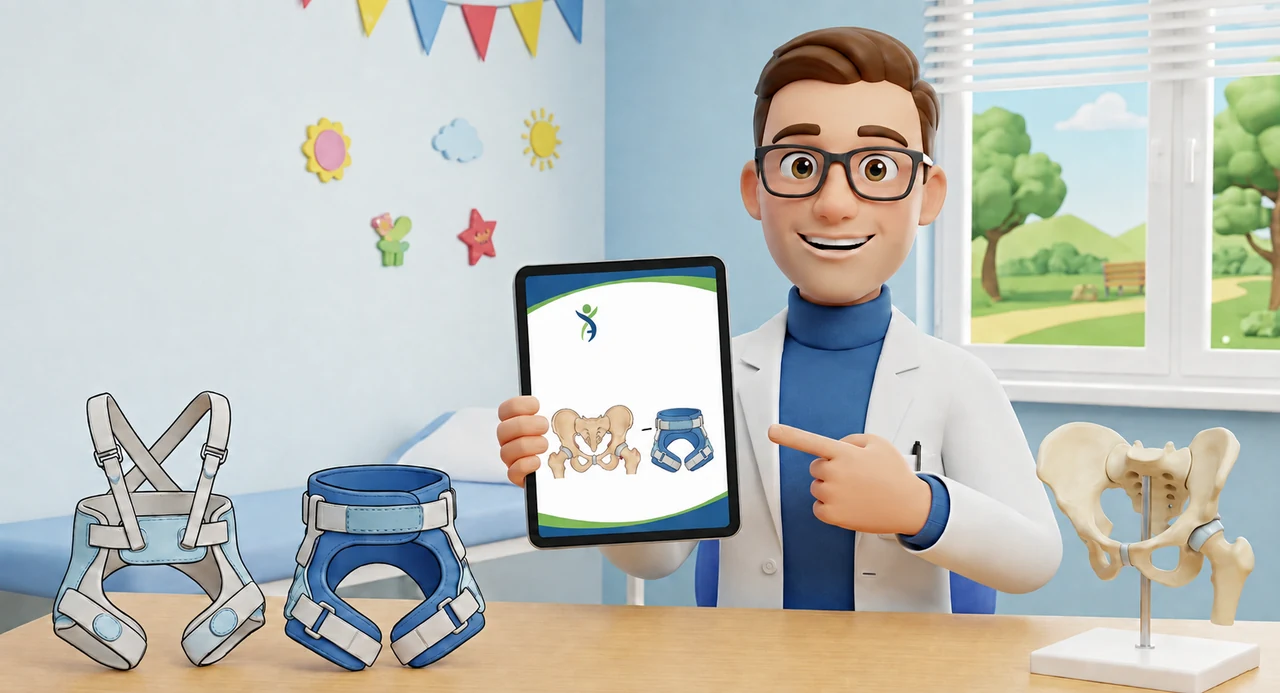
After the ultrasound normalization of a stable dysplasia treated with a dynamic orthosis, the decision remains on how to discontinue treatment: immediate cessation or progressive reduction over several weeks.
A randomized trial published in 2026 directly compared the two strategies. [1]
How the Study Was Designed
Infants had started treatment before 3 months of age and were managed in the same way until ultrasound normalization. Subsequently, they were randomized to either immediate cessation or weaning for 4–6 weeks. [1]
The primary endpoint was the acetabular index measured on X-rays at 6 months.
The 6-Month Result
The average acetabular index was 24.8° in the weaning group and 26.9° in the group that stopped immediately, with a statistically significant difference. [1]
The percentage of hips with an AI ≥30°, a threshold that in the protocol led to considering further part-time bracing, was similar: 17% versus 22%, with no significant difference. [1]
Weaning therefore seems to influence average radiographic maturation in the first few months, without demonstrating in the same study a clear reduction in the number of hips requiring additional treatment.
What Happens at One Year
At 12 months, the difference in acetabular index between the groups was no longer evident. [1]
The interpretation is not simple, partly because children with residual dysplasia could receive further treatments after the 6-month check-up. These interventions inevitably tend to alter the comparison over time.
How I Use This Data
Immediate cessation remains a reasonable strategy after a straightforward course and convincing normalization. The trial does not show a clinically worse outcome at one year. [1]
A brief weaning period can be considered when one wishes to continue supporting acetabular maturation for a few more weeks, knowing that the demonstrated advantage primarily concerns the acetabular index at 6 months.
The study was conducted using a Pavlik harness. The principle of gradual discontinuation can also be discussed with other dynamic braces, but the method and hours of use cannot be automatically transferred from one device to another.
What Remains Uncertain
This RCT does not clarify whether the small early radiographic advantage of weaning reduces clinically relevant residual acetabular dysplasia in subsequent years. [1]
Radiographic follow-up therefore remains important regardless of the method chosen to discontinue the brace.
Disclaimer: informational content; does not replace an individual clinical evaluation.
Reference
[1] Kuka CC, Hall CE, Bram JT, Sarkar S, DeFrancesco CJ, Sankar WN. To Wean or Not to Wean: A Randomized Controlled Trial of Pavlik Harness Weaning in Infantile Developmental Dysplasia of the Hip. Journal of Pediatric Orthopaedics. 2026 (online ahead of print). PMID: 41641599.