Femoral and Tibial Torsion
Walking with feet turned inward or outward: the rotational profile involves the hip, leg and foot, and in most children evolves spontaneously with growth.
Quick Answers
Why does my child walk with feet turned in?
Do corrective shoes or braces help with torsions?
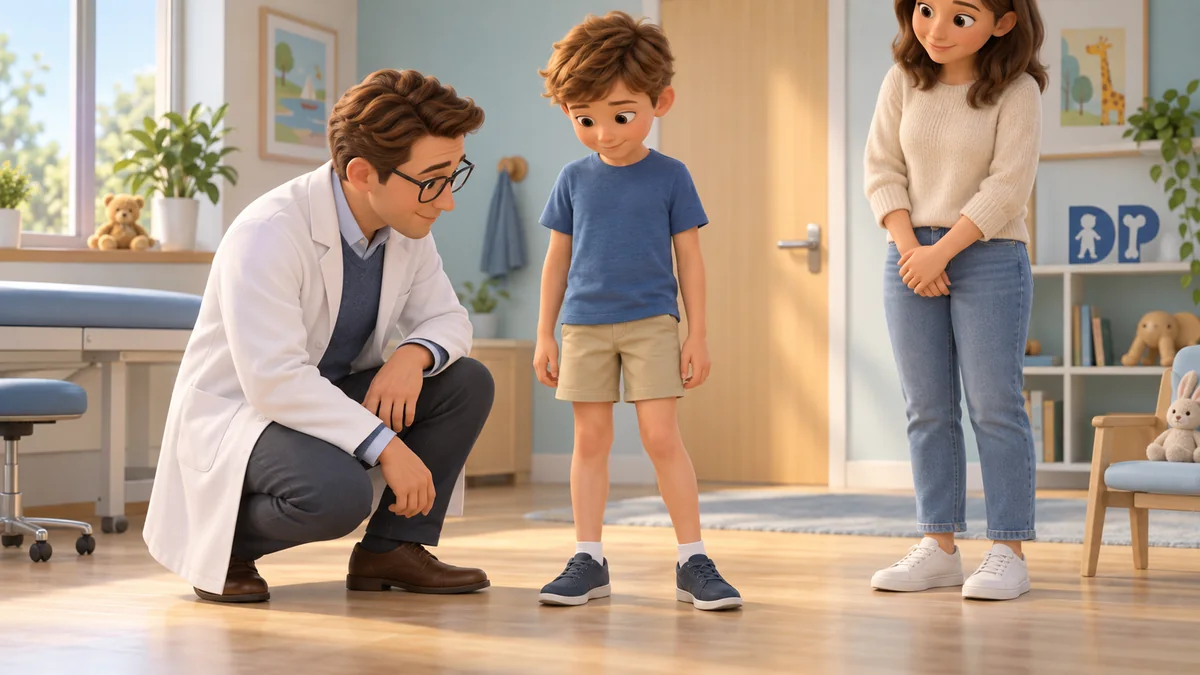
Several segments shape walking
The thighbone, shinbone and foot contribute to walking direction. Feet alone do not reveal the rotation of the bones.
Read all the illustrated explanations →Walking with feet turned in or out is a common variation during growth. What is visible from the outside, however, is only the end result: rotation of the lower limb is built up at several levels, and the same gait can originate from different points.
For this reason the assessment starts from the complete torsional profile, examined level by level:
- hip and femur: how much internal and external rotation the hip has, and how the femoral neck is oriented (anteversion or retroversion);
- leg and tibia: internal or external tibial torsion, assessed with the thigh-foot angle;
- foot: the shape of the medial border and any forefoot adduction;
- gait: the foot progression angle, that is how the foot is oriented relative to the direction of walking, which summarises the contribution of the levels above.
Understanding at which level the rotation arises changes the interpretation: the external appearance may be identical, but cause, expected course and indications differ. Age, symmetry between the two sides, the trend over time and the presence of pain, frequent tripping or functional limitation all matter as well.
Many patterns change spontaneously with growth and only require follow-up over time. More structured pathways are considered in marked, asymmetric or persistent torsion, or when daily life and sport are genuinely affected.

🔄Torsions Correct with Growth
Lower limb torsions (tibial and femoral) are part of normal skeletal development. Most correct spontaneously by age 10-12. Special shoes, night braces, or insoles don't accelerate this natural process. Monitoring progression is sufficient in almost all cases.
Assessment and treatment
When to seek evaluation
- Very pronounced intoeing gait
- Frequent falling or tripping
- Asymmetry between the two legs
- No improvement after 6-7 years
- Functional limitation in daily activities
What is evaluated
- Rotational profile evaluation
- Thigh-foot angle measurement
- Foot shape examination
- Gait analysis
- Eventual rotational imaging in selected cases
Treatment options
- Reassurance and observation in most cases
- Suggest alternatives to prolonged W-sitting in young children (cross-legged, side-sitting), without turning it into a strict ban
- Corrective osteotomy only in severe functional cases
Frequently Asked Questions
Why does my child walk with feet turned in?▼
Do corrective shoes or braces help with torsions?▼
When is surgery needed for torsions?▼
Why do some children walk with their feet turned out instead?▼
Does W-sitting make torsions worse?▼
My child trips a lot: is it because of torsions?▼
Important Notice: The information on this page is for educational and informational purposes only and does not constitute medical advice. Each clinical case is unique: the appropriate treatment is determined during the specialist consultation, based on a thorough clinical examination and, where necessary, diagnostic imaging. For any doubts or concerns, please consult a specialist.