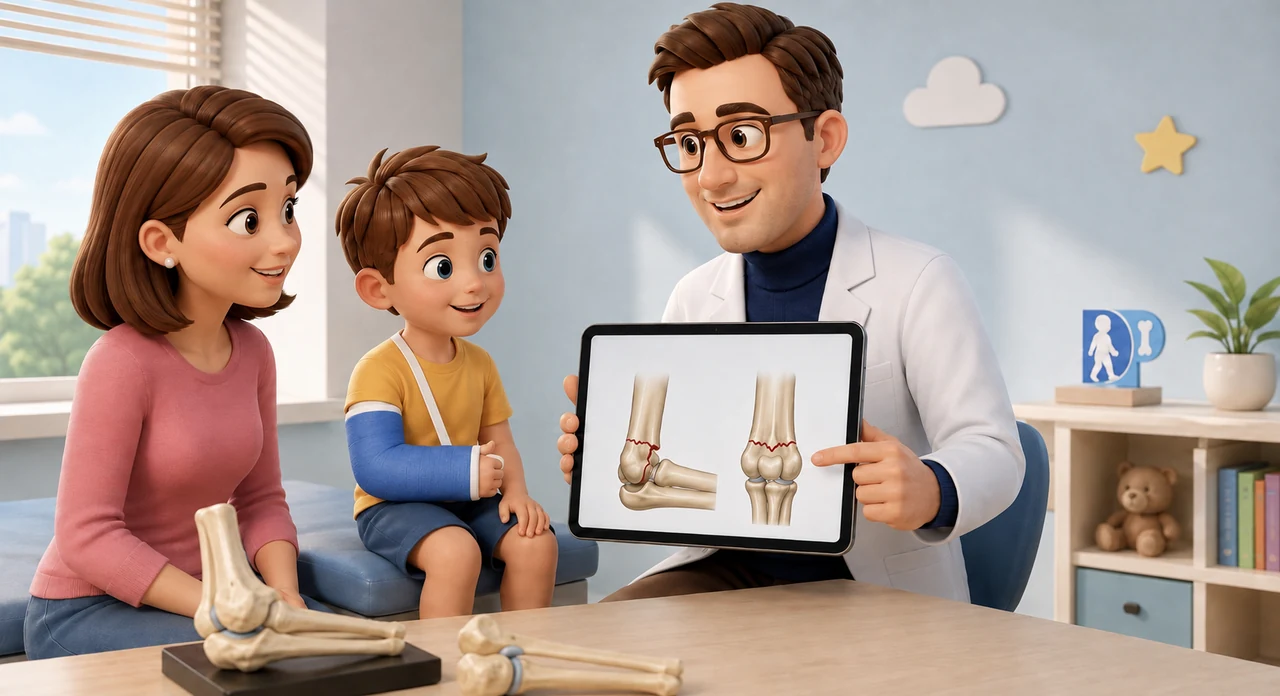
When a supracondylar humerus fracture is severely displaced, the preoperative explanation is more or less this: we will try to realign it without incising the elbow and stabilize it with Kirschner wires. However, if it is not possible to achieve or maintain a correct reduction, surgical exposure of the fracture may be necessary.
A study published in July 2026 in the Journal of Children’s Orthopaedics analyzed fracture morphology, instability, age, and time elapsed before surgery to understand which elements were associated with the need for open reduction [1]. The factors identified do not act in isolation, and the data on timing must be read in conjunction with the severity of the fracture and the organization of the surgical pathway.
The Study: 318 High-Risk Fractures
Darilmaz and Bulut retrospectively analyzed 318 children between 2 and 12 years old, operated on between 2015 and 2025 for Gartland III supracondylar fractures or for fractures that were found to be multidirectionally unstable during surgery and thus classified as Gartland IV [1].
All patients initially underwent an attempt at closed reduction and percutaneous fixation. In 192 cases, the closed procedure was successful; in 126 cases, it was necessary to proceed to an open reduction.
The conversion rate is therefore 39.6%.
39.6% is much higher than the expected rate in a general population of pediatric supracondylar fractures and reflects the selection of complex cases.
This is not a representative case series of all pediatric supracondylar fractures. The study includes only displaced and high-risk fractures, with a significant proportion of Gartland IV and "flexion type" fractures. The authors themselves clarify that this data should not be interpreted as the normal rate of open reduction in pediatric supracondylar fractures [1].
Furthermore, the decision to discontinue closed attempts and proceed with open reduction inevitably also depends on the surgeon's judgment. There is no universal number of maneuvers beyond which everyone makes the same decision.
Morphology and Instability
Flexion-type fractures accounted for only 30 cases, but in 24 out of 30 cases open reduction was necessary: 80% [1].
This data is consistent with previous literature. Flexion-type fractures are less frequent than the classic extension-type forms but can be much more difficult to reduce. The loss of normal periosteal support, the different direction of displacement, and the interposition of soft tissues can render usual maneuvers ineffective [2,3].
Gartland IV instability also played an important role. In the complete model, the presence of multidirectional instability was associated with more than five times higher odds of open reduction [1].
This does not mean that a Gartland IV fracture must be opened by definition.
A multidirectionally unstable fracture can still be reduced and stabilized percutaneously. The classification indicates that it will be more difficult to achieve and, above all, maintain alignment during wire insertion. It is a marker of difficulty, not an automatic indication for surgical access.
What about Timing? The Data is Strong, but Not So Simple
In the study, the average time between trauma and surgery was approximately 5.4 hours in children successfully treated with closed reduction and 15.1 hours in those who underwent open reduction [1].
Even after statistical adjustment, a longer interval remained associated with a higher probability of conversion.
The article's supplement makes the data even more evident:
- within 6 hours, open reduction was necessary in 60 out of 210 cases, or 28.6%;
- between 6 and 12 hours, in 48 out of 78 cases, or 61.5%;
- beyond 12 hours, in 18 out of 30 cases, or 60%.
This distribution suggests that timing may matter. But it also shows the limit of the most immediate interpretation: the risk does not continue to increase linearly between 6–12 hours and beyond 12 hours. The two groups have almost identical crude percentages, and the later group contains only 30 patients.
The authors themselves advise caution. Time might reflect not only a biological effect of waiting but also the complexity of the fracture, transfer from another hospital, soft tissue conditions, and the priority assigned to the case [1].
This data does not demonstrate a linear increase in reduction difficulty for every hour elapsed.
Why, in My Practice, Timing Remains Fundamental
In our practice, Gartland III fractures are placed on the urgent surgical pathway.
I do not consider this a routine administrative step. It means avoiding unnecessary delays, repeatedly checking vascular and neurological status, limiting the increase in edema, and addressing the fracture with a team accustomed to pediatric traumatology.
In my experience, when a Gartland III fracture is treated with appropriate timing, in an emergency operating theatre, and by an experienced team, the need to proceed to open reduction is much less likely and certainly significantly lower than what appears in this case series.
This is a clinical observation, not scientific proof. A single experience is not enough to demonstrate that early intervention prevents open reduction.
But this is precisely where the study becomes interesting: how much of the outcome depends on the fracture and how much on the pathway in which that fracture is treated?
Operating room availability, anesthesia, team experience, fluoroscopy quality, patient positioning, delicacy of maneuvers, and the chosen threshold for conversion are variables difficult to measure, but in real life, they matter.
Timing, therefore, is not just the number of hours elapsed since the trauma. It is treatment organization.
Two subsequent works reinforce this interpretation. A cohort published in 2026 showed that fracture severity remains the primary determinant of open reduction, but that timing and admission are also influenced by logistical factors of the pathway [9]. A meta-analysis on pathways with a dedicated paediatric trauma operating theatre also showed shorter times to the operating room and shorter hospital stays, without, however, demonstrating a reduction in the proportion of open approaches or complications [10].
Rapidly organizing the case remains useful, even if these studies do not demonstrate that bringing surgery forward by a few hours in itself reduces the need for open reduction.
What Previous Literature Says About Surgical Delay
Studies on timing do not provide a single answer.
Gupta and colleagues, as early as 2004, had not observed a significant increase in open reductions or complications when the treatment of supracondylar humerus fractures was performed after the first 12 hours [4]. Bales and colleagues, in 2010, reached similar conclusions in a case series of pediatric fractures treated with delayed pinning [5].
These works helped to downplay the idea that every Gartland III with a well-perfused hand and stable neurological status must necessarily be operated on in the middle of the night, regardless of the team's conditions.
However, a more recent meta-analysis on factors associated with open reduction showed strong heterogeneity among studies: the relationship between delay and conversion varies greatly depending on patient selection, fracture severity, and the organizational methods of different centers [6].
A brief delay in a stable and properly monitored child does not automatically lead to worsening. At the same time, avoiding unnecessary delays and treating the fracture in an emergency pathway helps limit edema, transfers, and organizational variables that can complicate treatment.
Other Factors That Increase Reduction Difficulty
The 2026 study confirms that there is no single element capable of predicting the need for open reduction.
Older Age
Children who underwent open reduction were, on average, older. In the statistical model, each year of age was associated with an increased probability of conversion [1].
This is plausible: with age, limb size, trauma force, and tissue rigidity increase, while some maneuvers become less simple compared to a young child.
Multidirectional Instability
Gartland IV loses both anterior and posterior periosteal support. During reduction, the distal fragment can be unstable in flexion, extension, and rotation. Even after obtaining an apparently correct image, maintaining it while inserting the wires can be difficult [1,7].
Flexion Type Fracture
This is probably the most evident preoperative sign. Literature associates these forms with a higher frequency of ulnar nerve injury and a higher probability of open reduction [2].
Displacement and Soft Tissue Signs
Significant coronal displacement, the presence of a medial spur, marked rotation, or the so-called pucker sign can indicate that the proximal fragment has traversed the brachialis muscle or become entrapped in the anterior tissues. In these cases, it is not just "more crooked": there may be a true mechanical obstacle to reduction.
Obesity and Neurological Deficits
Recent studies and a 2024 meta-analysis have indicated obesity, greater displacement, and initial neurological deficits as markers of a higher probability of an open surgical approach [3,6,8].
In the work by Darilmaz and Bulut, neurological deficit was associated with open reduction in the simple analysis but lost significance after considering age, morphology, and instability together [1]. This suggests that the deficit may primarily be a sign of a more violent and complex fracture, not necessarily the direct cause of conversion.
When Open Reduction is Needed
The goal is not to succeed at all costs in completing the surgery through small skin incisions. The goal is to achieve correct alignment and stable fixation without further damaging nerves, vessels, and soft tissues.
Insisting with repeated maneuvers on an irreducible fracture can be less safe than choosing a targeted approach.
Open reduction is not necessarily a complication. It can become the correct choice when:
- a fragment is incarcerated in soft tissues;
- rotation cannot be corrected;
- the achieved alignment cannot be maintained during fixation;
- a vascular or neurological problem persists that requires exploration;
- further closed attempts risk being traumatic and futile.
The problem is not "opening." The problem would be accepting an inadequate reduction just to be able to say that it was completed percutaneously.
What Really Changes in Practice
This article does not suggest scheduling an open reduction for all Gartland IV or flexion-type fractures.
It suggests anticipating difficulty.
Faced with a flexion-type fracture, an elbow with a pucker sign, an older child, or a fracture arriving after a prolonged transfer, it is reasonable to prepare the operating room and the family for the possibility of surgical access.
At the same time, the data on timing reinforces an organizational choice that I consider important: Gartland III fractures should not get lost on an elective list or suffer avoidable delays. They must enter an emergency pathway, with neurovascular monitoring and a defined operative window.
Not because there is a magic threshold beyond which the fracture becomes irreducible.
But because the probability of achieving a good closed reduction also depends on the conditions under which we try to achieve it.
Study Limitations
The sample size is adequate, but the design remains retrospective and single-center.
The cohort is highly selected: it includes only high-risk fractures, with 41.5% Gartland IV and almost 10% flexion-type fractures. The open reduction rate is therefore not transferable to the normal population of children with supracondylar fractures.
The time to surgery shows a very asymmetric distribution, influenced by a few extreme delays. Furthermore, the crude percentage of open reduction is almost identical between the group operated at 6–12 hours and the group operated after 12 hours. This weakens the idea of a linear hour-by-hour relationship.
Finally, conversion also depends on the surgeon's threshold. Three different teams may approach the same fracture with techniques, number of attempts, and indications for an open surgical approach that are not perfectly overlapping.
Final Comment
The most useful message is not that a delayed Gartland III must necessarily be opened.
Nor is it that timing is irrelevant because some studies found no differences after 12 hours.
The message is more realistic:
the need for open reduction arises from the interplay of fracture morphology, instability, age, soft tissue conditions, timing, and treatment organization.
Flexion-type and Gartland IV forms are intrinsically more difficult. A delay can add edema and complexity, but it can also simply be a sign of an already more severe case or one transferred from afar.
In my experience, placing Gartland III fractures on an urgent surgical pathway and treating them with appropriate timing makes the need for open reduction highly improbable and much less frequent than reported in this case series.
This is not a refutation of the study.
It is perhaps the most interesting question the study leaves open: how much does the fracture matter, and how much does the system in which we treat it matter?
References
[1] Darilmaz MF, Bulut M. Fracture morphology and multidirectional instability in failed closed reduction of pediatric supracondylar humerus fractures. Journal of Children’s Orthopaedics. Published online July 10, 2026. doi:10.1177/18632521261466892.
Link: https://journals.sagepub.com/doi/10.1177/18632521261466892
[2] Flynn K, Shah AS, Brusalis CM, et al. Flexion-type supracondylar humeral fractures: ulnar nerve injury increases risk of open reduction. Journal of Bone and Joint Surgery American Volume. 2017;99(17):1485–1487. doi:10.2106/JBJS.17.00068.
[3] Kolac UC, Oral M, Sili MV, et al. Identifying risk factors for open reduction in pediatric supracondylar humerus fractures. Journal of Pediatric Orthopaedics. 2024;44(10):573–578. doi:10.1097/BPO.0000000000002784. PMID: 39099078.
[4] Gupta N, Kay RM, Leitch K, et al. Effect of surgical delay on perioperative complications and need for open reduction in supracondylar humerus fractures in children. Journal of Pediatric Orthopaedics. 2004;24(3):245–248. doi:10.1097/01241398-200405000-00001.
[5] Bales JG, Spencer HT, Wong MA, et al. The effects of surgical delay on the outcome of pediatric supracondylar humeral fractures. Journal of Pediatric Orthopaedics. 2010;30(8):785–791. doi:10.1097/BPO.0b013e3181f9fc03.
[6] Transtrum MB, Sanchez D, Griffith S, et al. Predictors associated with the need for open reduction of pediatric supracondylar humerus fractures: a meta-analysis of the recent literature. JB & JS Open Access. 2024;9(3):e24.00011. PMID: 39108336.
[7] Mitchell SL, Sullivan BT, Ho CA, et al. Pediatric Gartland Type-IV supracondylar humeral fractures have substantial overlap with flexion-type fractures. Journal of Bone and Joint Surgery American Volume. 2019;101(15):1351–1356.
[8] Latario LD, Lubitz MG, Narain AS, et al. Which pediatric supracondylar humerus fractures are high risk for conversion to open reduction? Journal of Pediatric Orthopaedics B. 2023;32(6):569–574. doi:10.1097/BPB.0000000000001042. PMID: 36454244.
Disclaimer: content for general informational purposes only. It does not replace a medical evaluation.
[9] Nelson DR, et al. Clinical and logistical determinants of operative timing, surgical approach, and admission in paediatric supracondylar humerus fractures. Eur J Orthop Surg Traumatol. 2026. PMID: 42474524.
PubMed: https://pubmed.ncbi.nlm.nih.gov/42474524/
[10] Impact of a Dedicated Pediatric Orthopaedic Trauma Room on Efficiency Metrics and Complications: A Systematic Review and Meta-analysis. 2026. PMID: 41768093.