Back to fractures hub
    Surgery · Fractures

    Elbow fractures: the most delicate area in paediatric trauma

    The paediatric elbow is the area where «wait and see» is almost never a good idea. Many fractures here deserve a quick decision, because nerves, vessels, the joint and the growth plate are all at stake.

    Why the elbow has its own rules

    More than elsewhere, here time-to-diagnosis and quality of reduction matter. A mistreated elbow leaves stiffness, axial deviations (cubitus varus or valgus) or neurological problems that are hard to correct later.

    The most common surgical fractures

    Supracondylar humeral fracture

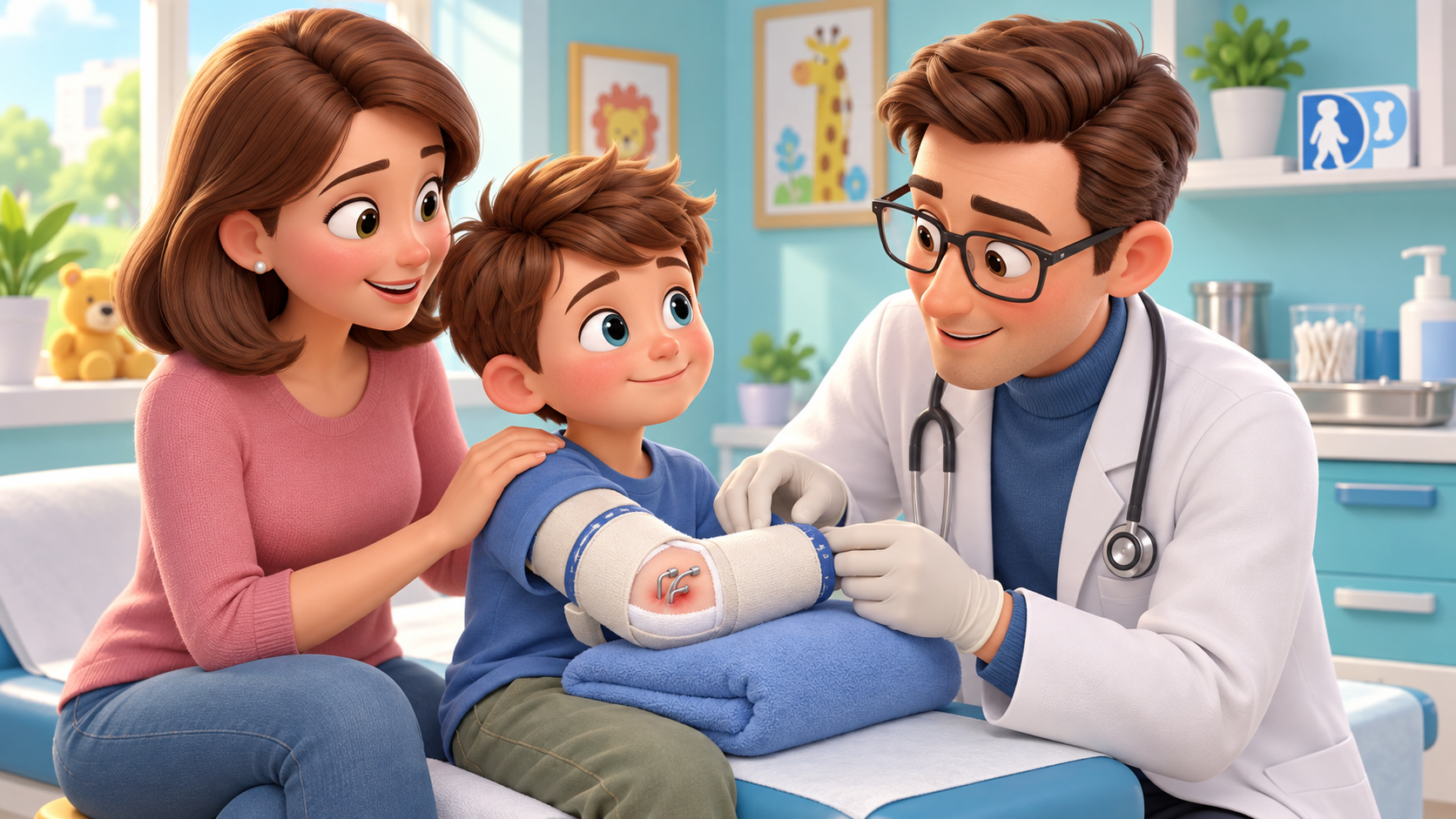
    Reduction (almost always closed, occasionally open) and fixation with two or three percutaneous Kirschner wires (crossed or lateral). Above-elbow cast for a few weeks, then wire removal in clinic.

    The «classic» childhood fracture after a fall on the hand. Displaced forms (Gartland II–III) have a surgical indication.

    Median, ulnar and radial nerve function are checked before and after surgery. Speed of reduction matters, especially in forms with vascular compromise.
    Lateral humeral condyle fracture

    Reduction and fixation with K-wires or, in some cases, screws. Post-op cast.

    Intra-articular fracture involving the growth plate. Even small displacements deserve special attention because of the risk of non-union and varus/valgus deviation.

    Medial epicondyle fracture

    Reduction and fixation with a screw or wires, depending on age and fragment size.

    Significantly displaced forms, fragment trapped in the joint, elbow instability (often in adolescents and throwing athletes).

    Radial neck fracture

    Closed reduction is attempted; if angulation persists, percutaneous leverage reduction or ascending ESIN (Métaizeau).

    Radial head angulations limiting pronation–supination, fragment instability.

    What parents ask in clinic

    Why can't a cast alone do the job?

    Because many elbow fractures are unstable or intra-articular. A cast alone does not control fragment position and, on such a precise joint, even small errors translate into functional problems.

    Do K-wires stick out of the skin?

    In some protocols yes, so they can be easily removed in clinic after a few weeks. They are protected with dressing and cast.

    Will stiffness remain?

    Some initial stiffness is normal and recovers over time. Persistent stiffness is less common when reduction is good and rehabilitation is gradual.

    Nursemaid's elbow: a separate note

    In young children, after a pull along the arm (yanked hand, lifted by the arms), you may see the classic picture of nursemaid's elbow: the child won't move the arm and holds it adducted. It is not a fracture and does not require surgery: a specific manoeuvre resolves it in a few seconds.

    A second opinion on a paediatric fracture

    Bring the ER report and the X-rays. A focused paediatric orthopaedic visit can clarify indication, timing and alternatives.

    Book a visit

    Content for general informational purposes only. It does not replace a medical evaluation.