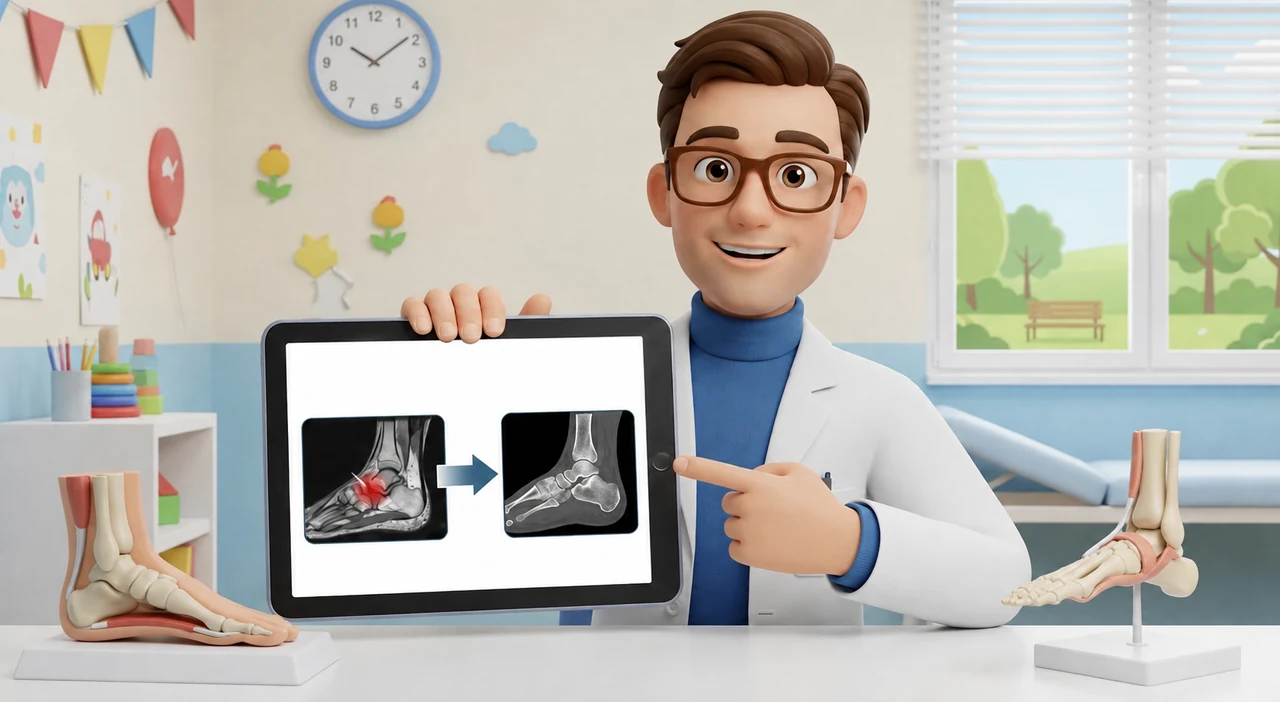
Hindfoot pain, subtalar stiffness, and recurrent sprains are some situations where a tarsal coalition should be considered. X-rays can be uninformative, especially in incompletely ossified coalitions.
CT has long been used as a reference method for defining bone anatomy. However, MRI has the advantage of also showing cartilage, bone edema, and soft tissue changes without using ionizing radiation.
How Accurate is MRI?
A study published in European Radiology evaluated the diagnostic accuracy of magnetic resonance imaging in tarsal coalitions. The cumulative sensitivity was 95.8% and specificity was 94.3%, with a very high inter-observer agreement. [1]
These results make MRI a valid diagnostic method even for identifying the coalition itself, not just for studying associated findings.
What Does It Add Compared to CT?
MRI can document bone edema, overload, impingement, and soft tissue changes that can contribute to symptoms. This is particularly useful in adolescents with pain and sports limitation but inconclusive X-rays.
Furthermore, it avoids radiation exposure, a significant advantage in children when the necessary information can be obtained with both methods.
When CT Remains Useful
CT offers a very precise definition of bone anatomy and can still be useful in surgical planning, in complex coalitions, or when MRI does not sufficiently clarify the morphology.
The choice therefore depends on the clinical question. To confirm a coalition and simultaneously evaluate associated causes of pain, MRI can often be sufficient. When detailed bone reconstruction is needed, CT retains a specific role.
Disclaimer
This content is for informational purposes only and does not replace a medical evaluation. In the presence of persistent pain, limping, foot stiffness, or repeated sprains, a specialist visit is prudent.
References
[1] Marth AA, et al. How accurate is MRI for diagnosing tarsal coalitions? A retrospective diagnostic accuracy study. European Radiology. 2024. PMID: 37855854.
PubMed: https://pubmed.ncbi.nlm.nih.gov/37855854/
Full text (PMC): https://pmc.ncbi.nlm.nih.gov/articles/PMC11126476/