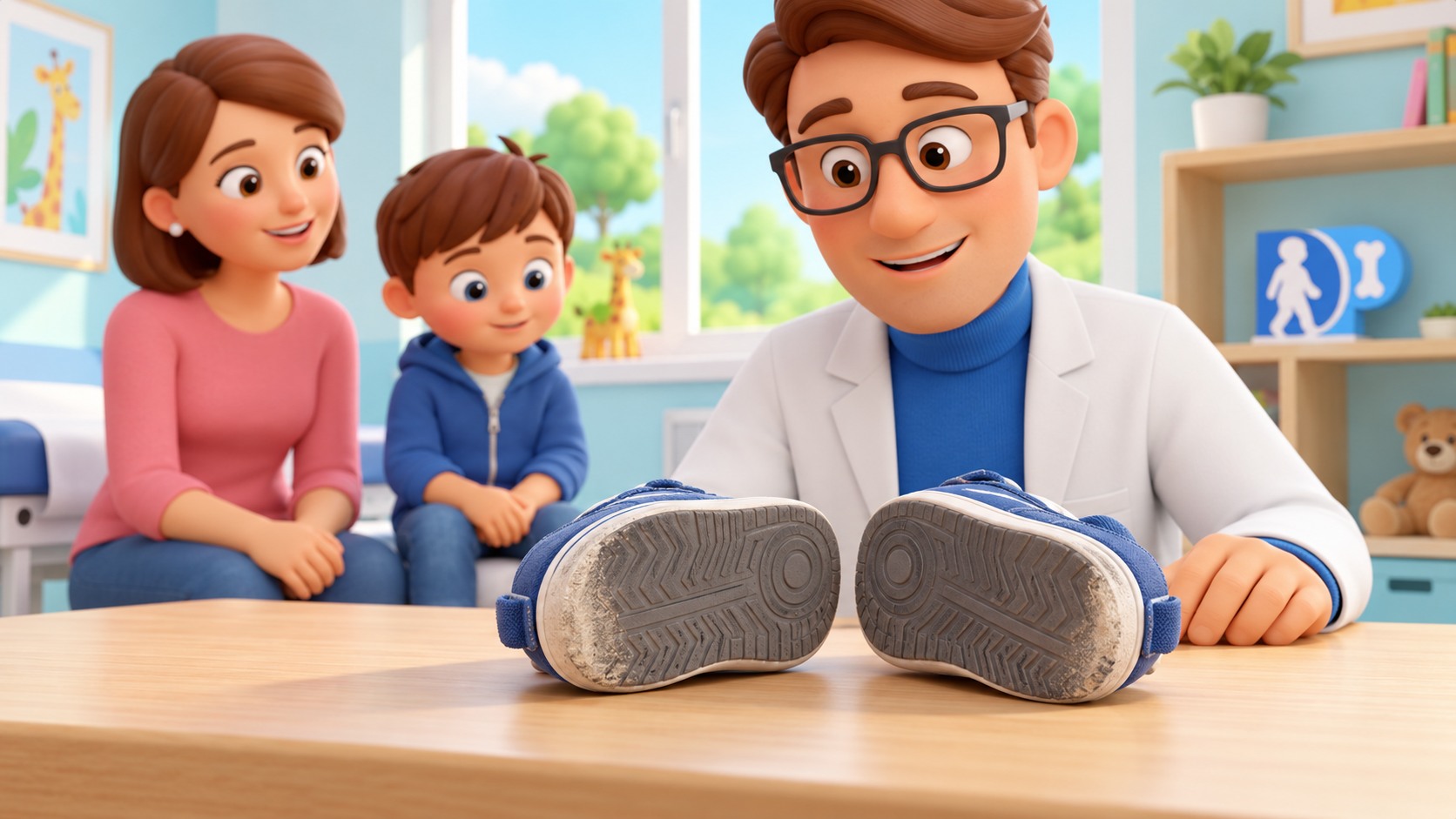
When you turn over a child’s shoes, you may find more wear along the inner or outer edge, or on part of the heel. It is natural to wonder: “Are they putting weight on their feet incorrectly? Do they need insoles?”
Wear alone cannot answer those questions. It needs to be considered alongside the child’s walking, any symptoms and the shoes themselves.
One edge of the sole, or just one shoe?
These are different observations.
Similar wear in the same area of both shoes should be distinguished from a marked difference between the right and left. It also helps to notice whether wear develops gradually or has changed from the usual pattern.
Give the doctor a simple description: “The right shoe wears down much more than the left” is more useful than “They definitely have a pronated foot”. Terms such as pronation and supination describe foot movements and positions; the pattern on a sole cannot, on its own, establish whether these are normal or problematic.
What to consider alongside the shoes
Before attaching a clinical meaning to the wear, consider how that pair is used: for how long, for which activities and whether it still fits. Comparing different models or shoes worn for different activities may be misleading.
Then consider the child:
- do they report foot or leg pain?
- do they limp or change their walking pattern?
- do they stop frequently or avoid running and playing?
- are there areas of rubbing or pressure, or a clear difference between the feet?
Pain and activity limitations are reasons to seek an assessment. 2 A worn sole cannot measure a difference in leg length or determine whether a shoe lift is needed: limb length differences require a specific assessment.
If the foot is flat, are insoles needed?
Flat feet in children need to be considered in terms of age, flexibility, symptoms and function. A worn sole does not automatically make a symptom-free foot abnormal.
The available evidence does not support routine prescription of custom-made orthoses for healthy children with painless flexible flat feet. The Cochrane review also highlights the low certainty of much of the evidence: that limitation matters when discussing possible benefits. 3
In some cases, an orthosis may have a specific purpose, such as easing symptoms or helping to manage shoe wear. This is not the same as creating a permanent foot arch. 1 The article on orthoses for flexible flat feet discusses this in more detail.
Do not add shop-bought lifts or wedges to compensate for the worn side without first establishing whether they are indicated.
When to have walking assessed
An assessment is useful if the wear is accompanied by pain, limping, foot stiffness or difficulty with activities. A marked, recurring difference between the sides also deserves attention, especially if the walking pattern has changed. 1, 2
If the child is well, plays without difficulty and the concern is only a worn shoe, raise it with the paediatrician at a check-up. On its own, this is not a reason to attend an emergency department.
However, suddenly being unable to walk or bear weight, or having fever with pain and a limp, calls for urgent medical assessment. The clinical symptoms are what make the situation urgent. 4
What to look for in new shoes
Check the size of both feet. The toes need room, the fastening should keep the foot secure and there should be no pressure or rubbing. Try both shoes on and watch the child take a few steps. 5
The guide to children’s shoes offers practical advice on choosing footwear. Buying a “corrective” shoe solely because the previous one has worn down gets ahead of the question of whether anything needs treating.
If you have arranged a paediatric orthopaedic appointment, bring the old pair as well: it helps show what you have noticed, alongside examining the child.
References
- Oxford University Hospitals NHS Foundation Trust, Paediatric Orthopaedics. Flat foot.
- Oxford Health NHS Foundation Trust, Oxfordshire Podiatry. Childhood foot problems.
- Evans AM, Rome K, Carroll M, Hawke F. Foot orthoses for treating paediatric flat feet. Cochrane Database Syst Rev. 2022;1:CD006311. PubMed: 35080267. DOI: 10.1002/14651858.CD006311.pub4.
- The Royal Children’s Hospital Melbourne. The limping or non-weight bearing child.
- Evelina London, Guy’s and St Thomas’ NHS Foundation Trust. Your child’s footwear. December 2025.
This information is educational and does not replace an individual medical assessment.